• Donate
  • Our Purpose
  • Contact Us
Executive Magazine
  • ISSUES
    • Current Issue
    • Past issues
  • BUSINESS
  • ECONOMICS & POLICY
  • OPINION
  • SPECIAL REPORTS
  • EXECUTIVE TALKS
  • MOVEMENTS
    • Change the image
    • Cannes lions
    • Transparency & accountability
    • ECONOMIC ROADMAP
    • Say No to Corruption
    • The Lebanon media development initiative
    • LPSN Policy Asks
    • Advocating the preservation of deposits
  • JOIN US
    • Join our movement
    • Attend our events
    • Receive updates
    • Connect with us
  • DONATE
Uncategorized

A bloody mess

by Kirsten Vance April 7, 2000
written by Kirsten Vance

Who would ever imagine that
sifting through someone else’s
garbage might create a ruckus.
But that’s exactly what happened <mark style=”background-color:#fff59d”>when</mark>
EXECUTIVE toured Saida’s medical facilities.
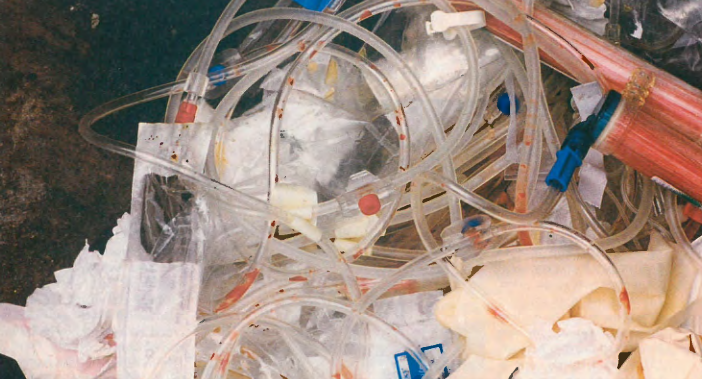
Syringes, used blood bags, tubes and IVs lay
loose and in untied bags in the bin behind
Dalaa Hospital. At Labib Medical Center,
syringes and medical gloves littered the
ground, while needles poked out of bags
inside the bin in the parking lot across the
road. There, after just one photo, hospital
security <mark style=”background-color:#fff59d”>showed</mark> up and a scuffle ensued
over the camera. After extracting the security
from the car door, the photographer and driver sped away, while this reporter ran
behind. A third, Hammoud Hospital, transported
its own waste to the city dump.
Strikingly, one of the scavengers who
inhabit Saida’s dump found the contents of
those bags too much to stomach.

Unfortunately, this is an all too common
example of how medical refuse is dealt with
in Lebanon. In the absence of any proper
national policy or waste management system,
hospitals are left to do what they will or can
within their own means. Of Lebanon’s
160 hospitals about 80% are private, with the
majority relatively small in size. That fact
alone could make enforcing a certain code of
conduct difficult. A full 75% of hospitals do
not even know how much waste they generate,
according to a nationwide survey carried
out by Dr Rita Karam, who has a PhD in
hospital waste management. Hospital risk
waste, which requires separate treatment,
includes such things as body parts, infected
materials, syringes, chemicals, radioactive
material and pharmaceuticals. Issa
Consulting and UK-based Environmental
Resource Management (ERM), <mark style=”background-color:#fff59d”>who</mark> are
working as consultants for the government,
estimate that out of a total 20,000 tons of hospital
refuse a year, about one-fifth can be considered
risk waste. That’s tiny compared to the overall daily volume of 3,000 to 3,500
tons of municipal waste. “It’s not the
amount, but the way that it’s handled and
treated that’s dangerous,” says Alissar
Chaker, environmental specialist with Issa.
“The problem is that when [the risk waste]
isn’t segregated it contaminates other waste
streams.” Some 73% of hospitals surveyed by
Karam responded that they do segregate risk
waste, while Dr Faouzi Adaimi, president of
the Syndicate of Hospitals of Lebanon,
claims that all practice segregation. “But still
you need to know if the segregation is done
properly,” says Karam. “Even if hospitals do
practice segregation, they don’t have an ideal method of disposal.” Segregation
should be practiced at each stage of storage,
transportation and treatment as well as
involve proper packaging and labeling.
Some hospitals don’t even have a budget or
waste officer responsible to follow the issue.
Currently <mark style=”background-color:#fff59d”>there</mark> is no regulation governing
how hospitals should manage their waste,
says Naji Kodeih, toxicology specialist
with the ministry of environment. “The
hospitals do what they want. In some
instances there is partial good practice,” he
says, naming the American University
Hospital and Hotel Dieu as examples.
“Partial good practice, but not complete.
This is not bad considering the prevailing
conditions in Lebanon.” But for some that is
simply not acceptable. Zeina Al-Hajj, who
heads the Lebanon chapter of Greenpeace,
refers to the situation as “complete chaos.”

When the old state-owned incinerators
were shut down in 1997, most medical
centers were no longer able to dispose of
their waste in this way. Meantime Sukleen,
which covers greater Beirut and Mount
Lebanon, refuses to collect medical waste
as it is only equipped to handle domestic
waste. “Instead of <mark style=”background-color:#fff59d”>hospitals</mark> investing in
clean technology since then, they have
continued with the same technology,” says
Al-Hajj. Some hospitals have their own
incinerators, but the conditions of those
are questionable due to the lack of control
and their location in residential areas. AUH
acknowledges that its current incinerator is
not suitable, but considers it the lesser of
several evils.

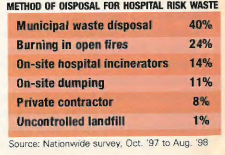
Karam’s survey found that just 14% of
hospitals incinerate their risk waste (see
chart). A large portion is disposed of
through the municipal waste system or by
burning in open fires. Illegal dumping has
been a problem, as has disposal through private
contractors. In many cases it is anybody’s
guess exactly where the waste ends
up. Some claim that medical waste also
finds its way into Sukleen bins regardless of
the company’s stance. “There’s no way we
should accept that medical waste is mixed
with domestic waste in the streets of Beirut
or Lebanon,” says Sarni Rizk, director general
of Rizk Hospital. But according to
Adaimi, most hospitals do sterilize <mark style=”background-color:#fff59d”>their</mark>
waste before disposal, as the equipment is already available for operating rooms. “It’s
not sufficient, I admit, but it’s not the monstrosity
that it’s made out to be,” he says.

In her study, Karam found that “with some
exceptions, the hospital waste management
situation in Lebanon is very far from being
satisfactory and needs to be reconsidered.”
That’s very similar to the findings of a wide-ranging
report on the state of the Lebanese
environment that was published by the ERM
in 1995. Despite its age, the report is still widely
referred to because of its comprehensiveness
and a general consensus that the situation
has not improved. At the time, ERM noted
that “most of the [hospital] waste generated
is collected and disposed of by municipal collection
systems, carrying serious risk of epidemic
and infection.” Indeed infection can be
spread through medical waste, but the source
of a disease is often difficult to determine.

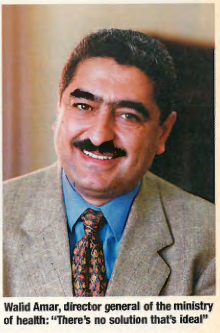
While acknowledging that preventative
measures would be ideal, Dr Walid Amar,
director general of the ministry of health,
plays down the gravity of the situation. He believes there is unnecessary panic due to the
attention the issue has received, while
Adaimi talks of “psychological pollution”
because of the nature of hospital waste.
“Hospital waste accounts for barely 1% of
hazardous waste,” says Adaimi, pointing to
other sources of waste, such as industrial and
slaughterhouse waste. “It’s exaggerated.”

Regardless, due to its potentially risky
nature, management of medical waste
shouldn’t be left to happenstance. In fact the
issue has been on the table since the early
1990s. About four years ago, the Council for
Development and Reconstruction (CDR)
estimated that implementing a solid waste
management system, including hospital,
would cost $135 million. The ERM-Issa
study on hospital waste was completed in
February 1999. And now the CDR is looking
at implementing separate projects for medical,
slaughterhouse and industrial waste.
The medical waste management project, the
more advanced of the three, will encompass
hospitals, dental offices, pharmacies
and other refuse of a similar nature, according
to Sarni Ferghali, the CDR’s program
coordinator for solid waste management.

The ERM-Issa study proposed a central
incinerator with a capital cost of $8.53 million
and annual operating costs at
$903,000, or $676 a ton. The other option
is thermal disinfection, which would
require a small incinerator for certain
waste. The capital cost is estimated at
$5.58 million, with annual operating costs
at $757,000, or $485 a ton. The creation of
a proper sorting, collection and transportation
system would bump those figures up
higher. The estimated cost to hospitals is $3
to $5 a day per occupied bed, which in all
likelihood would be passed on to the individual.
Adaimi argues that waste management
should be a service covered by the
municipal taxes that hospitals already pay
and that the patient should not be made to
bear the cost. Government officials, however,
counter that convention is for the user
to pay for waste management and that
those generating hazardous waste must be
responsible for its elimination.
But before worrying about the amount of
funding required and who should foot the
bill, the problem will be in building a consensus
between the various parties
involved in the decision-making process.
Though the study concentrated on incineration,
at the request of the CDR, it is still not
clear that it will be the chosen option. The
three parties involved in the decision are at
odds. The ministry of environment wants an
incinerator that burns at a higher degree than
the one proposed, while the ministry of health favors thermal disinfection.

Proponents of the latter say it makes dealing
with risk waste possible at the hospital
level with smaller equipment, eliminating
the need for a separate collection system and
the air pollution associated with incinerators.
On the other side of the fence, Kodeih
points to the fact that <mark style=”background-color:#fff59d”>thermal</mark> disinfection is not sufficient for about 6% to 8% of risk
waste, which must be incinerated.

Incineration is generally viewed as the
more tried and tested technology, which
has been made cleaner today. But Al-Hajj
criticizes the government’s entire waste
management policy for being based on
incinerators and landfills, whereas the current
world trend is to reduce and recycle
where possible.

Amidst the controversy, some hospitals
have decided to find their own solution. Last
year Rizk Hospital replaced its 40-year-old
incinerator and has begun implementing
waste management protocols in line with
ISO standards in hopes of being certified in
2001. “The idea for a centralized system is
great, but the major hospitals can’t wait
for the government,” says Sarni Rizk, the
hospital’s director general. He’s not alone.
AUH is having a new <mark style=”background-color:#fff59d”>incinerator</mark> assembled
that will meet the standards of the US-based
Environmental Protection Agency.

The hospital had tried to implement thermal
disinfection, but found such small-scale
equipment of the new technology unsatisfactory.
The major hospitals are considering a joint investment to use thermal <mark style=”background-color:#fff59d”>disinfection</mark>
on a larger scale as a temporary measure
until the government plan is implemented,
says Azmi Imad, the director of AUB’s
environmental health and safety.

Eventually the Lebanese authorities will
have to come up with a national solution, as
many hospitals won’t find the funds or the
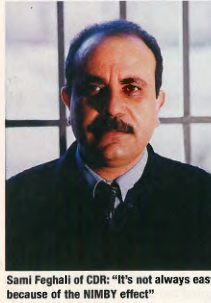
will to make such investments. Ferghali
says that waste management is a priority
and the CDR is pushing for the three parties
to come to an agreement. “It’s not
always easy because of the NIMBY effect.
People say ‘that’s good, but not in my
back yard.’ But things have started evolving
in the right direction,” he says. Once an
option is agreed upon and financing
secured, Ferghali estimates that the system
will take about 18 months to two years to
implement. In other words, hospital risk
waste will continue to be mismanaged at
least until 2002, and then only if a decision
is made quickly and proper implementation
and control follow. The Lebanese authorities
don’t have a good track record in fixing
what ails this country. So, don’t expect
a miracle cure.

Such a waste

Perhaps the only thing that has saved Lebanon from
being turned into an environmental disaster is the fact
that it’s not a highly industrialized country. It certainly
couldn’t be put down to sound management strategies on
the part of the government or individual diligence and care
by all industries. Both of those are sadly lacking. The fact is
that unless polluting industries are forced to stringently abide
by specific regulations, more often than not they won’t.

Discussions on dealing with industrial waste are still ongoing
between the ministries of environment (MOE) and industry,
the municipalities and the Lebanese Industrialists’
Association (LIA), despite the number of reports produced
since the mid 1990s. The ministry of industry and petroleum
produced its own in 1994, ERM followed suit in 1995, while a
massive report was prepared by Dar Al-Handasah and
another by a Dutch consulting firm a couple of years ago.

Anwar Berberi, president of the LIA’s environmental division,
contends that the reports were a waste of time and money as
they were conducted by non-experts and based on some inaccurate
data. Berberi, who has patented his own liquid waste
management system, is angry that this government hasn’t
involved the industrialists or the local experts in the process.

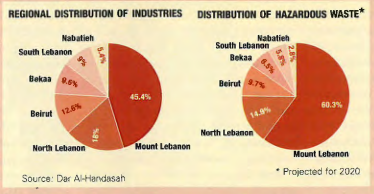
Hazardous waste was estimated at about 18,500 tons a
year in 1994 and projected to increase to 64,500 by 2020, according to the Dar Al-Handasah report. The largest
quantity is forecast for Mount Lebanon (see chart). ” In
Lebanon the quantity is small and the degree of toxicity low,
but there are some compounds in enough quantity to
represent a potential risk for serious pollution,” says Naji
Kodeih, toxicology specialist at the MOE, who estimates
hazardous waste at 10,000 to 15,000 tons.

In general, industries discharge waste with little – if any –
treatment into rivers, lakes, the sea, ground or sewage system,
though Kodeih notes that some of the big industries
do have their own treatment facilities. Berberi agrees, saying
that both liquid waste and hazardous solid waste are
“extremely mismanaged.” Many point to the tanneries as
the worst offenders, because of the heavy metals produced.

Kodeih says the government is working with large
enterprises such as the Lebanese Chemical Company and
Eternit, which still uses asbestos. Cimenterie Nationale
alone has spent $12 million to become more environmentally
sound. There is also a unit within the ministry that is
working on eliminating CFC emissions.

But finding the right fix across the board will not be easy.
Berj Hajian, the MOE’s director general, declined to meet with
EXECUTIVE to discuss delays in finding and implementing a
solution. One problem is the disorganization and distribution
of industry in Lebanon, says Kodeih. “It’s a question of
zoning. You have small industries in residential areas, and a
low awareness among the general population, industrialists
and decision-makers about the hazards of some waste produced.”

Currently there are some 22,000 industrial units scattered
around the country. It is estimated that over 70% are
backyard industries employing less than five people, while
just 2% are considered to be large, employing over 250. The
highest concentration of industry is in Mount Lebanon (see chart). And many industrial units are located outside
designated industrial
zones. There is a proposal
to cluster each type of
industry together so that
they can share the same
infrastructure, including
waste treatment, and
benefit from economies
of scale. But that is still
controversial. According
to Berberi, it’s a question of so many different parties wanting to take control. To
date, nothing has been decided. There are also few recycling
facilities as many have been forced to shut down due to economic
difficulties.

Many raise concerns about the level of pollution in certain
areas. But so far there has been no serious study on the effects
of industrial pollution on the environment or public
health. There is a high level of bronchitis and respiratory
diseases in Chekka and the population is affected immediately
around the plants in Zouk and Sibline, according to
Mutasem El-Fadel, professor of environmental and water
resource engineering at American University of Beirut.

The Dar Al-Handasah report proposed three alternatives
for managing each industrial wastewater, solid waste and air pollution.
It estimated the
national cost at $0.24
per cubic meter of
wastewater and $16.5
per ton of solid waste,
while preferring pre-treatment
of liquid
waste and segregation
of hazardous waste at
the factory. “The problem
in reality is not whether we have standards or not but
the means of implementation, this is the real problem,” says
Kodeih. One problem is financing: The MOE has one of the
lowest budgets of all ministries – it has been allocated just
$2 million this year. But it must be strengthened to act. Until
then, any plans or legislation will just continue to collect dust.
April 7, 2000 0 comments
0 FacebookTwitterPinterestEmail
Cover story

Back on the radar screen

by Hadi khatib, Peter willems & Kirsten Vance April 6, 2000
written by Hadi khatib, Peter willems & Kirsten Vance

T here was little hope for TMA’s survival

just a few years ago. Once one

of the world’s premier air freight

carriers, reaching the fourth position in

cargo capacity per mile hefore the war and

covering five continents, TMA was struggling.

It had lost most of its lucrative destinations

in the US and Far East and was left

with five aging B707s, down from 20

spanking new planes at its peak. The company

landed deep in the red. Headed by

Farid Raphael, chairman of Banque

Libano-Francaise, the Lebanese Air

Investment Holding (LAIH) bought 74% of

the airline from bankruptcy court in 1993.

In I 996, Raphael asked a little-known con-

L sultan!, Fadi Saab, to perform a complete

audit and create a plan to salvage the company.

Saab accepted and when he brought

in his results, Raphael said, “thanks, now

please implement it.” Hence the appointment

of Saab as chairman and president of

TMA in November of the same year.

Did Raphael pick the right man for the

job? Although TMA has not released 1999

figures, results indicate a clear improvement

since Saab took over. He claims to have

moved the company into the black in the last

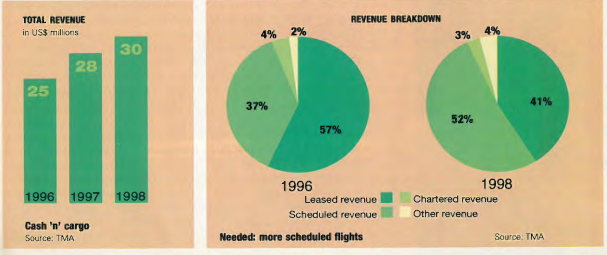
two years. Revenues grew from $25 million

in 1996 to $30 million in 1998. Leased

hours decreased by 12% to 67% of total

hours, while scheduled hours increased by

11 % to 31 %, representing 52% of revenues,

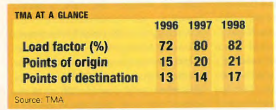
or $15 million. And as the number of

points of origin increased from 15 to 21 and

destinations went up from 13 to 17, the

load factor (cargo to capacity) increased

from 72% to 82%. That put TMA in the

uumber five spot in cargo load factor

among airlines under International Air

Transport Association, the world governing

body for air transport.

So how did he do it? In parallel with

Saab’s appointment and in accordance

with his restructuring plan, there was a

decision in 1996 to increase the airline’s

capital by $40 million. The injection is to be

subscribed by LAIH, with the first half

paid at the start of 1997. ”The increase in

capital stopped the heavy financial burden

of accumulated debt, as this money went to

covc:r loans that were costing us interest,”

says Saab. Ogden, a US-based conglomerate

with specialization in aviation, will participate

with a minority interest on the

remaining $20 million. Ogden has agreed to

invest in upgrading airport-handling facilities

and to enter joint-venture deals with

TMA on projects like the Beirut airport

free zone and Klayaat airport.

Next came a reduction in the airline’s

operating costs to increase efficiency. First

the workforce was reduced from about 650

to 400, followed by a cut in administrative

and general fixed costs. The result was a cost

saving of $2.5 mi.Ilion between 1996 and

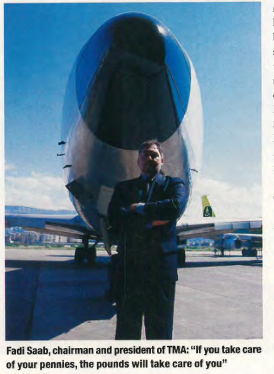
1997. “If you take care of your pennies, the

pounds will take care of you,” says Saab,

adopting the English proverh. Another

important cost-cutting measure came by

turning fixed costs tnto variable ones, with

the appointment of general sales agents,

or GS As. TMA had direct offices in places

like Germany, Japan, Hong Kong, Saudi

Arabia and Spain, which proved valuable

during TMA’s heyday. But when business

didn’t justify the expense, maintaining

those offices was an expensive proposition.

Jnstead GSAs are remunerated only

based on performance. With 14 offices

worldwide and 27 GS As operating another

35, TMA has managed to cut promotion and

sales expenses by 14% and general administrative

costs 17% from 1997 to 1998.

Finally, Saab took an overall look at

reducing fuel burn, maintenance, crew positioning

as well as landing and handling

charges. For example, double landing –

making a short stop on route to a destination

is now avoided. Instead of going from Paris

to Amsterdam and from Amsterdam to

London, TMA established hubs in Paris and

Amsterdam. Cargo from various European

markets is trucked to those locations.

Saab’s performance so far indicates that

he was the right choice for the job. And his

background explains part of the success.

This AUB graduate in economics and statistics,

received his MBA in finance from

France’s INSEAD, became vice president at

Bankers Trust in New York in charge of

international investment management

group for Middle East and Africa. He later

set up his own bnsiness, handling corporate

restructuring and venture capital for international

companies before returning to

work as a consultant in Lebanon.

But the situation at TMA isn’t exactly picture perfect. There is a.,problem with

IATA hooking agents, who are responsible

for booking cargo on outgoing flights.

About two-thirds of the 90 agents don’t

even work with the local cargo carrier.

Although Beirut is a transit stop for TMA on

its way from Europe to the Gulf and vice

versa, where the ratio of incomhig to outgoing

goods is nine to one, it is still an

important market to secure as TMA’s base

of operations. TMA claims to handle 30%

to 40% of the annual 50,000 tons of air

cargo moved in and out of Lebanon. That

would translate into about half the load it

handled during its boom years.

But some agents openly wonder who is

giving TMA cargo. “They need a fleet and

a schedule, which they don’t have,” says

Robert Douna, air freight manager at

Gezairi Transport and former shift manager

at TMA. Douna is one of the IATA

agents that books cargo on passenger airlines

like Air France (AF), MEA or KLM;

these have planes that can carry cargo in

their belly or larger ones that are used as

com bi es (half passenger-half cargo).

Bellies can take up to 4 tons of cargo on

average, while combies take up to 34 tO,!_lS

for Boeings and 16 tons for Airbus planes.

“The competition is offering exact deliveries,

frequent flights, more destinations and

money back guarantees if the cargo is not

delivered on time,” says Ousama Jureidini,

deputy general manager for Travel and

Cargo Divisions at Saad Transport, who is

a booking agent and a former TMA employee. Saab admits that exports from

Beirut to Europe are a problem for TMA:

“It’s a technical stop to unload some cargo

or to change crews.” TMA’s flights into

Beirut are scheduled from Europe on their

way to the UAE and Africa. Because

planes arriving from the UAE are usually

full and exports are minimal, there are no

scheduled flights to Europe. And with just

four operational planes, some of which are

chartered or leased, the frequency of

flights is inconsistent.

But the cargo TMA does pick up from the

30 agents it deals with in Beirut tends to

come from dedicated long-time clients.

Fouad Naja, CEO of Lebanese Trading and

Contracting, regularly gives TMA anywhere

from 5 to 20 tons of cargo containing

fish and textiles, and charters flights to

Europe. “TMA is so dynamic. They can do

miracles and Saab follows up on every kilo

of cargo we give him,” says Naja, who has

been a client ofTMA for at least nine years.

Meanwhile, Saab wants to offer alternative

solutions to increase local agent participation.

He’s looking at grouping them to

cooperate on TMA business so the cargo

carrier could appropriate scheduled flights

from Lebanon at good rates. Though this

won’t be easy, considering the competitive

nature of the business, some agents

already see the benefits of teaming up with

TMA. Mouhamad Jamil, owner of

Oumaya Transport and Trading Co., ships

about 3 to 6 tons of cargo of shoes and textiles

to UAE each week. ” It’s true that

TMA had more connections and more

flights, but they are intent on making this

company a true partner with its local

clients,” he says. In another move to

increase exports from Lebanon, Saab has

signed agreements with ministries, the

chamber of commerce and industrialists.

On top of the infrequent flights, agents

have other complaints about TMA’s services.

“There is a lack of information

between the sales representatives, and I

don’t trust the fragile labor situation they

have, where strikes can occur like in the

past, causing us many headaches,” says

Larene Haddad, manager at All Transport

Agency. Surveys done in 1997 and 1998 by

Information International indicated a list of

complaints, ranging from irregular service,

to lack of information, and more emphasis

on international flights to the detriment of

local clients. Recognizing this, Saab has

worked on intensifying the company’s

public image. He created a customer service

division in late 1998 and personally trained

his sales representatives to develop a team

spirit for better cooperation. He also developed

an IT system called ‘Super Cargo’

through an agreement with SETA. “It will

enable the clients to ge.t their own airway

bill, do transactions with us electronically,

trace and track shipments; it will solve a lot

of service problems,” says Saab, who has

invested more than $200,000 so far in setting

up the system. He also indicated that the

last strike was in 1996, and that labor relations

have since improved.

Saab will have to keep a close eye on other

airlines that arc competihg against TMA’s

route – mainly from Europe to the Gulf

and back with some reaching the Far East as

their ultimate destination, while TMA only

operates in the Far East on a charter basis.

Lufthansa, AF and Cargo Lux all have

scheduled flights in Beirut aJld price competition

is fierce. It is so fierce that

Lufthansa’s weekly freighter to Beirut will

most probably be discontinued, according

to Youssef Khatib, cargo sales

manager. He blames price dumping

from Cargo Lux, a

Luxembourg-based company.

(‘,in-,o I .m, initi,ill.v m,irlt>. ao-TP.Pments

to use TMA flight numbers,

later establishing its own

flight rights in 1995 and bringing

in two freighters a week.

Cargo Lux is a worldwide

cargo operator with over 14

hours of flight hours a day, one of

the highest rates in the world.

Operating out of an extensive

hub system, its unit cost is at least

30% to 40% less than any other

freighter operating in Lebanon.

“They are relatively new in

Lebanon and are usiug their

economies of scale to bring in

and take out cargo at low prices

and gain · market share,” says

Saab. TMA’s ability to stay competitive

in Lebanon is its

21,000m2 airport facilities.

Customs check points are located

within their facilities and there are areas for storage and han- dling, including cold storage for medicine

and perishables, a strong room for valuables

as well as equipment for hazardous materials

and for livestock. TMA is the only

cargo airline besides MEA, which handles

AF planes, with facilities to handle 707s and 747s. Those fees can run up to $1350 per

landing, according to Lufthansa, who uses

the facilities.

But can TMA deal with Cargo Lux price

slashing? According to Saab, the human factor

is the determining element in staying

competitive. “Cargo Lux is a mega-carrier

with no direct relationships with agents; we

on the other hand show flexibility and a

working relationship which caters to our

client’s changing needs,” says Saab.

Looking at the global picture, TMA

looks miniscule compared to other world

airlines. Commercial and freighter lines

such as Lufthansa, Cargo Lux, AF, KLM,

American Airlines compete on hub systems

that extend worldwide. Having refocused

operations on Paris

and Amsterdam as its main

hubs, TMA compensates

with 16 cooperation agreements

on certain destinations.

MEA, for example,

gives cargo to TMA for

flights to Amsterdam, while MEA takes TMA cargo from Europe to Kuwait.

TMA will soon beef up its fleet. There are

plans to lease medium-haul aircraft with a

capacity of 40 to 60 tons to replace the current

B707s and small feeder planes to take

care of the retail need of the market. These

new planes (one medium and one small in

2000, one medium and two small aircraft in

2001) will allow them to reach Far Eastern

destinations, while TMA waits for the US

ban to be lifted. Saab plans to strike more

alliances in order to extend TMA’s

reach in Africa and Asia. Following

last year’s transportation agreement

between Lebanon and Syria, TMA

signed a deal with Syrian Airways,

which doesn’t have a cargo department.

TMA will lease them planes,

operate joint flights and fly directly to

Damascus, starting next fall. “The

Syrian market is healthier than the

Lebanese market, with more balanced

trade and ex ports that justify

round trips,” says Saab. To better

serve the Syrian market, Saab hopes to

create a multi-model transportation

system via agreements with sea and

road transport companies.

However, freighter business is not

like it was during TMA’s boom years,

when passenger airplane capacities

were small, rendering cargo carriers an

important tool. “Today a freighter can

carry up to 50 tons, but a 727 passenger

plane can carry 18 tons, plus it

has several scheduled flights,” says

Sarni Abi Saab, cargo manager at

MEA. MEA net cargo income is around $17 million compared to TMA’s $24 million. Some $6 million –

20% ofTMA’s revenue -is generated from

pure lease contracts and don’t count as

actual cargo. “There’s not the advantage to

freighters like there was in the past,” says

Abi Saab.

Though growth is limited, the first steps

have been taken to get the company off

the ground again, but will it ever be tbe

TMA of old? “We’re a small fish in a big

pond, and our aim is to become a big fish in

a big pond,” says Saab.

April 6, 2000 0 comments
0 FacebookTwitterPinterestEmail
Best Sellers

Doing it right

by Gareth Smith April 6, 2000
written by Gareth Smith

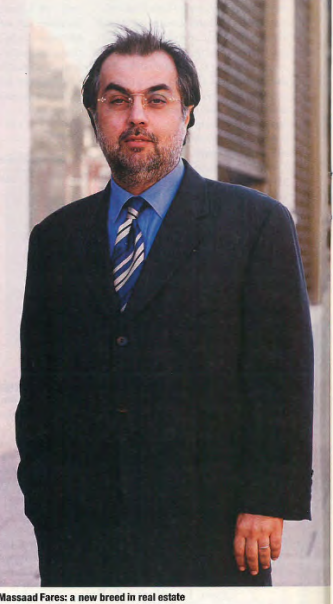
“I’m not really a developer,” says Massaad Fares.
Neither is he a broker and he has no background in
construction. His own, stylish office at the bottom of
Rue Foch is far from the image of a samsaar (real estate broker).
So what is he? “I am a technician,” he replies. Fares pinpoints
demand and finds the liquidity to produce the supply: he doesn’t
supply unless he has good reason to think that demand exists. Meet
a new breed in Lebanese real estate agents. For Fares, real estate
is not so much concrete as cash flow: location is not something to
stick a sign on, but just one part of a package.

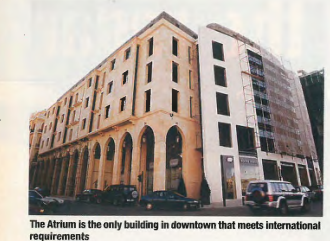
Fares is the man behind the Atrium, “the only building in downtown
that currently meets international requirements,” says Michael
Dunn of the international consultants Healey & Baker. The reason
is simple. Besides its prime location on the corner of Weygand and
Maraad, the Atrium offers the only large, open-plan offices in
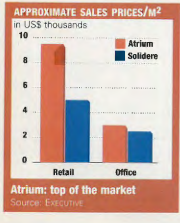
downtown. Hence, the Atrium’s 6,000 m² of offices and 3,000 m² of
retail are selling at some of the highest prices in Beirut. Fares studies
demand first. This, in itself, makes him different from many in
the market where it is estimated that there are more than $8 billion
worth of vacant apartments and prices are not adjusting to decreasing
demand. “The real estate sector in Lebanon is marked by several
inefficiencies, with a notable mismatch between supply and
demand, [and] sticky prices despite the current slump,” reads an
HSBC report released last summer. But the dark cloud has a silver
lining. “Despite the inefficiencies,” the report says, “the market hides
some profitable opportunities.”

Unlike some developers who threw up buildings willy-nilly during
the country’s post-war boom, Fares spent nearly a year doing his
homework. He looked at many locations in downtown before settling
on plot 448, housing a burned-out building at the junction of
Weygand and Maraad. The site had some important advantages. “It
was across the street from the souks and adjacent to the banking street.
I thought that if the banks came back, the area of their expansion
would be Maraad-Foch-Allenby,” he says. More importantly,
unlike elsewhere in the locality, Solidere had no plan to renovate the
building. Fares would not be constrained by the existing structure.

Fares realized that large open-plan offices, suiting the up-to-date
requirements of many international companies, would be rare in
Beirut Central District, at least until new purpose-built buildings
appeared much later elsewhere in downtown. Many of the available
plots in Maraad-Foch-Allenby were 200-400 m²; plot 448 was
fully 1,560 m². “There are customers for black shoes and customers
for white shoes,” says Fares. “Small offices might be suitable for
architects but not for brokers, it depends on the kind of business.
Many people don’t want to be going up and down floors every
time they need to speak to a colleague. Modern companies like purpose-
built offices where you can easily put in dividing walls or take
them away.” Another important component that is next to impossible
in restored buildings is the amount of underground parking,
150 spaces on four levels.

Fares carried out a tour de table to raise the capital from Saudi and
Lebanese investors for the Atrium, under the holding company
Prime Group, of which he was managing director with two partners.
The Atrium bought the land in September 1996 for $8 million, the first
plot that Solidere sold. The building’s design, by British architect Terry
Farrell and Lebanese Nabil Azar, was based around an atrium, an
empty, central vertical space that allows light to reach everywhere
inside. But if the product was good, the timing was far from ideal. Enter
recession. Real estate prices had already peaked by 1996, and demand
was falling by the time downtown came on stream. “The recession of
1999 was at the worst time for us, just as we were delivering,” says
Naaman Atallah, Solidere’s real estate sales and leasing manager.

Land and construction costs for the high-tech Atrium were $22 million,
putting Fares under pressure. “The economic downturn made us
a little nervous,” he admits. But, having done his homework, he is in
better shape to survive the hard times than other developers. All the retail
at the Atrium has been sold at a top price of $9,500 per
m², around double Solidere’s
target figure for downtown.
Circle Hitti’s move to the
Atrium from Verdun was a
huge boost for the downtown
as a whole. Most of the
Atrium’s retail has gone to
jewelers keen on its location
opposite the gold souk.
Jewelers have also taken the
bulk of the first-floor offices,
usually in lots of 300 m².

Fares is negotiating with Merrill Lynch over one whole floor, and with
a “leading British company” on another. His list price for office space
is $3,000 per m², some 17% above Solidere’s target prices. Two months
ahead of the building’s June hand-over, sales have not been as fast as
Fares once expected, but good considering the vast amount of empty
real estate across the city. “There are too many amateurs around. We
are having fewer inquiries now, but they’re more serious, for example
from large advertising and insurance companies. I think we’re looking
at an internal rate of return over five years of 26%.”

Fares’ next project seems as startlingly obvious as the Atrium.
He has bought a plot of land next to the new HSBC building in
Minaa El Hosn, in the vicinity of the St Georges and the
Phoenicia hotels, where he will construct a block of furnished
apartments for short-term let. The target market will be foreign
business people on assignment, consultants, for example, and
expatriates returning home during the summer. The 20 units will
be both one-bedroom and two-bedroom. Its total floorspace will
be 2,300 m², including retail on the ground floor, and it will have
1,000 m² of underground parking. To buy the land, Fares had to
track down 14 different people who had inherited it from the two
deceased original owners. He won’t disclose exactly how much
he paid for the property, but he concedes it was “close” to the
Solidere asking price, which is $1,050 per m² of built-up area. This
would put the purchase in the region of $3 million plus at least
another $3 million for construction.

Fares is optimistic that he will
recoup his costs. “Furnished apartments fetch up to $150 a day. On
an optimistic scenario, I will recoup the money in five years. On
a pessimistic scenario, it will take seven.”

Fares’ next projects are likely to take him further away from what
is seen as “real estate” in Lebanon. Fares plans on moving more into
asset management for large property owners. He believes there is
potential too in working for banks, especially where they have taken
real estate as security for lending. “We can clean up portfolios,” he
says. “Banks often don’t have this expertise in house. I managed
portfolios in Europe and the United States. I want to enhance our
base of clients.” Another area he wants to expand is sales and marketing.
Prime Group marketed Mouawad Group’s 1,200,000 m² of
land at Tel al Ghazal, above Jal al Dib. Most was sold as plots of
land, but Prime also marketed Parc Jaden, Mouawad Group’s
residential project on part of the land, and successfully sold all the
units (apartments between 200 m² and 350 m² at $800-$900 per m²).

Successful businesses are not afraid of change. The Atrium will
be the last project under Prime Group. The shift away from construction
towards sales, marketing and portfolio management
means the three partners are parting company. Fares will continue
working with Samir Barraj in Prime Realty, the holding group for
the Minaa El Hosn furnished apartments project, while Joseph
Mouawad leaves to continue work more closely linked to construction.

Fares’ emphasis on movement and flexibility is new in a
country where real estate has been seen as family-asset management.
“No developer should proceed just with his own money,” he says.
“They should leverage their investment, sell their mortgages and
move on.” For Fares, the future of real estate is as an investment vehicle,
and not as bricks and mortar.

April 6, 2000 0 comments
0 FacebookTwitterPinterestEmail
Best SellersUncategorized

Power play

by Samia Jouzi April 6, 2000
written by Samia Jouzi

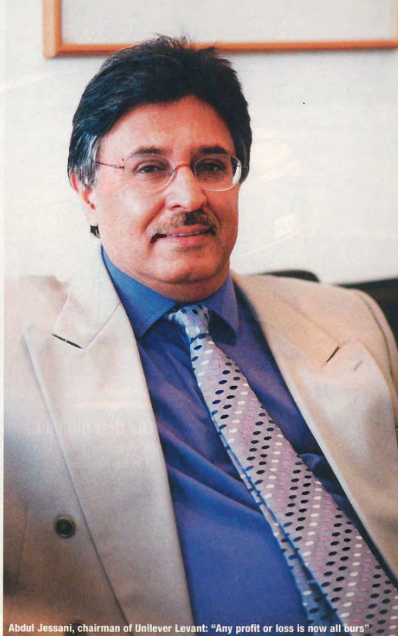
Abdul Jessani is reveling in newfound
independence. “Any profit
or loss is now all ours,” says the
confident first chairman of Unilever
Levant. Jessani came to Lebanon two years
ago to set up a regional subsidiary of
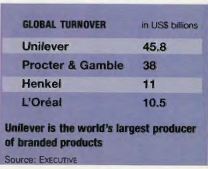
Unilever, the world’s largest producer of
branded products, including Lipton tea,
Signal toothpaste and Lux soap. Global
revenues totaled $45.8 billion last year.
Jessani’s arrival followed a massive corporate
restructuring of the company.

Decisions concerning international markets
were moved from the European
boardroom to the regional headquarters.
The UK-based Export Division, previously
responsible for handling regional markets
through a myriad of local distributors, was
dismantled. Today, Unilever supplies the
capital, key human resources and global
brand strategy while the local outfits are
responsible for marketing strategies and
turning profits in their respective territories.

Jessani now sits at the helm of Unilever
for Jordan, Syria and Lebanon, where he is
responsible for the performance of 16 key
brands. The firm’s rise or fall in this part of the world is his responsibility and Jessani
relishes the challenge. His sales target for
the Levant is $150 million by 2003, up
from less than $20 million in 1998, a very
ambitious goal considering that the region
is in the midst of a recession. That figure is
based on expectations of grabbing at least
25% of the $600-million Levant market
for product categories where Unilever
competes here. So far he is on target, having
increased sales by 200% in the first
two years.

How did he do it? Jessani reduced
Unilever Levant’s portfolio of brands from
44 to 16, to focus on brands that have the
greatest potential for growth. Products like
Ragu spaghetti sauce, Timotei shampoo
and Gibbs Sport aftershave were dropped.
The move preceded a similar restructuring
by the mother company. Over the next five
years, Unilever will reduce its brand portfolio
from 1600 down to 400.

“Our experience has shown that, when we
focus on a more limited number of brands,
we excel. If you have big brands, then you
have an advantage of scale in terms of production
and marketing costs and an advantage
in distribution. If you look at our big
brands, you notice that they are more profitable,”
says Jessani.

Unilever has boosted local manufacturing
for specific ‘champion brands’ products,
thereby reducing import costs. Some new
products have also been added to the local
manufacturing line-up.

Two years ago, Unilever manufactured
from one factory in Lebanon producing
only Lifebuoy soap. But since Jessani’s
arrival, the company acquired a second
factory. Now the company produces Lux
soap, Comfort fabric softener, Jif, Sunsilk
and Organics shampoo. In Syria, where the
company manufactures Sunsilk shampoo,
Omo and Surf laundry detergent and
Signal toothpaste, it has increased its production
of Sunsilk from 200 to 1000 metric
tons in the last two years. Unilever has
a total of six factories in the Levant.

Jessani has also streamlined the manufacturing
operations by reducing the number
of work shifts, changing the plant layouts
and machinery, designing systems
that reduce wastage and reorganizing loading
and unloading procedures. “We have cut a lot of costs at the factory and from the supply
chain,” says Jessani. With manufacturing
costs reduced, the company has been
able to reduce prices on brands like Omo at
a time when sluggish economies have cut
into people’s purchasing power. In Syria, the
shop price of the 2.7kg pack of Omo laundry
detergent was cut to 235 Syrian
pounds, just 10% more than local brands
and 20% cheaper than the only other foreign
brand produced under license in Syria,
Obegi’s Persil. But Jessani stresses that
price cutting must be selective so as not to
harm brand image.

Unilever Levant has also begun offering
more affordable options. About a year ago,
it started importing Good Morning, an
olive oil based soap, which is manufactured
at its sister company’s plant in Egypt
and is 40% cheaper than Lux. According to
Jessani, the brand has proven to be a strong
performer in Syria because it is less expensive
and superior to local competitors.

The company is also reorganizing its
imports, which include Dove soap,
Impulse deodorant, Close Up toothpaste,
Lipton tea and Vaseline. The breadth of
Unilever’s network can make imports a
more viable and cheaper alternative than
manufacturing. “We went through our
inventory across the world and checked
which brands were the most relevant for us,
which would suit our requirements best,”
says Jessani. For example, he found that the
cheapest way to supply the Jordanian market
with Organics shampoo was to import it
from Saudi Arabia, where it is manufactured. A trade agreement between those
two countries means that tariffs are near
zero. Unilever has also changed the marketing
strategy of some key products, like
Lipton tea and Vaseline.

So far, Jessani’s measures to boost sales
have had mixed results. On the positive
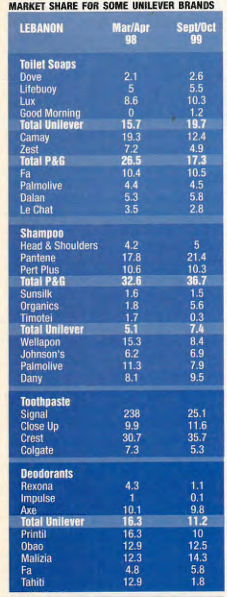
side, the market share of Lux soap has
increased in Lebanon from 8.6% in the
spring of 1998 to 10.3% by the fall of last
year, according to a retail audit conducted
by AMER Research. (AMER’s bi-monthly
retail studies were taken from surveys of
medium-sized supermarkets and did not
include statistics from hypermarkets or
cooperatives prior to 2000). The company
made this gain by keeping the price of Lux
down and hiring former Miss Lebanon,
Joelle Bohlok, to promote the product.
“They pushed Lux into the top three in the
soap category in Lebanon. They used to be
well behind,” says Georges Obegi, president
and CEO of Obegi Consumer Products. As
producers of everything from Persil laundry
detergent to Fa soap, the Obegis are one of
Unilever Levant’s main competitors.

Today, says Jessani, Unilever is the
Levantine leader in the sale of personal
wash products. With Dove covering the
premium market, Lux covering the middle
ground, and Lifebuoy and Good Morning
at the bottom end of the market (see table),
Unilever had carved out a 19.7% share of
the Lebanese soap market by October of
last year, according to AMER. This compares
with a 15.7% market share in early
spring of 1998. By contrast, the share of
Procter & Gamble (P&G), with their
Camay and Zest brands of soap, declined
from 26.5% to 17.3%.

In Lebanon, the company has also managed
to push up the local market share of
Comfort fabric softener from 48.5% to 56.2%
in the same time period. By manufacturing
locally, Unilever has drastically
reduced shipping costs, which were high
because of the bulkiness of the products. In
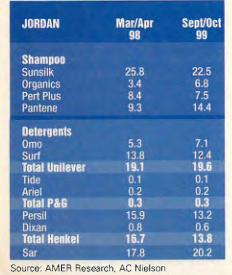
Syria, says Jessani, sales of Sunsilk shampoo
have increased nearly ten times while in
Jordan it’s the leading brand with a 22.5%
market share.

But in fact, not all
Unilever bets have
paid off. While demand for Sunsilk
in Jordan and Syria
has been strong, the
brand’s performance
in Lebanon
has been disappointing.
According to
AMER, the brand
controls just 1.5% of
the market. Results
were so poor that
Jessani was recently
forced to relaunch
the product.

Organics shampoo,
another major Unilever brand, has
made some gains in Lebanon and Jordan, but
is still struggling with less than a 7% share in
both countries.

“Organics achieved some market share
gains in Lebanon, but not as much as they
had been expecting,” says Nazar Najarian,
the general manager of Cosmaline, a Sarraf
Group company. “The brand’s message,
‘health from the roots’, is not unique.
Procter & Gamble has already used it. It
made Unilever look like imitators, not
innovators.” Locally, Unilever has a long
way to go if it wants to challenge P&G’s
near dominant position in the shampoo
market. The three Unilever brands of
shampoo, Sunsilk, Organics and Timotei,
control just 7.4% of the market, compared
to P&G’s 36.7% with Head and
Shoulders, Pantene and Pert Plus.

By its own admission, Unilever needs to
pay more attention to the lucrative detergent
business in Syria. It already cut the price of
Omo but it’s still not clear whether the
move has helped the brand retain its estimated
15% share of the market against a
strong push by Obegi to increase Persil’s
5%. In Lebanon, where a tiny number of well-established brands dominate the market,
Unilever has decided against entering
the race for the time being. “Unilever is not
a competitor. Persil, Ariel and Bold have
90% of the market,” says Nadim Tabet,
managing director of Transmediterranean
that distributes P&G products. Only in
Jordan has the company been successful in
marketing detergents.

Unilever’s
more middle-range brand Surf, with a
12.4% share, is the
third most popular
detergent, behind
Sar with 20.2% and Persil at 13.2%, according to AMER’s figures.

Coupled with Omo’s
7.1%, Unilever has
the second best selling
portfolio of detergents there.

Jessani might
introduce new products
to the market, though he declined to say
which ones. The Levant market for all
product areas where Unilever international
competes is about $1 billion, compared to
the $600-million market Jessani is currently
fighting over. Bringing in a few more key
products could provide a boost.

Despite Unilever’s strength as a multinational,
the future won’t be an easy ride for
Jessani. Competition in the region is getting
more fierce. L’Oreal has opened its own
offices in Lebanon and there are strong
rumors that Colgate-Palmolive will follow
suit. P&G reached an exclusive local
distribution agreement with the Joud trading
company in Syria six months ago.
Joud has assembled and trained a 100 person
sales and distribution team and has a
sales target of $10 million for this year.

Jessani is also looking east.
Unilever’s sales are divided about equally
between the three countries. But with a
population that is nearly double that of
Lebanon and Jordan combined, Jessani
feels that Syria really represents the greatest
potential for the future. All that is needed
now is for the economy to liberalize.
Jessani is betting it will.

April 6, 2000 0 comments
0 FacebookTwitterPinterestEmail
Best Sellers

One step ahead

by Hadi khatib April 6, 2000
written by Hadi khatib

Changes are afoot in the country to
the east. A serious debate is underway
in Syria – one of the last bastions of
Soviet-style central planning – about economic
liberalization, opening up borders and
making it easier for foreign companies to
invest. Two years ago, the country signed the
Arab free-trade zone agreement, which will
require it to reduce trade barriers on other
Arab states’ goods to zero within a decade.

Syria is also considering entry into the
European Association Agreement, which will
require tariffs on European goods to be
phased out over a ten-year period. Free trade
spells trouble for an array of inefficient public
and private sector companies, which have
been living off the luxury of high import barriers.

In the global economy, only the fittest survive,
and there is one Syrian company that is taking
heed. Joud, one of the largest trade and manufacturing
firms in Syria, with over
1,500 employees and annual revenues
in excess of $115 million, has
proven itself capable of adapting to
change. Whenever a new opportunity
crops up, Joud takes advantage
of it. And now it is getting
ready to compete in a market-driven economy.

Established in 1933 by Mohammed Joud,
an orphan who traveled between Syria and
Lebanon trading apples and flour, the company
rose from humble beginnings and now
commands a hefty portfolio of business
activities. It is one of the country’s biggest
traders in foodstuffs, animal feed, steel,
wood and heating equipment. The company
is the official importer and distributor of
Goodyear and Fulda tires and manufactures
Mandarin, Syria’s number one soft drink.

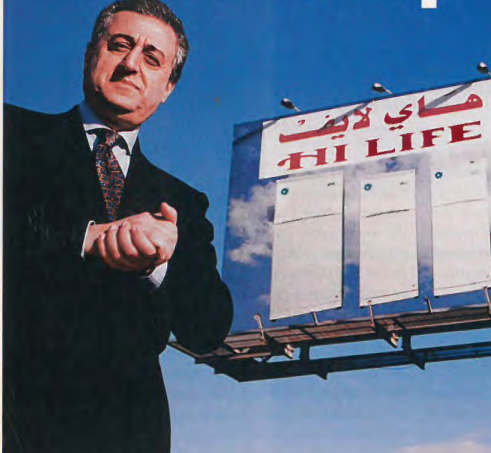
Joud also produces a range of home appliances,
including refrigerators, washing
machines, gas and electric ranges and
microwaves under the Penguin, Hi Life and
Riviera brand names.

How did the company get so big, especially
in an economy under heavy state control? By
anticipating the market and being the first to
take advantage of new opportunities. Today,
many of Joud’s most lucrative lines of business
are in areas that were in the strict
domain of the public sector. In 1975, when
the government opened up the manufacturing
of refrigerators to the private sector,
Joud wasted no time stepping into the business.
It formed a partnership with Penguin,
another private firm, built a factory and
within a year had rolled its first refrigerator
off the assembly line. In 1982, the line of
products was expanded to include freezers,
washing machines, gas and electric ranges, all
under the Penguin name. With demand rising,
a smaller second factory was opened in
Latakia in 1984.

In the early 1990s, two new opportunities
arose. The Syrian government passed
investment law number ten, which made it
cheaper and easier to import industrial
machinery, and began phasing out the use of
CFC (Freon)-producing appliances. Joud
spotted an untapped market. It wanted to use
the new investment law to build the country’s
first factory capable of producing appliances
compliant with the new regulations, but
its partner Penguin was not interested. “We
couldn’t reach an agreement with Penguin to
move to a bigger plant, and we felt we had to
satisfy the demands of the market, so we went
solo,” says Farouk Joud, general manager of
industrial operations. Joud formed another
company called Riviera and launched
Hi Life, Syria’s first brand of CFC-free
refrigerators and the first local manufacturer
to become ISO 9002 certified.

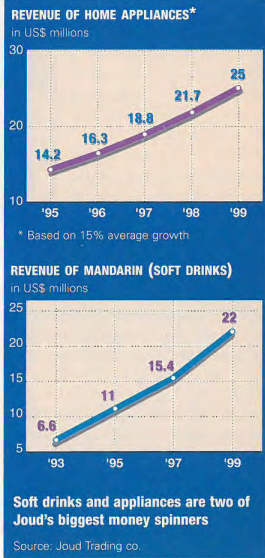
Today, Joud’s home appliance division
earns $25 million in revenues per year.
Thanks, in part, to a $450,000 per year
advertising budget, Joud claims that both its
Penguin and Hi Life brands control 30% to
35% of the 100,000-unit-per-year refrigerator
market. Its competitors, Al Hafez and the
state-owned Barada, each control a further
30% share, although Al Hafez says it produces
60,000 refrigerators a year (see “Chillin’
with the Big Boys,” February 2000). Joud also
maintains that its Riviera washing machines,
produced under the license of Italian manufacturer
Zerowatt, have carved a commanding
70% market share, and its microwaves,
despite having been in the market for only
three years, a 60% share.

Another opportunity that Joud wasted no
time in seizing was the government’s decision,
in the early 1990s, to reopen trade in
food items to the private sector – an area that
had been under the government’s tight control
since 1965. Today, Joud’s foodstuffs
division earns more than $20 million in revenue
annually. It is the importer of such popular
brands as St Louis sugar, Al Malak coffee,
and Chiquita bananas, while nearly 12%
of the division’s revenues come from exports
of locally produced olive oil, apples, lemons,
limes, oranges and seeds to Russia, Spain and
other Arab countries. With a 40% market
share, Joud’s only serious competitor in the
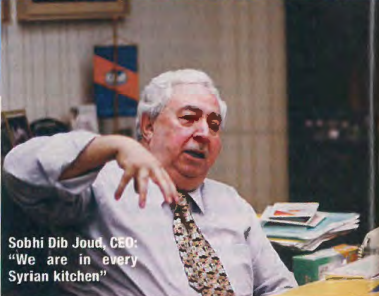
trade is Akhrass with 55%. “We are in every
Syrian kitchen, because my father taught me
how to weigh an honest 200 grams and
instilled the fear of God in me,” says Sobhi
Dib Joud, CEO of Joud and the eldest son of
the company’s founder.

The government also freed up the import
of animal feed to the private sector. Sure
enough, Joud was there. It now sells around
$30 million per year of animal feed, most of
which is imported in the form of yellow corn,
barley, meat meal, fishmeal and soya bean
meal from Belgium and France. Of this trade,
$4 million is by direct export to other countries.

Mohammed Joud, vice president, started
that division in 1992. Another example of
Joud taking advantage of new opportunities
was its entry into the tire business in 1994.
The company became the official importer
and distributor of Goodyear and Fulda
tires. Today, this division generates $3.7 million
a year in revenues, or a 33% share of the
domestic truck tire market and 15% for
farm vehicles.

One of Joud’s most dramatic success stories
has been Mandarin. With the international
cola heavyweights out of the Syrian
market due to import restrictions, Joud has
been able to make Mandarin the number
one brand, pushing sales from $6.6 million
in 1993 to $22 million last year. Mandarin,
the company claims, has a 39% local market
share, just ahead of the number two brand
Cadbury Schweppes, which has a 30% to
35% market share. Much of the soft drink’s
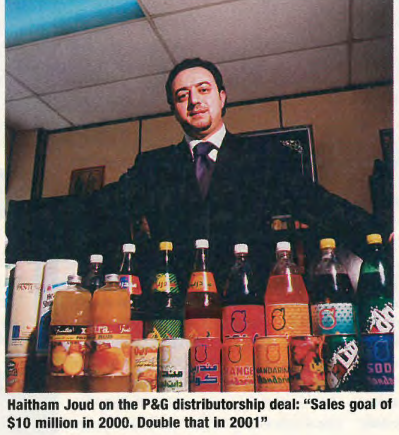
success, argues Haitham Joud, manager of
the soft drinks division, stems from the
nationwide direct distribution network. “In
Syria, once you improve your distribution
and marketing network, you exceed your
competitors,” says Haitham. Another reason
for Mandarin’s success is the diversity of
selection. “Joud has 12 flavors for all tastes
where we only produce three or four flavors,”
says Sidky Lyousfi, general manager of a factory
that produces Cadbury Schweppes.

Now, with economic liberalization on the
horizon, Joud is adding new feathers to its
hat. Two years ago, when Syria signed the
Arab Free Trade Agreement, Procter &
Gamble found the 16 million consumer
market a golden opportunity. For the first
time, the US-based multinational will be able
to import a multitude of brands into Syria –
including Pantene, Pert Plus, Always, Head
& Shoulders, Camay, Zest, Ariel, Tide and
YES – which it has already been producing
at its Saudi and Lebanese factories. The
international heavyweight chose Joud to be
its representative in this important new
market. “We had several criteria that we
presented to five distributors we picked
from hundreds who originally applied,”
says Ziad Chabaan, manager of manufacturing
at P&G Lebanon. “Out of five, we
picked Joud, because it was the company
best suited to our criteria.”

Joud is now P&G’s sole distributor in Syria
for the next 20 years or more. The company
has been busy building a 100-man sales
team, trained directly by P&G personnel, and
the multinational’s products have already hit
the shelves. “We will focus on diapers, detergents
and shampoo, with a sales goal of $10
million in 2000 and double that in 2001,”
says a confident Haitham. P&G will benefit by
being able to cross-advertise using Joud’s
portfolio of products.

Working with P&G will allow Joud to
improve its long-term planning, management
and distribution know-how. Joud will also be
able to attract contracts from other multinationals,
much in the way that Obegi in
Lebanon won the sole distribution
rights for McDonald’s through its
nearly 25-year connection with the
German-based Henkel corporation
(see “Can’t get enough,” March
2000). “P&G has very good products.
Joud, as a distributor, is very
good,” says Georges Obegi, chairman
of Obegi Consumer Products,
makers of everything from Persil
laundry detergent to Al Wadi Al
Akhdar canned foods. “They’re
professional. We’re not active in
diapers or shampoo in Syria. In
detergents, P&G Syria isn’t active
yet, but when they are, they’ll be a
challenge.”

Another new venture for Joud
was its 1995 partnership with the
Lebanese company BD&A, the
official representatives of Saatchi &
Saatchi (S&S) Middle East. That
deal placed the skills of a dynamic
international advertising firm at the company’s disposal. Today, the S&S
office in Damascus is mostly working for
Joud, helping it build strong brand images.
But in the future, there is significant potential
for the advertising firm to expand its
activities there. That will mean a new source
of profits for Joud.

Internationally, S&S focuses mainly on
big corporate entities like banks and insurance
companies. These sectors of the Syrian economy
are in the hands of the public sector. But what will happen
when the government finally allows the private
sector to enter these fields, like it did with
refrigerators, foodstuffs and animal feed?

“We will be partnered with a world-renowned
media company which will give us
a big advantage in serving those corporations
before any other media companies enter the
market,” says Haitham.

Another future plus for the company is its
position as an advisor for British American
Tobacco (BAT), manufacturers of such cigarette
brands as Viceroy, Lucky and Kent.
Currently, imports represent just 10% of the
tobacco market in Syria, and are controlled
by the state-run regie (Gotha). But, as with
many sectors of the economy, if the government
allows private companies into the cigarette
business, Joud’s association with
BAT will leave it in a position to dominate.

In Lebanon, BAT controls a 51% market
share, while Philip Morris, producers of
Marlboro, Merit, L&M and Chesterfield,
has just 38.5%, according to a retail audit
done by MEMRB in August 1999.

In anticipation of a housing boom – a
strong likelihood in the event of a Middle East
peace settlement – Joud is branching into
steel manufacturing. It has already become
one of the biggest importers of steel, wood and
heating equipment, a division that generates
revenues of $10 million per year. Now, the
company is building a $12 million plant
about 15 km from Latakia able to produce
profile sheets, reinforcing bars and other components
for construction. It will import its
raw materials from Ukraine and Russia and
sell to local dealers and wholesalers.

Even Joud’s soft drinks division is looking
to the future. So far, Coke and Pepsi,
with the exception of Pepsi’s 7-Up, have not
been able to penetrate the Syrian market
because the government forbids the importation
of the cola concentrate. But when
these restrictions are dropped, and
Mandarin is forced to compete, what will
happen to Joud? Well, the competition
might present an opportunity. In 1995, the
company received a letter of intent from the
Coca-Cola Company, giving Joud bottling
and distribution rights for Coke,
Sprite and Fanta. This means Joud
is poised to tap a potential gold
mine. Per capita cola consumption
is 12 liters a year in Syria,
whereas in Lebanon it is around 30
liters. “If Coke and Pepsi make
their way into the market in the
future, they will help bring the
soft drink consumption higher,”
says Haitham.

But a broadening of the economy
also poses new challenges. For the
first time, the home appliance
division is under attack from
imported Korean brands. While
the law prohibits the importation
into Syria of products that are
already produced domestically, a
trade agreement with Jordan
allows Korean brands produced in
that country, like LG and Daewoo
refrigerators, to enter the Syrian market.

“They have a fantastic finish and use digital
controls, but that kind of technology is not
needed in Syria and their prices are 30% to
40% higher than local brands, despite the
customs duties exemptions,” says Farouk.

Selim Antaki, CEO of LG Lebanon, disagrees:
“Although our appliances are digital,
they involve simple configurations that
any consumer can learn easily.”

More such challenges invariably lie
ahead. But Joud is a traditional family
business that has grown strong by adapting
to change. So long as it keeps on its toes,
it will likely do well.

April 6, 2000 0 comments
0 FacebookTwitterPinterestEmail
For your information

Waiting for Euro-Med

by Executive Contributor April 6, 2000
written by Executive Contributor

What steps should Lebanon take to join the Euro-Med Association Agreement?

KOURKOULAS
The main obstacle is that Lebanon must reduce or abolish
customs duties. They should replace this method of gaining revenues.
The government is already committed to introducing indirect taxation,
and we are assisting the government in introducing fiscal reforms.
But in the last few years the government has actually
been increasing tariffs.

KOURKOULAS
The rise in protectionism we have seen in the last three
or four years is the opposite of what we are trying to do. I think that the
Lebanese are aware of this, and they have always communicated their
willingness and commitment to go in the other direction. The problem
is the budget deficit and the fact that more than 60% of revenues are generated
from customs tariffs. But this is not the best solution, because not
only does it go against the terms of the association agreement, it undermines
the competitiveness of the Lebanese economy. Lebanon cannot
afford to continue in this manner.

The government is planning to replace customs duties with a value-added tax (VAT). But some economists feel that Lebanon is not transparent enough for it to be effective. What is your view?

KOURKOULAS
You should not underestimate the capacity of the
Lebanese economy to introduce VAT. There are examples of other countries
in the European Union who were reluctant to introduce VAT
because of the argument you have just made. For example Greece,
which was obliged to introduce VAT after its accession to the EU. The
fiscal authorities were not very organized; there was a lot of tax evasion.
But the introduction of VAT helped rationalize the fiscal system
and reduce the tax evasion problem.

Are you preparing future loans or grants for Lebanon?

KOURKOULAS
We are preparing some new programs. One is a
social development fund that will assist in the creation of jobs in remote
and underdeveloped regions. Twenty-five million euros will be dedicated
to the social fund, 11 million euros will be allocated for industrial
organization. We are also preparing a structural adjustment facility
for the Lebanese budget. These are all grants.

There is a lot of fear that Lebanese companies will become casualties once the country lowers its trade barriers. How real are these fears?

KOURKOULAS
The Lebanese market is small and this market
already has a high percentage
of import penetration.
I think that
it’s not correct to say
that customs duties
protect local production. The main reason for increasing customs duties
is for fiscal reasons: to increase revenues for the government.
Sometimes, local industry is the victim of these protections when they
have to pay customs duties for raw materials. We allocated 11 million
euros for industrial modernization with the objective of improving the
performance and the competitiveness of Lebanese industries.

Presumably, the Lebanese sectors that are competitive cannot rely on
this small market. The Lebanese know this better than we do. We feel
that, on the contrary, the realization of our free trade area with
Lebanon and Mediterranean countries will give them a much bigger
market in which to operate.

How can local industry compete? They have high energy and production costs, high labor costs and they pay high prices for raw materials.

KOURKOULAS
Compared to other countries in the region, the cost of
labor here is high, as is the cost of land. But I think that this country’s big
asset is its human resources. They can be competitive in more sophisticated
and more value-added services. In the service sectors or the tourist sector
they can be competitive despite the fact that the cost is higher. They can
be competitive in processing agricultural products. There are other high
value-added sectors that might benefit.

I think that the main obstacle is not the high labor costs but the cost of
administrative procedures. Sometimes, it’s more important for businesses
to reduce or simplify these procedures than to have lower labor costs.

Euro-Med is supposed to encourage European investment. But this is a tiny market and costs for businesses are high. Do you feel that European companies will really want to invest in Lebanon?

KOURKOULAS
I think that what is more important for businesses is
the whole administrative framework in which they will have to operate.
We feel that the conclusion of the agreement will send a strong signal
that Lebanon is going in the right direction, and I think that this will
increase the attractiveness of this country.

The market may be small, but other countries in the region will adopt
the same rules. I think that other businesses in the region would like
to operate on a regional level, not a national level. The sooner this agreement
is concluded, the better it will be for attracting investors.

April 6, 2000 0 comments
0 FacebookTwitterPinterestEmail
For your information

In need of an economic laxative

by Sami Atallah April 6, 2000
written by Sami Atallah

So whatever happened to the Euro-Med partnership agreement?
And wasn’t Lebanon applying as an observer to the
WTO? After all, countries around the world have been integrating
through the flow of goods, services, capital and technology
across borders. Others have gone further by establishing trade
blocs, such as the North American Free Trade Agreement,
European Union or Asia-Pacific Economic Council. Developing
countries are under increasing pressure to liberalize trade. Many
are not enthusiastic because of the disruption it may cause,
whether social, fiscal or economic.

The effects of trade liberalization on Lebanon have not been
properly assessed. Those who oppose it cry that it will lead to
unemployment and economic stagnation. The proponents draw
a rosy picture of growth and a boom in export-oriented industries.
I haven’t seen any serious work that supports these scenarios.
Nevertheless, I will make the following propositions. First, integration
with world markets is a source of disruption and upheaval
as well as an opportunity for profit and economic growth. Take the
East Asian countries. They performed well in the last decades by integrating
their economies with the rest of the world. However, it is this
integration that led to the capital crisis in 1997/8. Being a small country
with the pro-free trade institutions, Lebanon will inevitably undergo
full trade liberalization. And globalization, whether we like it or not,
is here to stay. So the more pertinent question is not whether to globalize
but how to do so.

Dani Rodrik, a professor of international economics at Harvard’s
Kennedy School of Government, suggests that countries should complement
trade liberalization policies with an “internal strategy of institutional
reforms.” He argues that the strategy must have three
components. First, a country must improve the credibility of its state
apparatus. This means that Lebanon can no longer rely on sound
macroeconomic policies of low inflation and stable currency to attract
investments. In the 1950s and 60s, inefficient and corrupt bureaucracy
and weak government institutions went hand in hand with
investment and growth. This formula no longer applies. Investors
expect countries to have transparent and accountable institutions.
Moreover, the government must have an efficient judiciary to
resolve conflicts, lower transaction costs and increase economic
activity. These have become the new prerequisites for investment
and growth.

Second, a country must also improve the mechanism of “voice.”
That is, Lebanon can no longer make policies in a vacuum: the economic
and social actors must be included in the decision-making
process. Private sector participation in economic policymaking is
low, except for the banking sector. Moreover, the labor associations,
despite their internal weaknesses, have often been marginalized by
the state or broken up for political purposes. The government has
also failed to bring other civil society organizations on board, particularly
social ones, and support their activities.

The social safety net must be improved, because trade liberalization
will severely affect certain groups in the economy. The organizations
that provide social care in Lebanon operate in a vacuum, leading to
a duplication of efforts, according to Adib Ne’meh, a lawyer and a
consultant to the UNDP. More than half of the population does not
have social security. And the existing social service system is often
manipulated for political purposes.

Lebanon has failed to prepare itself for globalization. Time is running
out. Economic treaties will soon be put back on the table and
Lebanon will have to sign. Without an internal strategy, the costs of
globalization will be too high. Social tension will inevitably arise.
Frankly, these institutional reforms are good not only as a means to
face globalization, but also as an end in themselves. The question
remains: Why hasn’t the government adopted any of them yet?

April 6, 2000 0 comments
0 FacebookTwitterPinterestEmail
For your information

Gagging the press

by Samia Jouzi April 6, 2000
written by Samia Jouzi

Freedom of the press is under threat, the media is screaming
in unison. The culprit is an apparently well-intentioned
proposal to place a ceiling on campaign expenditure and
advertising in a bid to limit the influence of money in parliamentary
elections. It’s not the spirit but the fine print that has the press
in an uproar. In trying to ensure equal access to airtime and a limit
on spending, the law would make it impossible to stay open for business
during elections, according to the press. “The proposed law prevents
the audio and visual media from covering one of the most
important political events in the life of the Lebanese people – the
parliamentary elections,” says Tanios Deaibess, general manager
of Sowt el Shaib radio station. “It contains
clauses that mix reporting with
advertising.” Private media representatives,
supported by the publishers’
union and the press syndicate, are trying
to have the draft law amended, specifically
clauses nine and ten (see chart).

The proposed law gives state-run
Tele-Liban (TL) and Radio-Liban the
exclusive rights to air campaign advertising.
“That contradicts, first of all, the
right of private television to equal treatment
with TL. Secondly, it undermines
an individual’s right to freely
enter into any commercial deal. And
thirdly, a Lebanese citizen has the right to
choose any form of media for the campaign,”
says lawyer Edmond Naim. Not
surprisingly, granting exclusive privileges
to TL has been rejected by private
stations. “Tele-Liban is a registered company just like all other television
stations. All institutions should be treated equally,” says
Gabriel Murr, advisor to MTV television.

On top of limiting airtime and spending, the elections are seen as
an opportunity to compensate the financially ailing TL. “When the
television licenses were granted in the past they deprived TL of the
right to exclusivity which it had until 2012,” says Hikmat Abou Zeid,
the prime minister’s media advisor. “But there’s a deeper problem
with TL that will not be solved with the one-off $5 million or so that
they might get during the elections,” counters Murr. The law suggests
giving all parliamentary contenders an equal time slot at a fixed
cost of about $1,326 for five minutes on TL and $130 for ten minutes
on Radio-Liban. The government now says that it’s open to
making the airtime free of charge to all candidates.

The government’s proposal to monitor the press on election coverage
would mean blurring what is campaign advertising as
opposed to legitimate reporting. “It prevents the radio and TV stations
from covering the elections as well as from being a medium
of publicity. It says the prohibition covers interviews, platform declarations,
candidate rallies, caricatures,
etc,” says Murr. Media professionals
believe that will make it impossible for
them to cover any political figures or
events during election time. Drawing the
fine line between publicity for candidates
and their platforms and reporting on
those issues is, legally speaking, tricky.
“Electoral advertising is making public
the candidates’ qualifications or informing
the public of the date and place of rallies
or the events. Reporting, on the other
hand, is discussing the platform or the
intentions of the candidates should they
get elected,” says Naim.

There is also the issue of advertising revenue.
Advertising goes up across the
board for all media with a political
license during elections. It increased by
some 15% for An Nahar newspaper during
the 1996 elections. Excluding the private audio-visual media not
only deprives them of revenue from campaign advertising but
also affects their ability to attract advertising during the pre-election
season, according to a memorandum sent to prime minister
Salim Hoss from LBCI and Voix du Liban.

The draft law sets the ceiling at almost $100,000 for campaigning
expenses and about $66,000 for publicity. But candidates have
spent a great deal more in the past. An election hopeful would not
have spent less than $500,000 during the
1996 elections, according to Edmond
Saab, the executive editor of An Nahar. The
cost of political advertising, which is four
to five times more expensive than commercial
advertising, doesn’t come cheap. A
page of platform publicity was priced at $15,000 last time around.

The government is expecting a heated
debate. “The proposed law is the first of its
kind and it is natural that it will cause controversy. The state is committed to two fundamental
principles: that of a ceiling on
campaign spending and ensuring that all
candidates have equal access to the media,”
says Abou Zeid. The draft will probably be
amended. But requests to withdraw and
redraft the law before it goes to parliament
would mean delays. If the law is put forward
in time for the vote, MPs will have the final
say on what they can or cannot do during the
run-up to elections.

Excerpts from the proposed law on campaign expenditure and media coverage

Clause 9 Electoral media and advertising for the benefit
of candidates means: conveying news of campaigns
and electoral lists (meetings, rallies, interviews,
symposiums, etc), promotion of events in
audio and visual media. In the press those that benefit
candidates (headlines, articles, slogans, pictures,
analyses, commentary, caricatures, etc), either directly
or indirectly.

Clause 10 To ensure equality amongst candidates
all private audio and visual media cannot air campaign
publicity for the duration of the election period
which begins when elections are officially
declared by the government.


April 6, 2000 0 comments
0 FacebookTwitterPinterestEmail
For your information

Checking out

by Hadi khatib April 6, 2000
written by Hadi khatib

The 36-year-old Coral Beach Hotel, once a summer playground
for Gulf princes, European holiday seekers and
Beirut’s elite, has closed its doors. After suffering three consecutive
losing years, Izzat Kaddoura, the owner, is calling it
quits and pulling out of Lebanon. The empty shell of the once-thriving
resort that employed
over 170 people is up for
sale at a price that has not
yet been disclosed.

Kaddoura blames the
recession, an unstable political
environment and a business-
unfriendly government
for the hotel’s failure. In
1997, Coral Beach had over
2,600 members and received
1,000 guests. Last year, the
hotel saw less than half those
numbers. Occupancy
declined from 60% to less
than 25% during the same
period. But Coral Beach is
not alone. Across the country
hotels are suffering.

An independent survey
done by Arthur Andersen of six leading hotels in Beirut showed that
the average price for a room has declined from $156.16 in 1998 to
$150.03 last year. The survey also showed that the yield for rooms
(occupancy multiplied by the average room rate) declined by 10%
in that same period, from $107.99 to $97.20. “We used to get company
representatives attending conventions as well as tourists from
all around the world. Today these same people go to the Gulf,
Egypt, Morocco, Tunisia, Turkey or Greece,” says Kaddoura. He estimates
that Rhodes alone attracts 1.3 million tourists annually, compared
to the 670,000 tourists who visited Lebanon last year.

Kaddoura complains that the cost of maintaining the Coral Beach also
took its toll. The hotel was spending nearly $300,000 a year on electricity
and the corrosive sea front climate cost the club another
$300,000 to $350,000 in yearly maintenance. Government policies
toward the struggling hotel sector haven’t helped. Two years ago, a
5% tax was imposed on hotel revenues but the struggling tourism sector
has received little support in return. “The government makes us
pay taxes, social security, transportation, schooling for our employees’
children as well as fees for street and sidewalk maintenance and trash
removal, which we do ourselves,” says Kaddoura.

The ministry of tourism, which plays a central role in promotion,
receives minimal funding. Its budget for this year was a mere $4.5
million, less than one-tenth of a percent of the total budget allocated
to all ministries (see “Switzerland of the Middle East No longer”,
March 2000). “We keep
hearing speeches from the
government that don’t
translate into action, they
simply don’t have a plan of
action and lack vision,”
says Nizar Alouf, managing
partner of the Riviera
Hotel. Last year, the
Riviera underwent a complete
rehabilitation. “The
commercial loan here is
higher than any other
country,” says Alouf,
adding that at best a five-year
loan carries an 11%
interest rate. In the Gulf,
the interest on a 15-year
loan is as low as 6%.

Meanwhile, as hotels suffer,
government officials and some within the industry continue to
act as though everything is fine. Last June, after the Israeli air
strikes, a letter was sent to members of the hotel owners’ syndicate.
It said that the syndicate and ‘responsible’ officials had devised a
plan to use the media to create an image of normalcy. The letter
urged all hotel owners, when speaking to the press, not to mention
any cancellations as a result of the bombings.

Kaddoura has grown tired of the rhetoric. He is investing elsewhere.
Six months ago, construction started on a $42-million residential project
in Conakry, in the Republic of Guinea, which he and seven other
shareholders are financing. The facility will include furnished apartments,
a beach and recreational facilities, supermarkets, restaurants and
hotels. The government gave the investors the 250,000 m² of land for
free as well as a seven-year tax exemption and a free license to build.
Kaddoura also plans to invest $7 million to open a company there that
will export fish to Europe. As for Lebanon, he warns the government
that if it wants to attract tourists it should take a lesson from countries
that have been successful and lay down the proper legal and regulatory
framework where hotels can prosper.

April 6, 2000 0 comments
0 FacebookTwitterPinterestEmail
For your information

Brain drain

by Natacha Tannous April 6, 2000
written by Natacha Tannous

Karim Habib (not his real name) is a young
and bright financial analyst. Four years ago
he was employed with one of the biggest
investment firms in the United States, where
he had a promising career ahead of him. But
the post-war feeling that Beirut would reemerge
as the Middle East’s financial center
inspired Habib to return to his homeland,
where he was offered a position with a newly
established investment company. His enthusiasm
has since waned. “What I came back
for is proving to be an empty shell,” he says.
Now intent on returning to the US, Habib will
be among the thousands of educated
Lebanese that emigrate each year.

Lebanon has long been a major exporter of human resources
(see box), but the civil war pushed unprecedented numbers
of people to emigrate. From 1975 until the end of 1993,
729,000 people emigrated – 19.9% of the net population at that time,
according to a study by statistician Anis Abi Farah. Displacement is
common during wartime, but what is uncommon is that the exodus
didn’t subside when the hostilities ended. By 1996 that number had
increased to 950,000. In other words, between 1994 and 1996 – years
of relative stability – another 221,000 people emigrated, a further
increase of 30.3%.

Should emigration be condemned entirely? “Emigration has
always been a major element of strength for Lebanon, because emigrants
transfer quite a lot of money to their relatives and also capital
savings,” says economist Marwan Iskandar of MI Associates.
“Whenever we achieved a surplus – except in ’96 and ’97 which was
due to borrowing – it was due to transfers from Lebanese.”

However, transfers cannot compensate for the losses due to emigration
of educated people. University graduates accounted for 32%
of emigrants between 1975 and 1996, reducing those within the resident
population to 22.4%. “We lost 300,000 university graduates in
that period. It cost us $30 billion to prepare them,” says Abi Farah, referring
to public and private investments in education. “Have we been reimbursed

$30 billion by them leaving?” Indeed not.

For example, a Lebanese working abroad as an electronics engineer
produces ‘X’ amount of value – let’s say $100,000 annually. He
might transfer $10,000 of his salary to his family in Lebanon. “If this
person was able to be productive here, we would get ten times more
benefit,” says Paul Salem, a political and development analyst.
“Obviously it’s a bad deal, but that’s what is happening because our
productive sectors aren’t able to absorb this amount of skilled labor.”

So the greater value is forfeited to the host countries, most of which
have developed economies. Abi Farah’s study shows that of the emigrant
university graduates, 23.9% went to the United States, 20.1% to
France and 13.4% to Canada.

Iskandar presents yet another, more recent study. “41% of all people
between 20 and 30 years are applying to emigrate – whether they
succeed or not, the desire is there,” he says. Lack of economic opportunity
is identified as the fundamental reason young people emigrate.
For those with jobs, incomes are low (Lebanon’s per capita income is
$3,000 to $3,500 annually) while the cost of living is high. And for thousands
of young graduates entering the job market every year, most cannot
find employment. No statistics are available on job creation.
Considering the economic stagnation of 1996 to 1999, job creation was
probably negligible, while there was possibly even job loss.

The government hasn’t traditionally taken a leadership role in the
economy. “But now, I believe the government should begin to take a
lead in certain areas where Lebanon has a comparative advantage,” says
Salem. Identifying potential sectors is one thing, taking action is
quite another. For example, the government has identified the technology
sector as strategic. “They have been talking about it for the last
year, but I haven’t seen any laws or regulations pass that would help
develop it,” says Habib. For this sector to develop, the government must
give tax breaks, create an information free zone and support specialized
institutes, such as training centers. It must also invest in upgrading
the school curriculums. In 1998 parliament endorsed a new curriculum
to improve the current system, which hasn’t been changed in
about 30 years. However, it was never implemented. The allocation
for the training of teachers was $13 million a year for three years. “We
put the new program on hold to save $13 million, but the returns of education
are enormous,” says Iskandar. If the trend of emigration continues,
“in the coming five years we will lose a further 500,000 people,
of whom 150,000 would be university graduates,” he adds.

Lebanon cannot sustain such losses and expect to achieve growth
via a ‘knowledge-based economy’.

Habib returned to Lebanon “with big plans to modernize and earn
a good living.” But his aspirations have been shattered by harsh realities. He cites nepotism, rampant corruption, bureaucracy, red
tape and wastefulness along with shortsightedness on the part of
the government. There is hope that the peace process will bring foreign
investment to Lebanon. But, according to Habib, “if there is
still chaos in the government, other countries will benefit from the
peace, not us.”

Global networking

The claim is true: The number of Lebanese people throughout the world
far exceeds those that reside within its borders. The first exodus started
in the middle of the 19th century because of economic hardship and
political instability. Since then the flow of emigrants has been steady, but
three periods of war commencing in 1860, 1914 (punctuated by
famine), and 1975, pushed unprecedented numbers to emigrate.

Today it’s impossible to compile accurate statistics on the size of the
expatriate community (including descendants). And the said population
of Lebanon is only an estimate. In the absence of statistics, a simulation
model is the best means to assess such data. Statistician Anis Abi Farah
has developed a software program called nasripop, which can produce
data on the Lebanese population. The program calculated that in 1999
Lebanon’s population was 3.2 million, while the number of Lebanese emigrants
(including descendants) was 8.3 million. According to nasripop’s
projection (see chart), the expatriate community is growing at a
faster rate than the resident population, so that in 2010 there will be 3.9
million residents and 11.6 million emigrants.

“Lebanon stands out as one of the few countries in the world with a
larger expatriate community compared to its own,” says Paul Salem, a
political and development analyst who sees a positive side to this.
“Lebanon needs to recognize that we are – and will always be – a global
country.” Israel is probably the only other “global country” in the world.
It has always recognized this and includes the diaspora in its national
affairs, an approach that has proved beneficial to economic development.
Many expats have achieved success, and Lebanon could gain by similarly
involving them in state affairs. “A lot of them are wealthy, influential
and have global connections,” says Salem. “Have them represented
in parliament, let them have a say in economic policy – involve them
in the country.” Now might just be the time, as Lebanon embarks in the
global economy. “Global trade requires a global network, and our allies
around the world are the Lebanese around the world,” says Salem. “They
are a great resource.”

Salem is a progressive thinker. But personal experience of Lebanese
communities in the United States, South America and the Caribbean
leaves this writer doubtful that such solidarity is possible. True to form,
division and discord characterize Lebanese emigrant communities. It
would take charismatic, dedicated leaders to lobby the Lebanese
worldwide to join hands and contribute to the greater good of Lebanon.

April 6, 2000 0 comments
0 FacebookTwitterPinterestEmail
  • 1
  • …
  • 698
  • 699
  • 700
  • 701
  • 702
  • …
  • 705

Latest Cover

About us

Since its first edition emerged on the newsstands in 1999, Executive Magazine has been dedicated to providing its readers with the most up-to-date local and regional business news. Executive is a monthly business magazine that offers readers in-depth analyses on the Lebanese world of commerce, covering all the major sectors – from banking, finance, and insurance to technology, tourism, hospitality, media, and retail.

  • Donate
  • Our Purpose
  • Contact Us

Sign up for our newsletter

    • Facebook
    • Twitter
    • Instagram
    • Linkedin
    • Youtube
    Executive Magazine
    • ISSUES
      • Current Issue
      • Past issues
    • BUSINESS
    • ECONOMICS & POLICY
    • OPINION
    • SPECIAL REPORTS
    • EXECUTIVE TALKS
    • MOVEMENTS
      • Change the image
      • Cannes lions
      • Transparency & accountability
      • ECONOMIC ROADMAP
      • Say No to Corruption
      • The Lebanon media development initiative
      • LPSN Policy Asks
      • Advocating the preservation of deposits
    • JOIN US
      • Join our movement
      • Attend our events
      • Receive updates
      • Connect with us
    • DONATE