• Donate
  • Our Purpose
  • Contact Us
Executive Magazine
  • ISSUES
    • Current Issue
    • Past issues
  • BUSINESS
  • ECONOMICS & POLICY
  • OPINION
  • SPECIAL REPORTS
  • EXECUTIVE TALKS
  • MOVEMENTS
    • Change the image
    • Cannes lions
    • Transparency & accountability
    • ECONOMIC ROADMAP
    • Say No to Corruption
    • The Lebanon media development initiative
    • LPSN Policy Asks
    • Advocating the preservation of deposits
  • JOIN US
    • Join our movement
    • Attend our events
    • Receive updates
    • Connect with us
  • DONATE
For your information

Bullet proof bank

by Gareth Smith March 24, 2000
written by Gareth Smith

Even in the occupied zone, people still needed banks. With
its two branches, in Marjayoun and Bint Jbeil, Fransabank
enjoyed a monopoly among 100,000 people. With the
Israelis gone, the bank is in pole position to beat off rivals if stability
returns and the local economy recovers. “They were daring,”
says Nassib Ghobril, an analyst at Lebanon Invest, “and others are
now thinking of following them.”

Thinking, but not acting — at least yet. Lebanese banks are
unlikely to stampede south immediately.

“I don’t think any of the other
banks have applied to work in the
zone,” says Sarni Sfeir, press
spokesman for the Central Bank. “We
will be monitoring the situation.”

Uncertainty persists in the South,
especially with the Shebaa Farms
issue not yet resolved. This leaves
Fransabank sitting pretty. In the
short term, customers require a safe
port and, in due course, Fransabank
will have a firm base.

But think of the worst scenario:
what if someone blows up the bank?
No worries, says Ibrahim Qoleilat,
Fransabank’s deputy general manager:
“The branches in the South hold a
minimum of paper money. What’s
there? Only furniture and PCs.”

And
customers have seen it all before, says
Habib Rohayam, manager of the Bint
Jbeil branch: “People are not unduly worried.
They remember that when the
bank closed in 1978, they could still
withdraw their money from Beirut.”
Back then, the area — known not
so affectionately as Fatahland — slipped into disorder. But gradually
a strange kind of order returned, albeit under Israeli occupation.

“The people who had relocated from the South were
always asking us to go back,” says Qoleilat, “and eventually we felt
the time was right.”

The branches in Bint Jbeil and Marjayoun reopened in 1993,
around the time that the Lebanese ministries increased their presence
in the zone. But Fransabank never closed its branch in
Jezzine, which remained an unofficial part of the zone until last
summer.

In Bint Jbeil and Marjayoun, the bank found a promising
market, as trade with Israel was booming and more than 3,000 local
inhabitants were earning good wages south of the border. The Bint
Jbeil branch has 10,000 customers, which is nearly double the national
banking average of 5,500. The Marjayoun branch is
prominently situated at the entrance to the town.

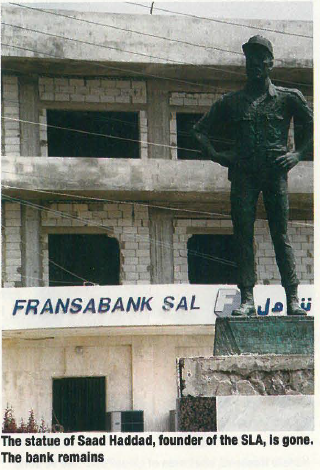
Until the pullout,
a statue of Saad Haddad stood in front of the bank. (It has subsequently
been destroyed.)

“We are serving the whole region,” says
Qoleilat. “Where someone needs a banking service, we provide it.”

In practice, the services offered by the bank are less comprehensive
than elsewhere in the country. Neither branch, for example, has
an ATM. Personal loans have been “limited,” says Rohayam,
adding that it’s not due to difficulties
in assessing or collecting collateral.

Quite how the bank managed during
the years of the occupation, understandably,
is a sensitive matter. But it
has coped successfully with the
anomalies produced by 22 years of
Israeli control.

Think only of the legal
situation: the darak (police) and the South
Lebanon Army (SLA) both had “law
and order” roles; the Israeli-sponsored
civil administration worked alongside
the Lebanese government ministries.
Court decisions were left pending
until the end of the occupation.

How easy was it to deal with default in
such a peculiar legal situation? “The
bank had its own law,” says one
employee. “This could be either the
darak or the SLA.”

Rohayam declined
to elaborate on his policy for bad debts.
“I would protect myself,” he says. “I
don’t know anything else.”

It’s easy to see why Rohayam is
upbeat, at least for now. In the short
term, the cash flows into Fransabank because residents of the now
unoccupied zone save for a rainy day. The local economy went into a downturn
as soon as the Israeli government confirmed its withdrawal.

But there’s an optimistic scenario for the former occupied zone,
at least beyond the short term. A fair proportion of the 100,000 people
who have left the zone during the occupation will want to go
home, and many of them will want to bank.

Front-runners to join Fransabank are probably Al-Mawarid
and Beirut Riyad Bank, which are owned by two natives of
Hasbaiya, Marwan Kheiredin and Anwar Khalil, respectively.

“These banks will know the situation on the ground better than the
bigger, more aggressively marketed retail banks like Audi or
Byblos,” says Ghobril, who is from Hasbaiya. “Local people will
feel more comfortable with them.”
March 24, 2000 0 comments
0 FacebookTwitterPinterestEmail
For your information

Paridora’s mailbox

by Kirsten Vance March 24, 2000
written by Kirsten Vance

While some point the finger at the Canadian-run consortium,
which took charge in October 1998, Fakhoury, like
most, does not. The contract stipulates that all MPT
employees should be able to join LibanPost, based on an assessment
of skills. Some did choose not to transfer. But employees insist that
this was due to the lack of regulation to protect them once transferred,
that the selection process favored youth, and that political pressures
played a role in appointments. (Issam Naaman, the minister responsible,
declined repeated requests for an interview.)

“What is the future
of those who are taken by LibanPost when the contract ends?” asks
Boutros Harb, a lawyer and member of parliament. “Nothing was
stipulated, nothing at all; and I think the government was irresponsible
in this case.”

Part of the problem was trying to get the accord of the Civil Service
Board to allow MPT employees out ‘on loan’ to LibanPost.

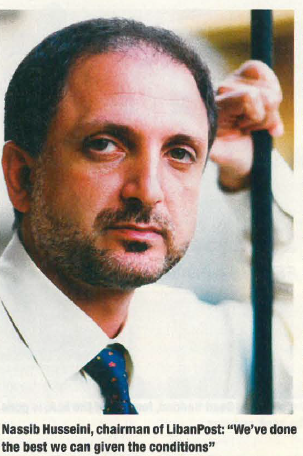
“But this is an internal government matter,” says Nassib Husseini,
chairman of LibanPost. “The priority has always been for MPT
employees. But would you, as a customer or citizen, expect us to wait
another five years to settle this issue?”

Further, there were some
205 ‘untouchables’ that the minister retained to form a regulatory
body, and many of these are the most qualified. Almost 400 didn’t
make it through the selection process, says Husseini.

“We did
put on the table a firm 250 written job offers, and 71 of them accepted,”
he says. The current LibanPost staff totals 450.

But with the employee issue brewing, LibanPost could soon find
itself the receiver of an MPT special delivery: the matter may be headed
to the Council of Ministers.

“LibanPost will have to agree to modify
the contract,” says an MPT official.

Having a regulatory framework
in place, he argues, might sidestep the employee imbroglio and
other problems.

At the same time, MP Georges Kassarcji wants to have
the 12-year build-operate-transfer contract brought back to parliament:

“As soon as we finish with the cellular issue, I want the LibanPost file
put back on the table.”

The debate centers on the constitutionality of the contract. Harb
insists the contract contravenes Article 89 of the Constitution,
while others point to Article One of Decree 126 (see box), which governs
the former Directorate of Post, Telephone, and Telegraph.

An
independent lawyer consulted on the matter said that the decree only
touches on distribution, not running the entire concession, and
that the Constitution takes precedence.

This is not the first time such a debate has erupted. It’s an issue
that just doesn’t seem to die for LibanPost — one that threatens to
be continually questioned by MPs or with each new government
that comes into power.

“Whatever the decision of the government,
we will respect it. But we feel we have a solid contract; so if it is
challenged, there’s compensation linked to that,” says Husseini.

“Our
objective is not to kill the guardian of the vineyard; our objective
is to eat the fruits, which is a project that is good for both parties.”

There’s also the matter of the international couriers (see “Down and
Out in Beirut,” January 2000). The amendments to the contract gave
LibanPost the right to collect, as part of its revenues, what is essentially
a tax on private courier companies.

When the tax was
increased last June from $6 per kilo on inbound documents only to
$12 per kilo on both inbound and outbound,
the couriers cried foul and have
refused to pay. The outstanding tax bill
will reach about $9 million by June.

According to the MPT official, this part
of the contract will also have to be amended.

“I hope that it’s changed too. Why?
Because I am looking for a healthy
environment,” says Husseini. “I think
we share that goal with both the government
and the courier industry.”

If the MPT employees and others
have complaints, it hasn’t been smooth
sailing for LibanPost either. Husseini’s
worry? That LibanPost is working with
a fixed revenue-sharing formula and a
fixed tariff scale, as well as delivering in
villages at a loss.

“How can we compete
with someone who works without a
license and charges local tariffs that are
lower than the government’s?”

The company also suffers from the same bureaucracy that inflicts
most businesses. One problem, which has
slowed down the process of renovating post offices, has
been getting permits. It’s no secret that the municipality
isn’t exactly quick on its feet in that arena.

Some offices
have yet to be passed from MPT control to LibanPost. Bureaucracy
has also impeded the launching of new products. And red tape at
customs undoubtedly makes Lebanese hesitant to send or receive
more than letters internationally.

On the upside, items up to LL 1–2 million in value should be delivered
without going through customs very soon.

Nonetheless, LibanPost is reassessing its expectations of breaking
even by year three. Husseini declined to reveal how much the company
is losing, saying only that this is a time of investment.

While the
volume of mail more than doubled in the last year, it’s still low compared
to levels in the West.

“Unfortunately, the win-win conditions we
were hoping for didn’t materialize, and we are at a turning point,” he
says. “We should make a decision on whether the conditions are now
there to invest more.”

LibanPost has invested
$20 million so far and is committed to
investing at least $50 million over the life
of the project.

While some say the
Canadian team has threatened to leave,
Husseini refutes that claim. The coordination
committee hasn’t met in over a
year and a half — that’s a pretty clear indication
of how poor relations are between
LibanPost and the MPT.

LibanPost is two-thirds owned by Canada
Post Systems Management together with
Profac, a joint venture between Canadian
firms Bracknell and SNC-Lavalin.

The
remaining third is held by Qantara
Holdings, a Lebanese company that
Husseini set up for the project.

“We’ve
done the best we can given the conditions,”
says Husseini. There is still room for
improvement, however (see box).

So are the Canadians
worried by the cellular war?

“What we care for is to be assured
that a written contract is respected
and that arbitration clauses are respected,”
says Husseini.

March 24, 2000 0 comments
0 FacebookTwitterPinterestEmail
Editorial

Cold comfort for change

by Executive Editors March 24, 2000
written by Executive Editors

It is time to celebrate. After 22 years of occupation in South
Lebanon, Israel pulled out quickly and quietly, leaving the
country with a sense of relief and a brighter picture for the future.
But it is also a time to worry. Solidere, Lebanon’s biggest company,
is reeling under the harsh economic conditions and political
uncertainties in the region. If that isn’t enough, the company is
wrestling with the government over permits.

The cabinet has approved the long-awaited privatization bill. A sell-off
of state-run assets could cut the debt by 30%, but it’s unclear how
privatization will be handled, or if it actually happens.

The country’s two cellular telephone operators, LibanCell and
Cellis, have their own reasons for worry. The government, claiming
the companies have breached their contracts, has ordered each
to pay a $300 million penalty or risk having their contracts canceled.

LibanPost, which began pumping new life into the country’s faltering
postal system over a year and a half ago, is also facing a barrage
of difficulties.

This month’s cover story examines the effects of the Israeli withdrawal
on the economy. Peace and stability following the pullout
could bring untold benefits. But if there is violence, the results could
be devastating.

All around, there are uncertainties in Lebanon, and uncertainty is
the enemy of economic development. Some matters, like what will
happen following the Israeli pullout, we have little control over. But
for others, like the cellular contracts, LibanPost, and Solidere, we
do. By hassling companies that are investing in rebuilding the country
and its economy, we are telling future investors that Lebanon
is not a safe place for business. Haven’t the Israelis done enough
of that already?

March 24, 2000 0 comments
0 FacebookTwitterPinterestEmail
Executive Living

Sailing without wind

by Executive Contributor March 22, 2000
written by Executive Contributor

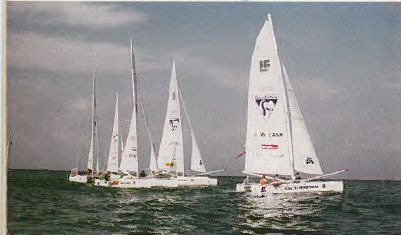
Centuries ago, Phoenicians set sail from these shores
for destinations as far away as the Atlantic coast of
Africa or even, some speculate, America. Today,
despite formidable obstacles, a small group of Lebanese
sailors are struggling to keep this sea-faring tradition alive.

Just four years ago, the Lebanese Yachting Federation was
reestablished after a long absence during the war. Its first
mission was to select athletes to represent Lebanon at the Pan
Arab Games, held in Lebanon in 1997. With a $50,000 grant
secured from the ministry of youth and sports, the federation
was able to buy 12 laserboats and 12 international class
mistrals (sailboards).

The Lebanese team’s performance was hardly noteworthy,
but the event marked the rebirth of competitive sailing in
Lebanon. Today, a small but proud group of passionate enthusiasts
is taking to the water in search of that elusive feeling of
freedom that can only be found on the sea.

“You must always have a strategy and expect the unexpected,”
says Eddy Nehme of Laser sailing. “You have to use your
head and angle the boat to get the most from the wind and the
water. It’s fun – the sensation of contact with water and wind.”

Besides selecting teams to compete in international competitions,
the federation organizes a regular program of about
12 regattas every year. But in its drive to advance the sport, the
federation has encountered a number of obstacles.

The federation only owns the boats it purchased for the Pan
Arab Games and one Optimist boat, donated by the Kuwaiti
sailing team. Since the federation’s boats are strictly reserved for competitions, sailors must rely on sailing
clubs to provide them with boats they need for
training. But there is only a limited number of
clubs in Lebanon and most do not have sufficient
funds to buy new boats, which cost
from $2,000 for a Mistral up to $5,000 for a
Laser. This means that only a limited number
of people can participate in the sport. “We
need new clubs,” says Joe Salame, a sailing
buff and owner of Windriders, the exclusive
distributor of Dart and Laser boats.

But huge barriers faced Salame when he
tried to set up a club. First he had to sign an
official contract with the owner of a beach
property. But the properties had to be legally
owned, which is rarely the case in
Lebanon. At the same time, the law prevents
the legitimate owners of beach properties
from subletting. “If they give a concession,
they will lose theirs,” says Salame.

The more popular clubs are private and usually
charge steep annual membership or entry
fees. “We need affordable access to the sea, so
that people can learn to sail,” says Salame.

At the same time, a lack of funds and little
sponsorship means that members of the federation
must donate money in order to keep
activities going.

“The annual budget should be $100,000 to
have a proper and professional federation,”
says Nehme. The actual budget is between
$5,000 and $10,000.

With such modest financing, there’s little
hope of finding a Lebanese sailing team at the
Olympics anytime soon.

There is some local talent around, but no
funds to nurture it. “We don’t have the budget
to qualify for the Olympics,” says Nehme,
adding that it would cost between $20,000 to
$25,000 annually to prepare just one athlete
for the Olympics

March 22, 2000 0 comments
0 FacebookTwitterPinterestEmail
Executive Living

Craving sushi

by Executive Contributor March 22, 2000
written by Executive Contributor

The Lebanese palate may be softening. Not long
ago, if you wanted something raw, kiba nai, raw
lamb meat, was the meal of choice. Now the subtler
Japanese dish of sushi – raw fish – is all the rage. Its chic,
healthy and very exotic. But if you’re thinking of heading
out tonight to one of the multitude of sushi bars that have
opened recently, think again. Reservations often have to be
made days in advance.

“There are a lot of people who want to discover sushi,” says
Fawzi Ghantous, manager of the stylish new restaurant So.

Sushi comes in three varieties: sashimi, slices of plain raw fish;
sushi, slices of raw fish atop small rice patties; and maki, which
can be prepared in a variety of ways but is generally small
pieces of fish or vegetables rolled in rice and held together with
dried seaweed. Maki is by far the most popular dish in
Lebanon. A particular favorite is the California maki, an Americanized
sushi creation made out of processed crabmeat, avocado
and cucumber, rolled up in a rice and mayonnaise mix,
and then sprinkled with sesame seeds.

Part of sushi’s allure is the way that it is eaten. It is always presented with a serving of wasabi (spicy Japanese
horseradish), a bottle of soy sauce and marinated ginger. The
use of chopsticks is encouraged. First, pour some soy sauce
into the small dish provided. With chopsticks, take a bit of
wasabi and stir it into the soy sauce. Place a sliver of ginger
onto the sushi, dip it into the soy sauce and eat.

Saki, Japanese rice wine, is the usual accompaniment for
sushi. It is best sipped hot and is always served in small
ceramic bottles. Saki usually comes in two sizes. The single
is usually priced at about LL10,000 while the double is
about LL16,000. Beer lovers might want to sample the
Japanese brands Sapporo or Kirin, which can be found at
most restaurants for about LL6,900 per bottle.

Like almost everything that is chic, sushi does not come
cheap. Prices vary according to the weight and type of fish
used. Maki is less than half the price of sushi. A serving made
from tuna, crab or salmon is priced at around LL1,500. The
price more than doubles if it is made with eel or salmon roe.

At So, patrons sitting at the ‘sushi bar’ can treat themselves
to an array of dishes that pass before them on a revolving con-
veyor belt. Each dish is priced at LL4,500. Still, the countless
types of sushi listed on menus can prove tricky for novices.

But pre-set platters are always popular. At So, a 16-piece platter
costs LL32,000 while Le Sushi Bar offers a 24-piece platter
for LL35,000. Nippon Maru offers a 26-piece platter for
LL40,000 and an ultra-exotic 46-piece platter, made with imported Japanese fish, for LL95,000. Tokyo restaurant’s ‘Tokyo Set’ includes
eight pieces of sushi and cucumber maki for
LL38,000 and comes with miso soup and
pickled cabbage salad. Benihana has set
business lunches at LL37,500.

March 22, 2000 0 comments
0 FacebookTwitterPinterestEmail
Executive Living

Adventures in globe trotting

by Natacha Tohme March 22, 2000
written by Natacha Tohme

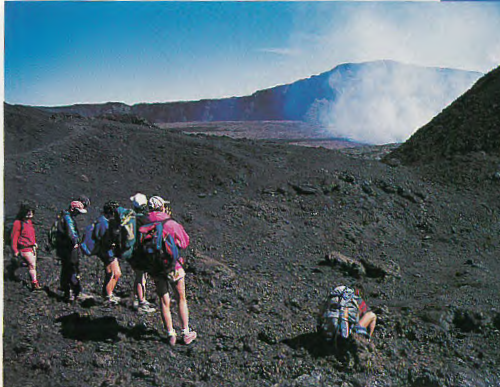
Ever fantasized about going
on a safari in Tanzania?
How about horseback riding
across the Atlas Mountain range in
Morocco? You may be able to make
your dreams come true.

Sports Evasion, the exclusive agent
for a French government-funded
organization called UCPA (union of
centers for outdoors sports activities),
is organizing some exotic
excursions to far-off destinations.

“If you like hiking, and you’d like to
visit Nepal, you can go hiking in
Nepal. It’s a different way to discover
a country. It’s sports tourism,” says Eva
Aouad, manager of Sports Evasion.

Every year more than 250,000 people
and 350 school groups partake in
UCPA tours. The excursions, says
Bassam Turk, owner of Sports Evasion,
are priced affordably for
young people. They allow individuals
to express their personality
through sports and experience living in multi-cultural communities. “It’s a very social goal – it’s
very French,” says Turk.

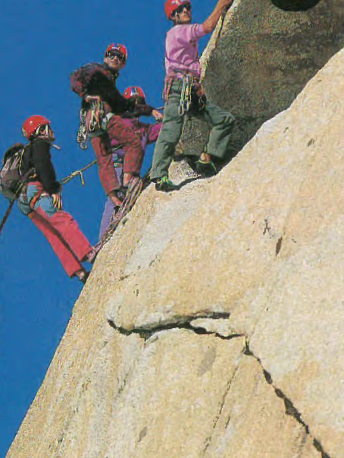
UCPA publishes two catalogues annually, each offering
about 5,000 different tours. More than 60 outdoor activities
in over 40 countries are available.

Clients can pick itineraries that best suit their level of expertise.
Multi-sport programs, such as mountain biking, hiking,
kayaking and windsurfing, are also available. Turkey, Crete,
and the Canary Islands are popular destinations for these
activities. Packages include airline tickets, accommodation,
three meals a day, sporting equipment and insurance. Prices
range from $650 for a one-week excursion to nearby
Greece, Crete or Turkey, all the way up to $3,500 for a 21-
day hiking trip in Peru.

Since Sports Evasion opened in November 1998, it has
booked 150 UCPA trips. Last summer business was bad
because of the earthquakes in Turkey and Greece, the two
most popular summer destinations for the Lebanese. But it
has picked up since winter, with organized ski trips to such
exotic European resorts as Chamonix Aiguilles, Les Deux
Alpes Venosc proving very popular.

Turk and Aouad opened Sports Evasion to offer the
Lebanese UCPA’s diverse selection of tours. But now the two
are on a related mission to give people living in foreign countries
the chance to explore Lebanon. “Our main aim is to
make Lebanon a destination in the 2001 summer catalogue,”
says Aouad. UCPA is keen to offer a 12-day trek
through the mountains. Hikers would start in the Chouf,
move to Tannourine, and finish their adventure in the
North. Eventually, the company hopes to add rafting along
the Awali River to the program.

“We have a very good rafting season, especially when there
is a lot of snow,” says Turk. Meanwhile he has been trying
to raise the profile of his new travel company. Last month,
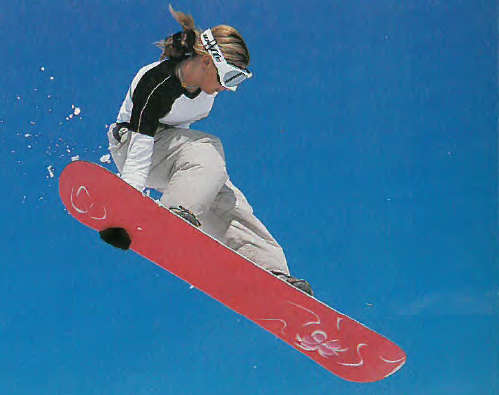
Sports Evasion organized the Lipton Snowblast, an aerobatics
ski and snowboard show in Faraya. The event
attracted 18 foreign athletes and will be broadcast on European
sports channels and LBC.

“It gives us exposure and people get to know what kind of
notoriety we have,” says Turk.

The company also distributes leaflets at popular health
clubs and at Crepaway restaurants as well as providing information
by direct mail. Turk also believes that most people hear about Sports Evasion by word of mouth.

While Sports Evasion receives a commission
from the UCPA for the business it generates, the
company has been looking for additional ways to
generate revenue.

“It takes about two years to be on the right track and
at least five years to have a healthy sales volume,
that’s why we created our other products,” says Turk.

Besides UCPA tours, the company offers trips to
international sporting events, such as Formula 1 racing
and Wimbledon.

It is also diversifying into other
areas, such as tours for senior citizens
and Christian pilgrimages.

But whatever the challenges,
Turk remains very enthusiastic
about the potential of sports
tourism in this country.

“It’s a new product,” he says
enthusiastically, “and there’s not
much competition yet.”

21 days in Nepal

Suha Naimy, a young geography teacher,
dreamed of trekking in the Himalayas.
She spent nearly a year inquiring at
countless local travel agencies, but to no
avail. Finally, she discovered Sports Evasion,
which booked her on a UCPA (union
of centers for outdoors sports activities) trip
to Nepal. When Naimy arrived in Katmandu,
she met up with 13 other adventurers
from France. “I was the only person
from Lebanon,” she says.

Led by two guides – one Swiss and the
other Nepalese – the group spent 11
days in the Himalayas, camping, trekking,
and rafting.

“I still remember the feeling – it’s fresh in
me and gives me energy,” she says.

The expedition gave her the chance to
mingle with people from different cultures
and the group still keeps in contact
via e-mail. Besides the trekking, Naimy
spent a week sightseeing in Katmandu.

The 21-days trip cost $1,700, including
airfare, the all-inclusive UCPA tour, and a
two-night stay in a hotel. “I couldn’t
believe it – I was expecting something
like $3,000,” she says. Naimy is already
planning another adventure. “I want to
go on a safari in Kenya and trek and
camp in Kilimanjaro,” she says.

Free riding in France

A lawyer by profession, Karim Eid is passionate about skiing. He
has twice gone on UCPA skiing trips to the French resorts of Argentiere
and Val d’Isere. But Eid prefers the more daring form of skiing
called free riding in which skiers challenge uncharted and often
dangerous slopes. Free riders climb to areas where chair lifts don’t
go in search of powdery slopes with 40 to 60 degree inclines. “You
have to walk a lot,” says Eid. “But it’s a great sensation skiing on
that snow.” Because of the risks involved in free riding, expert
guides accompany the groups and skiers are equipped with safety gear in case of emergencies. “The
trips I like to go on are specialties, so
they are more expensive,” says Eid. But
at $1,150 each, the one-week all-
inclusive
packages are reasonably
priced. “Everything was included – the
airline ticket, equipment, hotel accommodation,
meals. If I did these trips independent of UCPA, it would
cost four to five times more.” Both trips gave Eid the chance to
meet other free riding zealots, and he enjoyed it so much that he
is heading for the slopes again next month.

March 22, 2000 0 comments
0 FacebookTwitterPinterestEmail
Tech Knowledge

Techwire ; In windows we trust

by Executive Contributor March 22, 2000
written by Executive Contributor

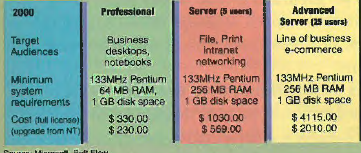
Microsoft’s much-awaited Windows
2000 has finally made its worldwide
launch. The new product comes in
three packages, Professional, Server, and
Advanced Server (see table). The new
operating system is an upgrade to
Windows NT rather than to Windows 98,
and is therefore designed to target businesses
rather than home users. Still,
Windows 2000 incorporates the features of
Windows 98 to make for an easier-to-use
platform. What’s the best thing about the
new version? “Its reliability in running
with multiple users and multiple applications,”
says Charbel Fakhoury, Microsoft
Lebanon’s business development manager.

Windows 98 users suffered from crashes
because individuals would run several different
programs, including games, says
Fakhoury. But Windows 2000 is designed
for a business environment, which eliminates
this problem.

Gartner Group predicts that 15 to 20% of
Windows 98 commercial users will be
upgraded to Windows 2000 Professional by
the end of this year, increasing to 40 to
45% by the end of 2001. Only 3 to 6% of
Windows NT users are expected to
upgrade to Windows 2000 by year-end,
while 45 to 50% are expected to have done
so by the end of 2001.

On a scale from one to ten, Majed Al-
Saadi,
a Microsoft certified systems engineer,
gives Windows 2000 an eight. He considers the new program very easy to use,
especially with the integration of Plug and
Play from Windows 98, and is impressed by
its high level of handling security. Saadi said
that the only reason he did not give
Windows 2000 a ten was because of its
steep price and because it requires users to
be re-trained. According to Saadi, the total
cost to upgrade is $1000 per user, which
includes cost of ownership, installation,
hardware upgrades, and training. “Home
users will not benefit very much from the
features of Windows 2000 because it is
designed for a network environment,” says
Saadi. “It’s slower than Windows 98 and
Millennium.” Home users should wait for
Windows Millennium, due out next year.

Internet service provider Sodetel has cut
prices and is offering new prepaid cards
in an aggressive push to attract dial-up
customers. The new cards cost $15 and
allow users to sign up for free using the
website. Clients get a choice of unlimited
access for $15 per month or “pay and
stay”, at $2 per hour. Previously, the company’s
rate for unlimited off-peak hours was
$20 per month, one of the highest in the
industry. The company earns most of its
revenues from corporate customers,
according to Louis Hobeika, Sodetel
chairman. “We’re looking at the consumer
market,” he says. “We’re under-utilizing
our network now. I think we can easily
double our clients.”

The company has issued 2000 cards so
far. They are available at 66 points of sale
throughout the country. The ISP has also
added a new design for its website. Some
within the industry expect that tough competition
will cut the number of ISPs from 15 to five by the end of the year. Sodetel
clearly plans to be one of the survivors.

Slow connection, fast download

TerraNet has reorganized and reduced the
graphics on its web site in order to
speed up download times and facilitate easier
access. The main page is now plain and
dominated by text. “All the inside pages can
now be accessed directly from the main
page,” says Fadi Ghazzaoui, the company’s
marketing manager. The webmaster has
instructions to not exceed 43kb for the file
size, down from 100kb. Downloading
should not take more than 20 seconds at
33000bps, or 46 seconds at 24000bps. Two
new sections were also added: Jokes and
Sports. The website is more user-friendly,
but those used to the old look will miss the section icons at the top.

New ISP on the block

A new company is preparing to enter
the already heavily saturated market
for Internet service providers. Diginet, an
ISP that was founded last summer but has not
yet gone into operation, recently started
advertising one-month free Internet access
in a bid to lure customers. The new company
will probably start offering services next
month, according to Ghassan Khazen,
operations manager for Diginet. The company,
formerly owned by Ghassan Mahdi,
was bought out in December by the US-based
Eagle InterCommunications.

“Diginet is now 100% owned by
EagleCom,” says Khazen, who claims the
company currently has 300 lines and an E1
(2 Mb) broadband to Cyprus with a direct
fiber optic connection to the US. The ISP will
donate 5% of its profits to research institutions
for the development of prosthetics.

According to Khazen, Diginet plans to
expand its customer base by acquiring
small local ISPs. The arrival of EagleCom
coincides with the acquisition of Lynx by
PSINet, another US-based company.

March 22, 2000 0 comments
0 FacebookTwitterPinterestEmail
Tech Knowledge

The next wave.com

by Mira Baz March 22, 2000
written by Mira Baz

Ego and tradition have tended to
dominate Lebanon’s business circles.
Losing control of the family
fiefdom is viewed as one of the worst
nightmares, regardless of whether that
might involve a sound business decision.
But this is the new generation and
Lebanon’s Internet service providers are
among those at the forefront.

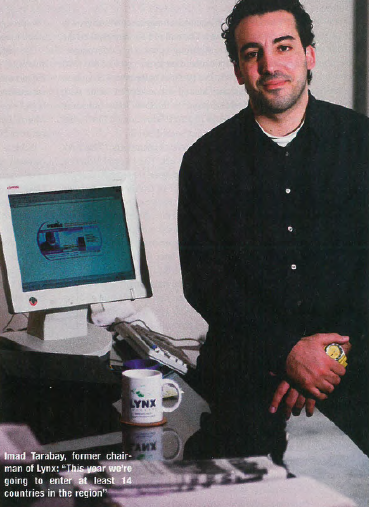
Imad Tarabay, the 27-year-old chairman
of Lynx, received an offer he couldn’t
refuse and wouldn’t disclose from
PSINet, a US-based multinational Internet
company with revenues of $555 million
last year. It was a tough choice: either roll
up the drawbridge and face a competitive
local market alone, or give up the reigns reins to
an international heavy**-**weight. Tarabay,
now vice-president of sales and marketing
for PSINet Middle East and Africa, decided
to sell at the end of December. And as
competition increases and prices drop,
more of Lebanon’s ISPs are having to face
the bitter reality that they cannot stay afloat
without financial backing.

But what on earth would attract a multinational
to a market of not more than
100,000 Internet users, less than 0.05% of
worldwide surfers?

The target is not just the local market.
Now, Tarabay is standing tall among local
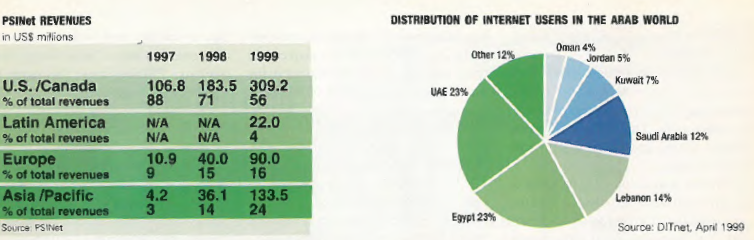
competitors and is readying the company for an aggressive push into the Middle East, a
region with an estimated 1 million Internet
users (see chart). “This year we’re going to
enter at least 14 countries in the region,”
says Tarabay. The buy-out of Lynx is part of
PSINet’s strategy to expand internationally
by acquiring existing ISPs rather than
establishing new ones from scratch. In
1999, the company acquired 43 ISPs
worldwide, including the purchase of
seven in Latin America (see box).

According to Tarabay, PSINet was
attracted to Lynx’s fiber-optic network.
Though ISPs are generally reluctant to
reveal the arrangement of their network’s
structure, the majority have routes through Cyprus or the UK. Lynx, the self-proclaimed
fifth largest local ISP with over
4,000 subscribers, claims to be the only
one with a direct fiber optic connection to the
US, avoiding any nodes or intermediary
connections. This minimizes the number of
errors and error-corrections during transmission.
Lynx still had to go through the
MPT. “I spent six months working on it,”
says Tarabay.

The regulatory environment could create
obstacles to further expansion into some
countries in the region. Egypt, where there
are about 55 ISPs, Jordan and Saudi Arabia
offer attractive markets for acquisitions.
Others, like the UAE, where one company
monopolizes the Internet, are off-limits. In
Lebanon, ISPs are at the mercy of the ministry
of post and telecommunications
(MPT), which has the sole power to grant
companies the bandwidth they require.

But whatever the hurdles now, the company’s
strategy is long-term. Many multinational
companies go into markets prematurely
in order to gain a head-start on competitors.
Ericsson, the Swedish mobile phone manufacturer,
recently opened a regional office
here. Sony, Japan’s leading electronics giant,
opened its Lebanon office two years ago.
Both are the first in their industries to enter the
local market, before the environment
becomes attractive to competitors.

“Privatization is being echoed in Lebanon
and international research firms contracted for
studies,” says Sam Lutfallah, executive
director of Inconet. “They are lured by this.”
And what better way to get into a market
than by linking up with a local firm. It was
Lynx that originally approached PSINet in
July with an offer to form a joint venture.
Tarabay, who had established Lynx with his
partner Raed Rayess only three months earlier with a $300,000 initial investment,
wanted to expand into the region and needed
a financial backer. “We had a lot of contacts
in the area, but we needed technical
and financial assistance,” he says. “Any
country you want to go into requires an
investment of $1-2 million to start up.”
Negotiations proceeded till November,
when PSINet suddenly handed Tarabay its
offer to buy.

But the new entity will not recreate the
Internet. The company has the same dial-up
and e-commerce services offered by other
ISPs. A number of services that PSINet
provides elsewhere, such as ISDN and
VoiceOver IP, cannot be offered here for the
moment because of the monopoly of the
MPT. “They are offering nothing that
[other ISPs] here don’t have,” says Abude
Omari, CEO of Cyberia. Since it’s a carrier
as well, PSINet/Lynx will be able to sell international links out of Lebanon to other
ISPs, once the MPT relinquishes its monopoly.

Lynx can take advantage of the financial
and technical boost in order to improve
services. Tarabay plans to upgrade the
amount of bandwidth in order to increase the
speed and capacity of connections.

Although the company may have the
financial weight to cut rates, don’t expect
any new price wars on dial-up. Already,
Lynx has some of the highest rates on the
market, ranging from $14.99 for unlimited
access ($9.99 for students) up to $29.99 for
unlimited corporate accounts. Tarabay
says that there are no plans to reduce these
rates any time soon. “Cutting prices was
never our strategy,” he says. “We’re going
to maintain our prices because we believe
that if you want quality you have to pay a
higher price.” Nor is the competition worried.
“This move will not affect prices,”
insists Fadi Ghazzaoui, marketing manager
for TerraNet.

With dial-up prices unprofitably low,
Lynx is focusing on the corporate market,
where it can offer a greater array of services
at higher rates. That will pit it against
Inconet, the self-proclaimed leader in corporate accounts.

PSINet’s acquisition of Lynx came as
no surprise to others in the sector. “The natural
trend is toward consolidation,” says
Bahjat el-Darwiche, IntraCom’s managing
director. “If ISPs are not backed up
financially in some way, they will not
last,” says Tarabay.

The prospect of international firms entering
the market did not seem likely last
September. Sitting in his office in Hamra,
Omari was skeptical. “Why would [a
multinational] want to operate this small
Internet service in a market of 60,000
users, when they add close to a million
users per quarter?” he told EXECUTIVE at the
time. But now he thinks differently:
“International players who bring in money
and expertise show that the market is interesting.”

Louis Hobeika, chairman of
Sodetel, welcomes the healthy dose of foreign investment that the entrance of companies
like PSINet into the market will
bring. ISPs are having trouble surviving
with rates so low, and most of the major ones say that they would welcome some sort
of partnership with a large foreign firm
(see box). PSINet’s move just might be
what’s needed to get the ball rolling.

Top of Form

PSINet’s expanding by buying out ISPs worldwide

Internet carrier PSI Net was the first company to commercialize the Internet in 1989.
CEO William Schrader was one of the founders of NYSERNet in 1985, the first network
to link university, government, and corporate supercomputers in New York.

He realized the potential of the Internet when corporate clients started approaching
NYSERNet. Being a non-profit organization, the company subsidized PSI Net
to sell Internet services.

Acquisitions in the third quarter ended September 30, 1999:

  • Transaction Network Services (TNS): provider of eCommerce data communications
    processing. Revenue in the third quarter 1999 was $46.1 million, net profit
    $5.5 million. Sold for: $720 million in cash and stock.
  • In the US/Canada: Two ISPs, Internet Network Technologies (US) and TotalNet
    (Canada). Add 100 business accounts.
  • In Europe: Seven ISPs in Spain, Austria, Hungary, and Italy. Add over 1,200 business
    accounts.
  • In Asia Pacific: Two ISPs in Hong Kong, Global Link and Vision Network Online.
    Add 500 business accounts.
  • In Latin America: Seven ISPs in Panama, Brazil, Argentina, and Chile. Add over
    500 business accounts.

Would you sell? Here’s what the ISPs replied

Word has it that America Online
Inc. (AOL) has its eyes set on the
local market, though it seems that the
rumor’s been running for a while now.
EXECUTIVE also found out from several
sources that the French ISP Wanadoo
(www.wanadoo.fr), associated with
France Telecom, is in talks with Gellis.

This is the next big thing now.

Most ISPs refer to “partnerships”
rather than mergers and acquisitions.
The sector should witness a number of
joint ventures in the near future. Here’s
what the main players had to say.

CYBERIA: “We have no incentive at
this stage to sell. We might partner up,”
says CEO Abude Omari. Cyberia is privately
financed and will continue to be so.

INCONET. “We welcome a joint venture,”
answers executive director Sam Lutfallah, “but one in which we have a controlling
interest. We would not release our
shares.” But, he adds, if the offer were
good, the company would be open to a
buy-out. Inconet is under the umbrella of
GlobalCom, a holding company half
owned by Audi Investment Group.

SODETEL. Louis Hobeika said that he
is open to a partnership. Telecom Italia
and France Telecom together own 50%
of Sodetel.

TERRANET. Marketing manager Fadi
Ghazzaoui claims talks are underway “in
Europe and Arab countries for a partnership.
Acquisitions are not healthy,
because they would allow an [international]
firm to take control of the local
market.” TerraNet is a sister company to
LibanCell. Nizar Mohsen Dalloul is a
major shareholder in both companies.

Bottom of Form

Bottom of Form

Hack Attack: the World Wide Worry

Accessing someone’s server can be surprisingly easy.

Luckily the “art of hacking” is still rudimentary in Lebanon

Hack attacks are all the news almost monthly now.
International news, that is. Think you’re safe from similar
attacks because your Internet service provider certifies
it, because you have a firewall, or because there are no hackers
locally? Think again. “Hacking, like AIDS, is thought to happen
to other people,” says MajorD0m0. “But it can happen anytime,
anywhere, to anybody. It’s simple, and I can prove it.” So EXECUTIVE took him up on his word.

MajorD0m0 is a 20-something ethical
hacker, a rare breed whose reputation has
been soiled over the last decade by Internet
vandals and egotistical teenagers. In fact,
MajorD0m0 is a hacker in the original sense of
the word, which used to describe an amateur with a thirst for knowledge about computer technology without the
malicious intent. Web-wise, MajorD0m0‘s hacking expertise is the
result of years of surfing and learning.

“Name your website,” smiles MajorD0m0. He makes hacking look
easy, to the extent that one forgets its implications. He uses point-
and-click software, and types in just a few commands. The tools are
at his fingertips on the PC. Each is a downloadable program rarely
larger than 50kb and thus takes minutes to install and use.

They are just a few clicks away on the Web. Port scanners detect
types of networks, servers and ports that give leeway to hackers.
A trojan horse is a program embedded in email attachments that
can be secretly sent to users, allowing hackers to take control of
the remote computer. Mail bombers send thousands of junk
emails to an address, blocking or slowing down access to
emails. Password crackers are programs that can crack a user’s
password. The list goes on.

He thinks up a few local dot-coms, considering the rush to e-commerce
and everybody feeling hip about being online. Scanning a
server, MajorD0m0 detects which ports are “open.” Any information
a port provides gives the hacker more to work with. Most
ports are susceptible to some form of attack, be it access to files
or databases. He clicks, types in the website’s IP address, and up
comes the message: “start scan … ports 0 to 1000.” Seconds later
a list of ports follows. “Eureka,” he exclaims.

Each of the seven websites he tried, owned by major local
companies, had at least eight ports exposed, most commonly the
file transfer and mail ports. Secured sites wouldn’t allow scanners
to detect any of their ports. Their security system would trace the
intruder’s IP address and block access from it. MajorD0m0
demonstrates with two secured websites, where the scan message
appears but returns no information. This is one step short of
actually breaking in. But that’s as far as MajorD0m0 will go.

Hacking in Lebanon is still amateur, MajorD0m0 confirms. It’s
usually done upon a dare. The hacker uses software to crack a
friend’s email password, or take control of their desktop, turning
it into a zombie, shutting down Windows and performing tasks remotely from their own
computer, all for a laugh.

Locally, the Internet’s
limited speed (up to
36kb/s) and the lack of
permanent connections
to the Web pose difficulties
to any serious hacking
activity.

But that should not be
comforting. The threat is
global, and proficient
hackers worldwide can
attack. There is little
awareness of security in
the Middle East as a
whole and in Lebanon
particularly. Hackers
from Brazil recently
vandalized several websites in the UAE and Saudi Arabia. Vandals usually post a message
mocking the webmaster or the institution, send greetings to their
buddies and boast about their skills. After such attacks, the
servers have to be shut down and scanned, since it’s not easy to
identify exactly what the hacker did.

This is not to imply, however, that anyone can or should attempt
hacking. In fact, amateurs lacking programming and Internet
knowledge could put themselves in danger of being traced and
caught. A hacker doesn’t always go it alone, since collaboration
and speed are needed to “get in and get out” safely. MajorD0m0
points out that hackers work in pairs or groups. While one gains
access to the server and proceeds to vandalize it, the other erases
any “traces” left behind.

Did MajorD0m0 hack into any websites? No. Reading up on hacking
remains his hobby, and besides, he has better things to do. We might
be better off taking his word for it. After all, never dare a hacker.

March 22, 2000 0 comments
0 FacebookTwitterPinterestEmail
Money Matters

Greenspan: Serving more screwdrivers

by Peter willems March 22, 2000
written by Peter willems

The US is experiencing its longest economic growth
period in history. The end of February marked the
107th month of strong economic performance,
surpassing its previous record set in the colorful 60s (106
months between 1961 and 1969). A bull run on US equities

  • with the occasional hiccup – has kept in stride with
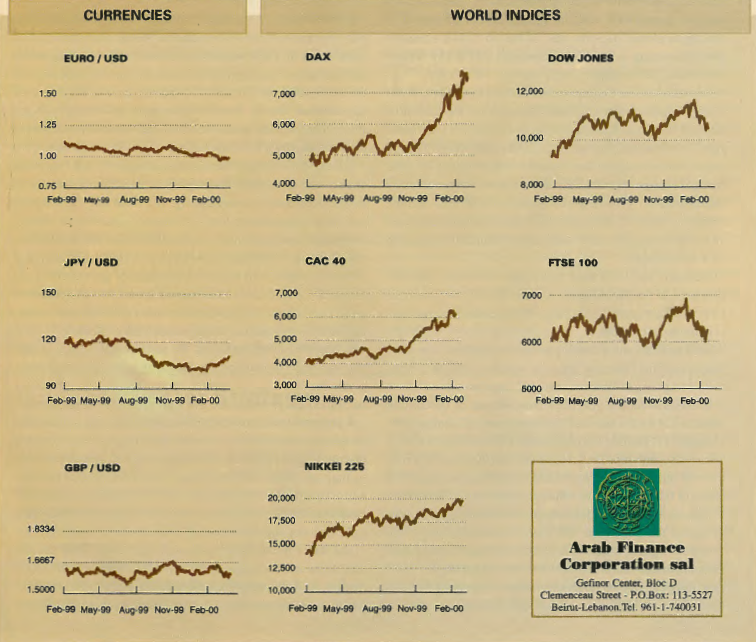
    growth. Over the last five years, the Dow Jones Industrial
    Average (DJIA) rose 197%, S&P 500 climbed 219%, and
    the Nasdaq composite index soared 907%.

Rejoice, celebrate, open a bottle of champagne? That’s not
what is happening on Wall Street. The Federal Reserve,
headed by chairman Alan Greenspan, is worried that the
American dream is on the verge of overheating (average
GDP growth rate over the last three years was 4.8%), with
the threat of inflation just around the corner. Since June last
year, the FED has raised the federal funds rate by a quarter
percentage point four times (three times for the discount
rate). Its objectives are clear: To keep inflation from getting
out of hand, the FED wants to strike first by curbing robust
consumption, slowing down the economy.

A slew of indicators show that there’s potential for overheating.
Greenspan is keeping his eye on the tight labor market.
In January non-farm payrolls increased more than
expected – by 387,000 – the largest jump in two years. That
pushed unemployment down from 4.1% to 4%, the lowest
level in 30 years. This could lead to wage and compensation
increases that would pass on to prices covering costs,
and there are signs that upward pressure on prices might
come soon. In the fourth quarter of 1999, the employment
cost index (wages, salaries and benefits) rose 1.1%, above
the expected 0.8% increase, followed
by a wage increase of
$.06 per hour in January.

Another concern for
Greenspan is the stock market
pumping money into consumers’
pockets which lifts consumer
spending. In 1989, 28% of
household financial assets were
linked to stocks. That now
stands at 54%, and Greenspan
believes that about a quarter of
the GDP growth rate is derived
from wealth coming from stock
gains. This gives Greenspan a two-pronged attack: slow
down the economy and/or get the
stock market to take a breather.

Greenspan’s intention of controlling inflation has sent
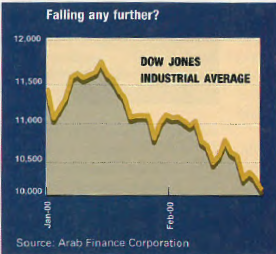
shimmers through some markets. So far this year, the DJIA
fell more than 11%. And to make matters worse, hikes in interest
rates are expected to continue this year. “The chances are
high,” says Douglas Wilde, a global investment strategist at
Merrill Lynch. “We will probably see interest rates go up
between 50 to 75 basis points by the end of the year.”

If this is the case, should investors expect the markets to
respond negatively, fueling a correction, or something
even worse? According to Gary Shilling, president of A.
Gary Shilling & Co, economic consultants and investment
advisers, there will be a correction or even a crash coming
from the sting of rising interest rates. But it appears that
there have been two markets going on recently. While
many stocks have already been hit, technology stocks
have been immune; they have pushed Nasdaq up over 8%
so far this year. Shilling believes that technology stocks,
which are seen as extremely overvalued (many companies
trade more than 100 times projected earnings in 2000, if they
have any), will eventually be affected with the rest of the
stocks and prices will plummet.

Wilde, on the other hand, believes Greenspan will be cautious,
moving rates no more than a quarter point each
time, knowing that markets are sensitive to his actions. The
chairman has a history of taming economic growth with a
soft landing. And some figures are working against the indicators
that are screaming danger. In the third quarter of 1999,
the consumer price index climbed 4.2%. But in the fourth
quarter, it increased by 2.2%, followed
by a less-than-expected
0.2% rise in January.

But Greenspan still appears to be
on the hunt. In his last semiannual
economic presentation to
Congress in mid-February, he
made it very clear that he would
continue raising interest rates
until consumer spending retreats
and the stock market calms
down. Tightening the screws is a
sure bet. But if and when it hits the
breaking point, sending all stocks
south, is anybody’s guess.

March 22, 2000 0 comments
0 FacebookTwitterPinterestEmail
Money Matters

The Global Strategist Fund Manager Survey:

by Trevor Greetham & Plum Shipton March 22, 2000
written by Trevor Greetham & Plum Shipton

Global economic optimism may have lost its upward
momentum according to our February Fund Manager Survey.
The inversion in the US yield curve could be taken as a sign
that Fed rate hikes are biting and the US economy is slowing.
If this were so, it could be time to cut cash and go overweight
bonds. A peak in the global manufacturing cycle would once
more align structural and cyclical forces in favor of disinflation.

Two risks keep us on the sidelines. First, the oil price could be
allowed to spike higher if OPEC think a high oil price poses no
threat to the global “e-conomy”. Fund managers do not expect
the oil price to stay at $30, but our global oils team are warning
of $45 if production is not increased. Secondly, and more
fundamentally, there is little evidence that the US economy is
slowing beyond the technical rally in bonds. Most fund managers
think the peak in Fed Funds is a couple of hikes away. We
are not so sure. We remain overweight cash in our UK benchmarked
global mixed fund.

Growth at any price?

We have used our Global Sector “Wheel of Fortune”
model to explain the fund manager love affair with TMT
(Tech, Media and Telecoms). These stocks are the New Era’s
cyclicals, or Growth Cyclicals. Cross-checking fund manager
preferences for Growth stocks with their preferences for
Cyclicals seems to bear us out. Japanese fund managers are most taken with TMT whereas US managers are the only ones
leaning towards Growth Defensives such as Pharmaceuticals.

Growth investors could be caught out in 2000 if the global
economy stays strong and commodity prices surge as they did
in 1994. When pricing power becomes widespread, investors
refuse to pay a large premium for long-term growth. Value
stocks tend to outperform by a wide margin.

When to switch back into the UK?

The UK equity market has underperformed Europe significantly
in the last couple of months. UK earnings
forecasts have not been downgraded. UK equities have been
de-rated by around 25% relative to Europe to reflect the fact
that fund managers expect the UK to slow while they expect
Europe to remain strong.

This period of UK underperformance could end in one of two
ways. UK economic optimism could recover as fund managers
factor in a peak in base rates and a soft landing in the economy.
Or European economic optimism could fall as the Eurozone
economy responds to more aggressive ECB rate hikes.

We expect a UK soft landing to precede any European slowdown.
But judging by Eddie George’s hawkish tone it could
still be a little early to switch back into the UK. There may be
one or two rate hikes left.

European Sector Strategy

• Extremes exist within the European equity market,
even to a greater extent than on a global basis.

• The TMT (Technology/Media/Telecoms) sector
generally has poor value, but newsflow and sentiment
are driving the sector higher.

• Differentiate within TMT – overweight IT Hardware/
Electronics, underweight Media.

• Hedge selected TMT with some value –
overweight Oils & Banks.

Extremes clearly exist within the European equity market,
where valuations are becoming somewhat meaningless.
Fear of underperforming benchmarks in the
institutional world at a time when consolidation is causing
some weighting nightmares, combined with a rush of liquidity
from the retail market into a relatively scarce space are just some
of the factors encouraging these extreme sector divergences. We
are painfully aware that trying to predict the “bursting of the bubble”
is difficult, and in any case, these sector divergences could
continue for longer than anyone anticipates.

The divergences between sector performances and valuations
are even more extreme in Europe than in the US. European TMT
trades on over 60x 2000 forecasted earnings (I/B/E/S), compared
to the US TMT constituents of the S&P, which trade in aggregate
on just over 40x, yet both groups have similar growth prospects.
And whilst 29% of the US TMT stocks have actually declined over
the past three months, this has only occurred to 12% of European
TMT stocks.

The driving forces of these extreme positions are partly global,
partly European, and are illustrated below.

• The long-term growth of the market is estimated by analysts
to be 10%, while the long-term growth rates for the IT Hardware,
Software, Media and Telecoms sector are 26%, 21%,
12% and 15% respectively and are on a rising trend.

• Penetration rates in Europe are much lower than those in the
US allowing room for catch-up.

• Consolidation is still driving the TMT sector. 1999 saw
record M&A activity where 32% of all global M&A
involved a European target, up from 23% in 1998. And this
year has started well, with the Vodafone/Mannesmann deal
beating all global M&A records. Of the top 50 M&A deals in
1999 involving a European company, 42% (by value)
involved a TMT company, up from only 3% in 1998.

• According to our Gallup survey of fund managers, Technology/
Media/Electronics and Telecoms are the four most
favored sectors in Europe and this has been the case since
April 1999 when pharmaceuticals dropped from its high
perch. And not only do they remain favored sectors, but over
the past three months, fund managers have actually
increased their preference for each of these four sectors.
Research in the UK shows that the Gallup survey is best used
as a confirming indicator rather than a contrarian indicator
on a sector basis.

• Although we don’t have ownership details yet for Pan
Europe, UK fund managers are currently only 94% weighted
in TMT and post the Vodafone/Mannesmann merger this
is likely to fall to 86%.

• News stories abound fuelling investor sentiment. Screening
Reuters and the Financial Times for stories involving companies
announcing an “Internet strategy”, there have already been
160 stories so far this year (an annualized rate of 1840) compared
to 324 for the whole of 1999 and merely 27 during 1998.

• Liquidity is pouring into the markets. Borrowing in the US
to buy securities rose at an annualized rate of over 400% over
the past quarter, which accounted for 25% of the growth in
total US bank lending. In addition, according to Trim Tabs,
US margin debt as a percentage of market cap has now
exceeded the September 1987 previous record of 1.38%.

These are signs of excess in financial markets. Although similar
comparable data is not available for Europe, we also know
that European mutual funds saw inflows into equity funds in
Q4 1999 of $40 billion – a record quarterly inflow.

• Scarcity of tech stocks is a relevant factor for European
investors. Although TMT now accounts for 32% of European
market cap (up from 18% 12 months ago), this still lags the
US where the TMT weighting is 42%. The European/US
divergence is clearly much greater in the Internet space
alone, where the European Internet sector’s market cap is
around $140 billion (up from only $17 billion at end September)
compared to close to $1 trillion in the US.

We compared European sectors with their US and Japanese counterparts
in the February Sector Strategy and they were some of the
most staggering set of charts we’ve ever run, very clearly illustrating
the extremes within sector rotation on a global scale.

Our main message is the need to differentiate within the
TMT group. It is clearly not ideal to be completely out of the sector,
but just as in the US, where more differentiation is occurring
within the TMT group as the industry matures, we suspect
this will also take place in Europe. We would differentiate within
TMT in four ways.

1. Visibility. If, for any reason, investors’ risk aversion rises, their
time horizons will most likely shorten. We therefore recommend
those areas of TMT which are currently experiencing strong
earnings growth and upgrades and where visibility is greatest for
the future. Of those reported, 1999 results have certainly beaten
expectations for the telecom equipment and semiconductor
stocks, but the same cannot be said for all telecom/media stocks
(as illustrated by BT, Deutsche Telekom, GTS and Reuters).

2. Barriers to entry. There is an increasing risk that “too much
capital is chasing too few companies” and that overall returns
may be depressed by overcapacity. The fixed-line telecoms are
currently experiencing this, with heavy competition driving
down tariffs and destroying profitability. However, as an example
of an area with high barriers to entry, Nokia, Ericsson and
Motorola, together having a market share of around 50% (and
rising) of the wireless handset market, are able to hold onto their
pricing power and are significantly better able to absorb spiraling
R&D costs at a time when volumes are exploding.

3. Nature of the business. We suspect that Europe is likely
to undergo a technologically-led capex boom in coming years,
given the low cost of capital, technology catch-up. Capex
equipment plays within the TMT group are likely to benefit.

4. Interest rate sensitivity. We continue to believe that interest
rates could rise more than equity fund managers are currently
discounting and those stocks with the highest amount of value
in their terminal value are more vulnerable under this scenario.

Bearing in mind these factors, we remain overweight IT
Hardware/ Electronics, are underweight Media, and broadly neutral
Telecoms and Software.

The sector rotation and market obsession with TMT has created
some enormous potential opportunities elsewhere in the
market. And although value alone is not a strong enough catalyst
to provoke investors’ attention, both the oils and banks sec-
tors could be beneficiaries either from a broadening out of the market,
or from a significant change of sentiment caused perhaps by
one of our suggested triggers. We still believe the global economy
has room to surprise on the upside, and there is also a high
chance that the oil price remains firmer than the market anticipates.
With current Euro weakness, cost-cutting efforts and synergy benefits
and a firm oil price driving oils’ earnings significantly higher,
we view the oil sector as one of the best plays on a continued
global upturn.

The oil sector’s price relative is almost back to Fall 1998’s lows
(when the oil price was closer to $10 per barrel), while the
prospective P/E relative of the sector is at a ten-year low. Note, the
Telecoms sector has outperformed the Oils Sector by 84% since
the start of Q4 1999. Prospective EPS Relative Price relative

European Banks have clearly been dogged by expectations of
Internet-induced structural declines in the industry combined with
rising bond yields. We suspect however, that more than enough bad news is discounted in sector valuations, and that another wave
of industry consolidation, potentially on a cross-border scale (or
even potentially involving the TMT sector), could be the catalyst
to revive the sector. However, we suspect that outperformance
from the banks could be quite limited while sentiment remains
so attached to TMT.

Previous research into sector correlations, both in Europe
and the US highlighted the significant inverse correlation
between the financials and TMT. Banks are better viewed as a
hedge against a “bursting of the bubble” rather than a long-
term theme, but are strongly favored over both insurers and life
assurers given current valuations. Our largest underweight positions,
alongside Media, are pharmas, retailers, diversified industrials
(which include German electricity stocks), transport and life
assurers. These are generally sectors whose ratings remain at risk
while their earnings are in decline relative to the market.

March 22, 2000 0 comments
0 FacebookTwitterPinterestEmail
  • 1
  • …
  • 699
  • 700
  • 701
  • 702
  • 703
  • …
  • 705

Latest Cover

About us

Since its first edition emerged on the newsstands in 1999, Executive Magazine has been dedicated to providing its readers with the most up-to-date local and regional business news. Executive is a monthly business magazine that offers readers in-depth analyses on the Lebanese world of commerce, covering all the major sectors – from banking, finance, and insurance to technology, tourism, hospitality, media, and retail.

  • Donate
  • Our Purpose
  • Contact Us

Sign up for our newsletter

    • Facebook
    • Twitter
    • Instagram
    • Linkedin
    • Youtube
    Executive Magazine
    • ISSUES
      • Current Issue
      • Past issues
    • BUSINESS
    • ECONOMICS & POLICY
    • OPINION
    • SPECIAL REPORTS
    • EXECUTIVE TALKS
    • MOVEMENTS
      • Change the image
      • Cannes lions
      • Transparency & accountability
      • ECONOMIC ROADMAP
      • Say No to Corruption
      • The Lebanon media development initiative
      • LPSN Policy Asks
      • Advocating the preservation of deposits
    • JOIN US
      • Join our movement
      • Attend our events
      • Receive updates
      • Connect with us
    • DONATE