• Donate
  • Our Purpose
  • Contact Us
Executive Magazine
  • ISSUES
    • Current Issue
    • Past issues
  • BUSINESS
  • ECONOMICS & POLICY
  • OPINION
  • SPECIAL REPORTS
  • EXECUTIVE TALKS
  • MOVEMENTS
    • Change the image
    • Cannes lions
    • Transparency & accountability
    • ECONOMIC ROADMAP
    • Say No to Corruption
    • The Lebanon media development initiative
    • LPSN Policy Asks
    • Advocating the preservation of deposits
  • JOIN US
    • Join our movement
    • Attend our events
    • Receive updates
    • Connect with us
  • DONATE
Best Sellers

Message in a bottle: SOS

by Hadi khatib March 20, 2000
written by Hadi khatib

“I had a dream of making this company
the biggest industrial entity
in Lebanon, but I’ve realized that
I can’t and the government doesn’t care to
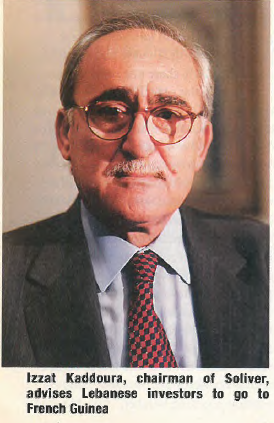
help,” says Izzat Kaddoura, chairman of
Soliver (Société Libanaise pour l’Industrie
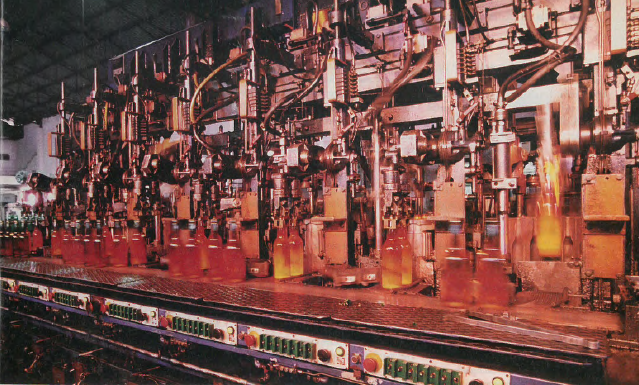
des verres et porcelaines). A glass bottling
factory located in Choueifat, Soliver supplies
Pepsi, Coca-Cola, Almaza, Libby’s, Liban
Jus as well as other oil, wine and spirit manufacturers.
Kaddoura is a major investor in
the hotel industry with over $100 million in
investments, but is also having doubts
about the future of tourism. “I’m leaving my
investments in tourism and industry and
telling all Lebanese investors to go to
Conakry, French Guinea, where opportunities
are a dream,” says Kaddoura.
What he says makes sense. When new
management took over Soliver in 1990, it
had between $5 million and $6 million in
debt. Under the current general manager,
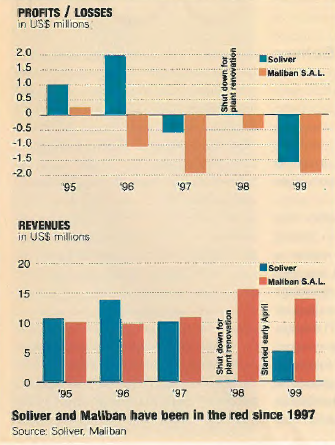
Ghazi Kraytem, Soliver posted good earnings
at the outset. It made close to $5 million on
revenues of $50 million from 1991 through
1995, and almost $2 million on revenues of
$13.8 million in 1996. But the following
year things changed. Soliver posted a
$600,000 loss on revenues of $10 million in
1997, shut down for renovations in 1998
and posted $1.6 million in operational losses
last year on revenues of $5.1 million.
Soliver is not alone. Maliban is the only other local
manufacturer of glass bottles and its story isn’t
any better. Its last positive earnings came in
1995 – $238,000 on revenues of $10 million.
Since 1996, Maliban has lost $5.4 million on
$50 million in revenues. A couple of months
ago, Maliban shut down one of its two furnaces,
cutting its production in half, from 150
tons a day to 75. “If we continue in this losing
fashion we will shut down the factory for
sure,” says Amine Tayara, legal advisor,
director and one of the founders of Maliban.
So what has precipitated the negative
returns for those companies? During the
early 90s, glass-bottling factories began
mushrooming in Saudi Arabia and the Gulf.
Capacity increased 600 to 700% for a market
that wasn’t there. Maliban is owned by the
Madvani Group and run by Turner Associates,
an offshore management company. The
Madvani Group actually started the
expansion in Saudi Arabia, opening a factory
there in the early 80s. That factory started
out producing 60 tons a day and ten years later
increased to 600 tons (about 700,000 1-liter
bottles). The company also has ties with
Savco, another Saudi glass factory.

The real expansion came in the early 1990s with
Zujaj, a glass factory in Riyadh. That was followed
by a string of factories in Jeddah,
Jabal Ali Free Zone, Dubai, Oman and finally
Kuwait. A study by the Madvani Group
showed that total demand in Saudi Arabia is
just 380,000 tons of glass containers a year,
while industry supplies over 650,000 tons.
The result was dumping in neighboring
countries, which has been especially felt in
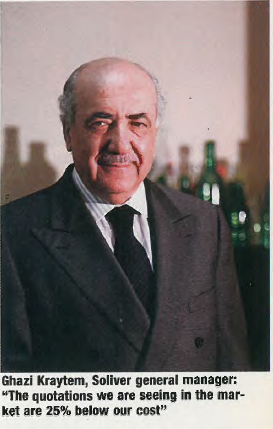
Lebanon. “The quotations we are seeing in the
market to our clients are 25% below our
cost!” says Kraytem. That figure was confirmed
by Tayara.

In an attempt to protect their markets and
stave off foreign competition, the two local
manufacturers have had to sell below cost.
Their prices are still slightly above that of
imports. Some small bottlers are willing to
pay a fractionally higher price for locally produced
bottles to avoid the cost of financing
and warehousing, as they lack the facilities.
“But large bottlers, who have the required
finances and facilities, are not willing to
buy our bottles except when they match the
low prices of imports,” says Kraytem.

Both Soliver and Maliban have completely
lost export markets to Saudi Arabia
and the UAE, which are more than self-sufficient.
Soliver has seen exports to Syria and
Jordan drop from 25% of production to 12%
to 15%. Maliban, which had previously
exported about 60% of its production to
those countries, has averaged 27% in the last
five years.

Fuel is another problem. From December
1998, its cost went up from $100 a ton and
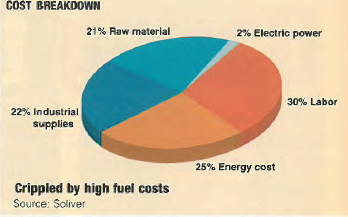
currently stands at $190. For Soliver, fuel represents
about 49% of energy costs, while
energy represents 25% of total costs. “We
have to lower our selling price and our cost
is rising, the government doesn’t see the
impact of a 10% price increase in fuel,” says
Tayara. Soliver and Maliban have been lobbying
the government to allow them to
import fuel, or to buy from the government
at market costs without the margins that
they impose on it.

Labor costs are also high,
representing 30% of manufacturing costs.
To make matters worse, the last three or
four years have seen the emergence of a
new player in the container market,
Polyethylene Terephthalate, or
PET plastic bottles. Since our
last interview with Petco’s
“21st Century Plastics” (May
1999), this PET factory has
registered impressive growth
numbers. Petco has twice
raised its capital, which today
stands at $8.5 million, and
has since doubled its capital
equipment investments to
$15 million.

Capacity has                                                  
increased from 70 million
bottles last year to 280 million
this year. Petco opened a
brand-new facility four times
bigger (8,000 m²) than the
previous one. Demand for
PET bottles in 1997 was just
40 million bottles. Petco has
also begun exporting to
Syria, Cyprus and Egypt.

PET has entirely replaced glass in the water
bottling industry and has expanded the beverage
bottling market, introducing 2-liter, 5-liter,
6-liter and soon 8-liter bottles. The only
markets where PET has yet to replace glass
are for soft drinks and juice, though boxes have
already stolen a big chunk of the latter. Juice
is filled while hot and glass doesn’t deform
during the bottling process. Though the
technology exists to produce PET bottles that
won’t melt during hot filling, it would require
a $3 million to $4 million investment, while
the market is too small to warrant that.

“However, this is coming in the near future,
and as for the soft drink market, we will totally
start replacing it next month,” says a confident
Hermez. Petco manufactures at 50% savings
on energy; it now has 12 lines of production
and plans to expand to all ranges and sizes of
the container market.
The glass industry has not yet thrown in
the towel. Fortunately for Soliver, the new
management team embarked on an investment
program and strategy, which were the
basis for another major investment when the
crisis hit. Soliver has invested more than $6
million since 1992 to update machinery,
using company profits and loans, while the
general manager was given the freedom to
run the company without interference from
shareholders.

And who better for the job than
Kraytem? The former managing director
of Trans Mediterranean Airlines was largely
responsible for transforming it into one of the
largest cargo carriers, spanning the globe,
during his 37 years there.

Kraytem began by improving the working
environment by giving medical and life
insurance and paying for transportation costs
to get the best out of the employees. He later
worked on company-client relationships,
even coordinating with some of his customers
on plans to help maximize sales and
efficiency in operations.

But when the company began registering
losses a few years ago, management had to
decide whether to shut down or meet the
challenge. They opted for the latter. To do that,
Soliver had to renovate the complete operations
of the factory, installing newer, more
efficient technologies to reduce labor and
operating costs. That investment was $14
million, which brought the total to $20 million
since 1992.

This will enable Soliver to
introduce an innovation, which speeds up production
by 15% and produces lightweight bottles.
That is important because now Soliver
can supply a lightweight bottle (below 160
grams) that can hold the same amount of
liquid as a 200-gram bottle. Because bottles
are priced according to weight, the new bottle
will cost less for the client, giving a competitive
edge. It will also allow Soliver to
compete against other container manufacturers.

Soliver has begun installing a third line to increase flexibility between light and heavy bottles to reduce stoppage time, which previously took up to ten hours, and improve overall efficiency.

The new electronic equipment
allowed the company to lay off 70
employees, but at a heavy cost. Under pressure
from the Ministry of Labor, Soliver had to pay
$1 million on top of employee indemnities.

Similarly for Maliban, a second furnace –
though now closed – and lines came into production
in early 1997 at a cost of $22 million.
Subsequent layoffs at Maliban also totaled 70.

Even still, the two firms are operating
under difficult conditions. The key is to
expand products and markets. Soliver is
striking back at PET, trying to take back a
share of the water market, which plastics
has seemingly conquered. “We believe there
is a demand for water in glass bottles in a market
niche welcomed in hotels and first-class
restaurants,” says Kraytem. He emphasizes
that the glass container is the healthiest bottle.
“Sabil has already put in their order and
others will follow,” he says.

Next for Soliver
is manufacturing glass wine bottles; the
company hopes to sell to the Egyptian market,
where wine consumption is increasing,
and supply local wine producers like
Kefraya and Ksara, who currently import.
Next are the 4- to 5-liter gallons and jars for oil
storage and other purposes. Manufacturing
water pipes (argile) is also part of Soliver’s
current plans, a promising product considering
its high use among Lebanese.

Maliban has similar ideas. “We cannot
rely on the soft drink market, we have to
diversify to get out of this problem,” says
Tayara. Maliban has six lines of production
designed to diversify into jars for the food
industry, table glassware and pharmaceuticals.
The company has installed a sand
plant just for the processing of pharmaceuticals
and cosmetics, which requires
special sand batching. There are also plans
to export to Jordan and Saudi Arabia, which
currently rely on imports.

What are the chances of them picking up the
pieces in such difficult conditions? There’s a
clear shift in the US towards PET except for
alcohol and some soft drinks, but even there
changes are happening. “Europe has not
been as affected by PET as the US market,”
notes Kraytem. The Saudi market is diversified,
using cans, glass and plastic bottles for
the beverage industry. “There’s a 60% drop
in glass containers for soft drinks due to substitution
from either cans or plastic,” says
Mohtaram Kaddoura, Soliver’s executive
director. “The large beverage container market
has been replaced by PET.”

EXECUTIVE
has already seen PET sample containers for
pharmaceuticals, cosmetics and juice, and it’s a
matter of time before they compete against
glass in those markets as well.

Hermez predicts that demand for glass
bottles from the beverage industries will
drop dramatically in the near term. But even
if he’s wrong, it’s unclear how long the
companies can survive.

“Considering all the efforts put in by both
companies, we sense the great difficulties that
the glass industry is facing,” says Kraytem,
adding that there might be good opportunities
for exports once the Iraqi market opens up.
He believes that their prospects can be
improved locally should they get an adjustment
on fuel costs and protection against
dumping from the government.

Kaddoura had obtained two licenses in
1988 to produce glass in Syria and Africa
and considered leaving to where operating
conditions are more favorable.

“The only regret I have is believing the
promises made by ministers during the previous
government, which the new government
said they’re not obliged to fulfill,” he says.
March 20, 2000 0 comments
0 FacebookTwitterPinterestEmail
Best Sellers

Sleepless in Lebanon

by Hadi khatib March 17, 2000
written by Hadi khatib

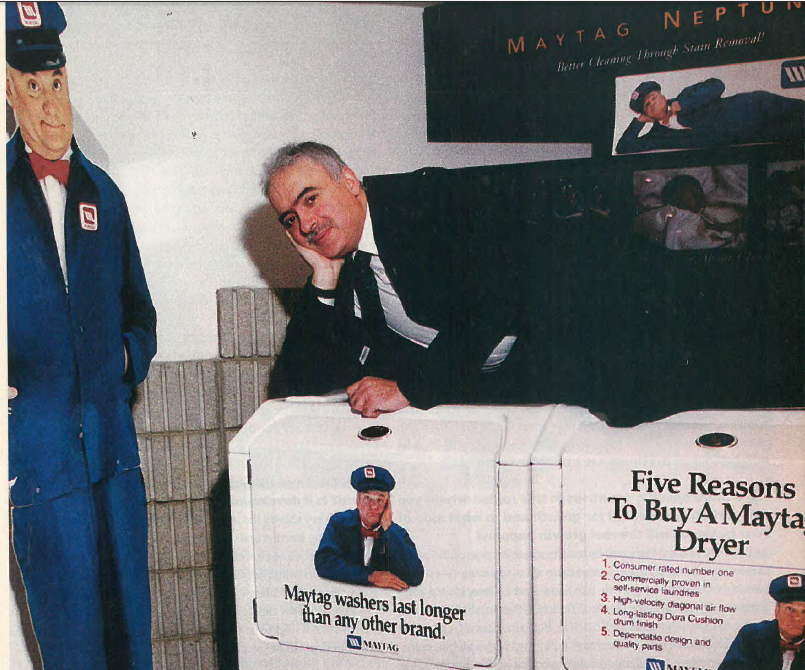
One look at 45-year-old Raji El
Mawla, regional manager of the
Maytag Group, and you would
probably think that life is pretty easy for this
businessman. He speaks with a calm voice
and rarely wears a suit and tie to work. But
first impressions can be deceiving.

It is 9am at Mawla’s office. He has a portable phone close to one ear and a cellular
in his hand. He is busy typing an
email to the corporate office in the US
while trying to resolve a misunderstanding
between an area manager and a distributor.
In the following hour, he manages to
schedule two or three field meetings,
respond to a few of his nearly 70 daily
emails and receive five urgent phone calls,
that he responds to in the same relaxed
manner. “Hello, what seems to be the problem
… I see … don’t worry … relax, I’m
on it as we speak … Your problem will be
solved by tonight … How’s the family?
Good … Keep up the good work, goodbye.”
After two minutes, the crisis is over.

“Easy and effective communication is
essential in this business,” says Mawla.
“People can reach me via email or cellular
24 hours a day.” Mawla must oversee the
work of four area managers based in
Lebanon, Saudi Arabia, Tunisia, and
Tehran. He is responsible for 65 distributorship
accounts in such countries as Saudi
Arabia, Jordan, the UAE, Kuwait,
Pakistan, Egypt, Tunisia, Morocco,
Senegal, and the Ivory Coast. Because of the
overlapping days and hours of operation in
the countries under his command, Mawla
works a seven-day week. With Maytag’s
corporate office in the US eight hours behind local time,

he usually does not get home until late at night.

Mawla is truly sleepless in Lebanon, but has
it paid off? The answer can be found in his
office. Sitting on a shelf is a red Everlast
boxing glove, awarded to him for reaching his
mid-year quota. Next to it are six certificates
given to him by the Iowa home office for
exceeding his quota each year since 1993.

Five years ago, when Mawla introduced
Maytag to the Middle East, it was a little
known brand. Today, it leads the pack among
US imports, both locally and regionally.
Since his promotion from area manager to
regional manager in 1994, Mawla has doubled
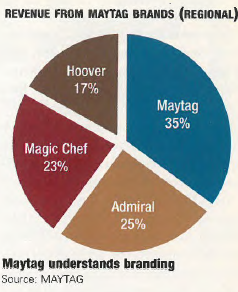
local sales of Maytag brands, which
include Maytag, Hoover, Magic Chef,
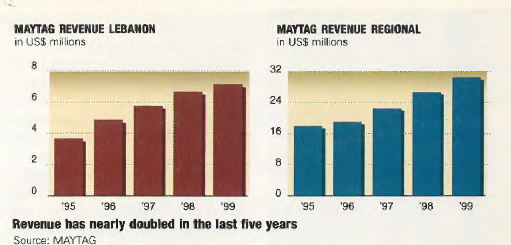
Admiral and Norge. Revenues have gone
from $3.5 million in 1995 to $7 million in
1999 and the company has carved out a
10% share of the local market for refrigerators,
which compose the bulk of
Maytag’s sales, which include washing
machines, floor cleaners and gas ranges.

His performance regionally has been equally
impressive, expanding revenues from
$18 million in 1995 up to $30 million in
1999. In relation to other US brands, local
market share of Maytag’s brands has grown
from 32% in 1997 to 61% in 1999, outpacing
GE, Frigidaire and Kelvinator. In Saudi
Arabia, Maytag has a 45% market share
against other US imports and in the UAE,
42% against US imports.

But what is most impressive is that Mawla
has managed to make these gains in a market
where imports of US refrigerators (the
bulk of the group’s sales) have been declining
rapidly. With the country in a recession,
people cannot afford to buy expensive US
manufactured refrigerators. As such, cheaper
Korean and locally produced refrigerators
have been slicing into the market share of the
US brands.

Statistics from the Ministry of Economy and
Trade indicate that imports of complete
American-made refrigerator units have
dropped from 36,000 units, $21 million, in 1998
down to 15,000 units, $15.7 million, in 1999 (see
“Chill in with the big boys,” February 2000).
This gives US refrigerators a 19% share of the
80,000-unit-per-year local market.

Meanwhile, Concord, a locally produced
brand which sells for at least half the price

of its US rivals, has boosted its output from
2,500 units in 1992 up to 30,000 units in
1999. Sales of popular Korean brands, such
as Samsung and LG, have also been strong.

“Until last year, GE was selling about 7,000
units per year. Last year, they started to
come down and we are taking their share.
Koreans as a whole have been coming in
strongly in the last five years,” says Antoine
Cherfane, president of AC Holdings, distributors
of Samsung refrigerators. The
Korean manufacturer has spent hundreds of
millions of dollars upgrading its manufacturing
facilities, building a state-of-the-art
robotics factory that is able to produce 2 million
units per year. The company sells some
7,500 units a year locally with sales volume
increasing at an annual rate of 25% over the
past three years, according to Cherfane.

Selim Antaki, chairman and CEO of LG
Lebanon, also reports a strong performance
for his company. With between
7,500 and 8,000 units being sold, Antaki
claims that LG refrigerators have carved out
a 10% market share. LG refrigerators are
equipped with patented new technology
called Door Cooling, a system that equalizes
airflow throughout the whole refrigerator.

“The Koreans are improving in their technology
while the Americans are sitting
idle, not really doing much,” says Gabriel
Traboulsi, general manager of Pharaon
Homeline, distributor of US-made brands
Magic Chef and Frigidaire, Taiwan’s
Sampo and France’s Brandt.

Antaki agrees: “American refrigerators
look like boxes with mechanical controls
and outdated technology that no longer

adapts to the consumer’s needs.”

But even as the demand for US refrigerators
declines, competitors admit that
Maytag remains a strong brand. “Among
other US imports, Maytag is the best
refrigerator,” says Antaki.

How did Maytag manage to do so well? A
quick look at the 17 years that Mawla has
been in this business and it is easy to understand
the secret of his company’s success.
From 1983 to 1989, he was an area manager
in Kuwait for Hoover. In 1989,
Maytag took over the Hoover operation
and the company’s two international divisions
were merged to form Maytag International.
After the Iraqi invasion, Mawla
was forced to transfer to London where he
became Maytag’s area manager for the
Gulf market, with the exception of Saudi
Arabia. In 1992, sensing an opportunity, he
brought the company to Lebanon.

Mawla’s direct management style has been
a key ingredient to turning Maytag products
into big sellers. Mawla visits all of the 65 distributors
under his control, checking on products,
quality of service, dealing with technical
problems and assisting his area managers
and distributors. “I do the product knowledge
training responsibly, and visit the service centers

randomly to make sure they are doing
their jobs properly,” says Mawla. The company
will soon have a locally based service
engineer stationed in Lebanon – for now, the
company relies on someone in London. The
engineer will visit the service centers of
wholesalers and Mawla, in turn, will check to
make sure the service engineer is doing his job
properly. He also conducts monthly and
quarterly meetings with his area managers
where he reviews market conditions, measures
the competition’s products and strategies,
evaluates achievements, reviews that year’s
plans and sets new goals.

The company also benefits from being able
to manufacture, under license, in a number of
regional countries, including Saudi Arabia,
Pakistan and soon Tunisia. This cuts the costs
by eliminating import tariffs. Mawla also
benefits from a strong product development
program. The Maytag Corporation, which
had sales in 1999 of $4.3 billion, has sunk
some $220 million into a new technology
called advanced product design (APD). The
system eliminates leaks and noise and makes
the Maytag refrigerator rust-proof. According
to US-based Consumer Reports magazine,
Maytag has been the number one preferred
refrigerator in the US for the last three years.
In February 1999, Consumer Reports ranked
Maytag’s 24-foot refrigerators first in terms
of energy cost, temperature performance,
noise and convenience.

Maytag also understands branding.
“Maytag spends heavily on advertising its
products,” says Traboulsi. Last year, the
company spent some $250,000 to host a creative
interactive TV show in Saudi Arabia, giving
away an equal $250,000 worth of Maytag
and Hoover products to winning contestants.
Locally, Maytag invests about $600,000 a year

in advertising, equal to the budget of
Concord and $100,000 more than the annual
budgets of AC Holdings and LG Lebanon.

But the main reason for Maytag’s success locally
has been its aggressive distribution network,
headed since 1995 by Nassif El Khechef,
chairman and general manager of Linkers
Group, distributor of the Maytag brand.
Khechef is also general manager of Herald
Trading Company, distributor of Hoover
since 1948, and chairman of Mangroup, distributor
of another Maytag brand called
Norge since 1998.

Khechef heads the distribution of three out
of the five Maytag brands. “Out of the 9,000
Maytag refrigerators that were brought into the
country in 1999, we imported 6,000, 75% of
sales,” says Khechef.

Linkers has a modern service and technical
center. It keeps a stock of spare parts for models
going back ten years. Khechef is responsible
for marketing brands locally in cooperation
with the suppliers. Linkers has a strong
relationship with Power Network, a high-impact

advertising and marketing company.

“I believe Maytag has the right partner by associating
itself with us and we made the right
choice by choosing them also. They have a
great product,” says Khechef. His company
also employs a well-trained sales force with
strong knowledge of the products they sell.
The group has an incentive policy for its distributors’
sales force. “The sales people are
greatly motivated. That was a smart move by
Maytag,” says Traboulsi.

Mawla knows. For a man who never rests,
motivation is his middle name. But he has his
priorities. “If you’re talking about choosing the
right partner, I have one at home. And as
long as I bring my children gifts from my trips,
they’re happy,” he says.

March 17, 2000 0 comments
0 FacebookTwitterPinterestEmail
For your information

Mobility calls

by Executive Contributor March 17, 2000
written by Executive Contributor

The opening of Ericsson’s regional office in Beirut is a rare and
welcome development, since pessimism clouds Lebanon’s outlook.
Nael Salah, vice president and general manager of
Ericsson Middle East, talks to EXECUTIVE about the future
prospects for Lebanon and the region, liberalization and the
company’s strategies. Salah’s office is responsible for 12
countries in the Middle East. Last year turnover for the region
was about $600 million, with infrastructure accounting for
about 70%. Annual growth in the past three years has been
30%, and Salah expects that trend to continue in the coming
years. The company has about 40% of the mobile phone
market in Lebanon and 35% for the region, with Nokia as its
biggest competitor for handsets.

Ericsson has just opened its regional office here.
Why Beirut?

SALAH When we decided to open a regional office in the Middle
East, we looked at a number of countries. Very quickly we shortened
the list and one of them was Lebanon. I would probably guess
that the most important factor is that in Lebanon there are many people
with a very high level of education, so we can recruit locally.
That means we have continuity in our work. There are other factors
as well, such as the geographic location of Lebanon between
Europe and the rest of the Middle East.

But many business people complain about the high
level of corruption, customs and bureaucracy here,
and most prefer Dubai.

SALAH Many of those things, if they exist, are not valid for us really.
Because we are a regional office we support Ericsson companies
in the Middle East. So our business is not with the society; it’s
more with the Ericsson companies of the area. Things like dealing
with authorities can be improved and simplified in terms of, for
example, getting work permits or establishing companies. But we
don’t feel this is a major obstacle.

Do you believe Beirut still has the potential to be
some sort of hub? Some have pretty much written it off
as a financial or transport hub.

SALAH We believe that there is very good potential for Lebanon
to play a major part in the business sector of the Middle East, but
there are a number of things that have to change. We believe that
there will sooner or later be a peace settlement and there will be
stability in the region. And we believe that the authorities in
Lebanon are serious about improving the infrastructure and that they
have an important objective to reestablish Lebanon as a hub for
many companies. So if we have stability, and if the authorities make
establishing Lebanon as a hub a major objective, I don’t really see
a problem in the future.

How can Lebanon convince other companies to set up
their regional bases here?

SALAH Foreign companies would like to hear the authorities
declare the establishment of Lebanon as a hub for the Middle East.
And number two would be to have additional development of the
infrastructure. You could make telecommunications more cost
effective; compared to Europe or the United States, it’s expensive
here. Transportation in terms of the airport and roads can be
improved. Then of course I would say all those formalities — registering
companies, issuing work permits, visas — these things can
be simplified.

What are Ericsson’s strategies for increasing business
in the region?

SALAH The Middle East is a traditional Ericsson market. So we
have established relations with people in the Middle East and we
have a good understanding of how people do business here. That
helps us today, and it will help us in the future. One of the major
strategies that we have is to be near our customers, so we have offices
in many countries in the region. We don’t want to be a competitor
to our customers; Ericsson’s strategy is to be a supplier of products
and services and not to compete in the operators’ business.

We have experienced liberalization in many countries before. This
has been happening for two or three years in the Middle East, and
it will continue. We have experience in that and can give support
to our customers to help them in a changing environment.

Are there specific countries in this region where you
see particular potential for growth and in what side of
your business will the real growth happen?

SALAH We believe there will be much growth in most of the countries
in the Middle East. Of course there are many countries which
have huge potential for growth, like Saudi Arabia, Iran, United Arab
Emirates, Syria, Lebanon, Jordan, Yemen. Other smaller countries
have a big growth rate as well, such as Bahrain, Kuwait, Qatar and
so on. We believe that the business will grow very much in cellular
infrastructure, cellular consumer products and in Internet systems
and services, so we target those areas.

What effect will privatizing part of the MPT (Ministry of
Post and Telecommunications) have on your business?

SALAH Today we are one of the major suppliers to the MPT. So I
think what we should talk about are the general advantages of having
privatization rather than having a monopoly. When we have privatization
and we have liberalization there are very obvious advantages.
Of course the market itself will expand a lot. And I believe that
we will gain from both of those things. Although we have a major share
of the business, I think the cake will be bigger. Even if we maintain
the same market share, the absolute volume of business will expand.
I’m convinced that this is very good for Lebanon in all aspects.
So we expect to see privatization within a short time.

Is a 25% stake enough to attract international investors?

SALAH My opinion is that many of the global operators are more
interested not in how much share they have in the company, but
more in what sort of business that company will be doing. I
believe that if cellular is part of that business then that would be
much more attractive.

They are on the right track. To establish a company and to sell 25%
is the first step. This 25% will increase and become a majority in the
future, or the total. In other countries in the Middle East, such as Jordan,
for example, they have sold a 40% stake to a strategic partner. In
Saudi Arabia they also have plans to privatize; they have already made
a company out of the telecommunications part of the ministry. In Oman
they have already formed a company and they are looking to privatize.
In Yemen this is also the case; they are giving two licenses for cellular.
Bahrain has already been privatized to a large extent for a long time.
In Kuwait there are two cellular companies — one was private from the
beginning and the other one started out government-owned and was
then partially sold off. There are many examples of liberalization in
the Middle East and these will increase in the future.

Is one of the biggest frustrations for Ericsson that the
cell phone companies are limited in the number of subscribers
they can have?

SALAH Of course it affects our business, so it will be positive for
us and for the telecommunications sector in general if this dispute
(between the MPT and cell phone companies) is out of the picture
as soon as possible.

What will most affect Ericsson’s business now or in the
future? Is it developments with the Internet?

SALAH Very shortly the industry will develop wireless data, which
is combining Internet and cellular telephony together. That will have
a major effect on our business. The third generation system will give
very high bandwidth between the telephone and the network for data.
Today the bandwidth is 9.6 kb/s, and that will increase very soon to
115 kb/s. With the third generation system, we’re talking about 384
kb/s. So this will give us very large bandwidth to data which means
that mobiles will be used for connecting to the Internet.

There are so many advances with cell phones, palm organizers,
laptops, getting Internet on the TV. Does this risk
a certain degree of confusion?

SALAH I don’t think it’s confusion. What is happening is that there
are many different industries which are converging together; this
is really the most important trend that will continue to develop in
the coming years. The computer industry, the communications
industry and the media or content will converge. It may be confusing
for some people, but I think it will mean simplification as well. You
will have things that have many different purposes; for example,
something like a PC will be a phone as well as a videoconference;
it’s your door to get information.

How far away is that?

SALAH I think that within about two to three years these things
will be happening on a large scale. We are already developing
the products.

Top of Form

March 17, 2000 0 comments
0 FacebookTwitterPinterestEmail
For your information

Empowering the private sector

by Sami Atallah March 17, 2000
written by Sami Atallah

The participation of the private sector in decision making is
an essential prerequisite for sound policies. This is because
it leads to policies that are compatible to the private sector
needs, reduces uncertainty in government decisions and fosters an
environment for investments. One factor attributed to the growth in
East Asia is the deliberation council, through which businesses and
government ministries and agencies discuss, debate and design policy
that is relevant to the economic sectors. In a 1997 World Bank
study, 48% of firms in South and South East Asia participated in decision
making compared to 30% of firms in the Middle East and North
Africa (excluding Lebanon), 28% in Sub-Saharan Africa, 17% in
the Commonwealth of Independent States and
16% in Central and Eastern Europe.

To what extent do Lebanese firms participate
in decision making? At first glance, it is
expected that involvement of firms in policy
making would be high. After all, Lebanon is a
private sector-based economy that avoided the
trap of statist or socialist policies that confounded
its neighbors for some time. But the
reality is in fact quite different. A survey of 250
firms conducted by the Lebanese Center for
Policy Studies in 1998 found out that only
16% of surveyed firms are involved in policy making
in one way or another. This is a lower level than firms in other Middle Eastern countries and even in Sub-Saharan
Africa. It seems that economic policy making is often done
in a vacuum with little involvement of the private sector.

A closer look at survey results shows more revealing findings.
Although just 12% of industrialists and 13% of agricultural firms have
participated in designing policies, 80% of the surveyed banks did
affect policies. Consequently, the banking sector has been performing
very well since the end of the civil war. Its record is fairly obvious:
a high growth rate of 23% in assets, 46% in shareholders’ equity in
1997, while deposits to GDP now stand at 170% (exceeding that of
developed countries), total assets to GDP of 200% (higher than high-income
economies). No sector can match the record achieved by the
banking sector. Hence, what makes the banking association — the sole
representative of banks — more effective in influencing policy making
than other associations? Three factors are at play.

The first factor is attributed to the importance of the sector in the eyes
of policy makers. Sectors that are considered to be compatible with the
beliefs and ideology of politicians for whatever reason tend to perform
better than other sectors. Hence, it is no surprise that the banking sector
— which is considered to be a pillar of the economic system in
Lebanon — has always enjoyed certain privileges. Before the establishment
of the banking association in 1959, the government had already
passed the Banking Secrecy Act. Later, it institutionalized the importance
of the association by requiring the central bank to consult with
the association on matters related to the sector. After the end of the civil
war, the government again placed the banking sector at the core of its
vision. The central bank and the banking association worked closely
together to modernize the sector. On the opposite side of the spectrum
lie industry and agriculture, which the government does not
consider to be crucial economic sectors. Hence,
the demands of their respective associations were either ignored immediately or met on an
ad hoc basis to avoid any escalation or tension.
Neither the policy makers of the independence
era nor those of the post-civil war period
have given these two sectors any significance.

The second factor that has affected the relationship
between the state and associations is
the financial leverage the former has had on
the latter. For instance, the banking sector
played a crucial role in financing the government
deficit. This was particularly important just after the end of the civil war when foreign
lending was not available. The banking sector bought 90% of
government T-bills. No other business association could match the
leverage that the banking sector had.

The third variable is the quality of the associations. Here I refer to
the objective, size, level of representation, dynamism and the activities
of the association. Business associations that have well-defined
goals representative of their sectors, are financially resourceful and practice
democratic rules in elections tend to be more effective. Again, the
banking association is a case in point. It has clear goals, represents all
the banks in Lebanon, has a relatively high budget, which allows a larger
scope of activities, and conducts elections every two years.

The absence of an accountable political system that would have
allowed the associations to lobby ministers and members of parliament
makes their work harder. However, until then, some work
needs to be done to the internal structure of the associations. Are
they ready to meet this challenge? That’s not clear.

March 17, 2000 0 comments
0 FacebookTwitterPinterestEmail
For your information

A failing grade

by Robert Tuttle March 15, 2000
written by Robert Tuttle

Remember all the glowing clichés you’ve heard about
Lebanon? A bastion of capitalism within a sea of controlled
economies, a regional hub, the Switzerland of the Middle
East. With relatively low tax rates and banking secrecy, Lebanon
must be one of the freer economies in the Middle East, if not the
world, right? Think again.

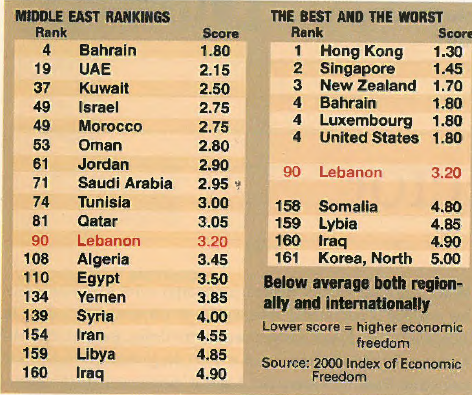
The Heritage Foundation and The Wall Street Journal, in their
recently released 2000 Index of Economic Freedom, ranked
Lebanon as number 90 among 160 countries (see chart), placing
it in the “mostly unfree category.” Lebanon found itself even
with such countries as Guyana, Madagascar and Moldova. Even
worse, it scored one point below Mongolia and three points below
Guinea and Ghana, while Fiji, Nigeria and Papua New Guinea
ranked just below Lebanon, tied at number 94. (Ratings are based
on 1998 statistics.)

Conducted annually since 1995, the survey has become something
of a benchmark for measuring the ease of doing business
in a country. Rankings are based on ten
broad factors of economic freedom: trade
policy, the fiscal burden of government,
government intervention in the economy,
monetary policy, capital flows
and foreign investment, banking,
wages and prices, property
rights, regulation and the
black market. Each factor is
scored from one to five and
averaged to determine the final grade. The
higher the score, the greater the government
interference in the economy and the lower the economic
freedom. Hong Kong topped the list of “free”
economies with a score of 1.3. Trailing the pack are repressed
economies like North Korea, which scored five. Lebanon’s score
was 3.2, below average, not only by world standards, but also by
regional standards. Among 17 countries in the Middle East,
Lebanon ranked 11th.

The study showed a direct correlation between the per capita GDP
and the level of economic freedom. “Countries with greater economic
freedom have a faster rate of economic growth and a higher
standard of living,” says Nassib Ghobril, an analyst at Lebanon
Invest. “The study is used by policy makers and investors to
assess the investment climate in a country. If a company were to
set up an office here, obviously it would want more business-friendly
policies. It’s not the country of choice. Why not set up in
Jordan, or the UAE, which is second only to Bahrain?”

Why did Lebanon score so poorly? Ghobril points to three important factors.
First, Lebanon scored a maximum of five on trade policies. High
tariffs and surcharges on imports are the main culprits.
According to IMF statistics, trade taxes account for more than
70% of the total taxes collected by the government. In an attempt
to control the high deficit, the government has increased tariffs over
the past several years. This will make the country’s hopes of joining
the WTO and the Euro-Med agreement difficult, as both deals
would require a general phasing out of trade barriers.

Lebanon has signed free trade agreements with Syria, Egypt and
Kuwait as well as the Arab common market agreement. “But still
overall the tariffs are considered very high,” says Ghobril.

Lebanon also scored five in the “black market” category, largely on
account of its rather porous border with Syria and its thriving
business in unauthorized cable television and pirated software.

Lebanon’s score was also disappointing
– 3.5 – on the fiscal burden of government, which includes income and corporate
taxation plus government expenditures. With a top income
tax rate in 1998 of 10%, Lebanon received a two for taxation. But
that was averaged with a score of five for expenditures, which were
almost 44% of GDP in 1998. Even in some areas where Lebanon
prides itself on openness, the results were disappointing. The
country received a three, “moderate barriers,” for capital flows and
foreign investment. According to the US Department of Commerce,
“Lebanon offers the most liberal investment climate in the Middle
East, with no significant restrictions on foreign investment.” The
report disagrees: “It restricts the amount of real estate a foreigner
may own and needs an efficient investment approval regime.”

It was not all bad news, however. Because of a “low level of
restrictions,” Lebanon received a two for its banking sector and on
prices and wages. As another bright spot, the index showed a modest
improvement from last year, when Lebanon scored 3.25. But
the score for 2000 is still far below its 1997 score of 2.95. And not
everyone agrees with the index’s rating. Kamal Hamdan, an economist
with the Consultation and Research Institute, feels that
Lebanon was under-rated in a number of areas. Trade barriers may
be high by international standards but by regional standards they
are not unusual, he argues. Hamdan also questioned how Lebanon
scored a five for black market, while Nigeria, which he believes has
a far worse problem, scored a three. The five for government expenditures
is also unfair, he says, because the survey calculates the
money spent on debt servicing. “I think Lebanon should be among
the top 30 to 50 countries,” he says. Marwan Iskandar, head of MI
Associates, agrees: “I think that these measures are rather arbitrary.
I would not give much credence to a study like this.”

There are reasons for hope and despair for next year. The “black market”
rating may improve if the new intellectual property rights law,
passed by parliament last spring, is enforced. On the down side, corporate
tax was raised from 10% to 15%, while the top income tax bracket
was increased from 10% to 21%. That could affect next year’s score.

OK, so Lebanon might not be a bastion of capitalism, but at least
it’s a nice place to live, right? Well, actually no, according to another
survey by international consulting firm William M. Mercer. It
ranked Beirut 168th out of 218 cities based on quality of living. The
survey was based on 39 standards including political, economic and
environmental factors, personal safety and health, education, transport
and other public services. Among the notable cities that beat
Beirut were Medellin, Colombia, the cocaine capital of the world,
and Cairo, Egypt, where the smog is so bad that a walk on the Nile
can cause lead poisoning. At the top of the list were Vancouver,
Canada and Zurich, Switzerland. At the bottom: Brazzaville and
Pointe Noire, Congo and Khartoum, Sudan. Well, at least in
Lebanon, we can ski in the morning and swim in the afternoon. Then
again, who would bother?

March 15, 2000 0 comments
0 FacebookTwitterPinterestEmail
For your information

Budget Banter

by Peter willems & Kirsten Vance March 15, 2000
written by Peter willems & Kirsten Vance

The first few days of February are probably not
a time finance minister George Corm would like
to relive. Before his 2000 budget could be
passed through an unruly parliament, Corm
was the target of three sessions of scathing
attacks. With some of the nastiest remarks
struck from the record, Corm was accused of
hallucinating and his policies called failures. The
“Cormic genius” was blamed for slowing economic
growth, increasing unemployment and
precipitating the brain drain.

By Peter Willems and Kirsten Vance

But were these accusations fair? EXECUTIVE spoke with the
finance minister, analysts and economists to discuss the
issues. “It doesn’t matter if the budget deficit comes in a little
above or below the target. It’s still way too high. There’s no reason
to rejoice,” says Nassib Ghobril, an analyst at Lebanon Invest.

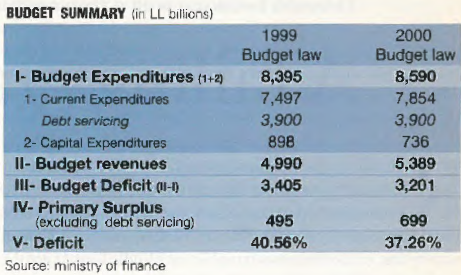
Within the 2000 budget, the deficit is targeted at 37%. Last year the
government aimed for the budget deficit to be reduced to 40% and beat
it by hitting 38%. (The government also beat its total deficit expectations
of 44%, coming out with 42%.) “The target this year is still
high, which means they will most likely meet it,” says Ghobril.

Why didn’t the budget come out with a lower target? “On the
expenditure side in 1999, we were able to cut heavily on a lot of allocations,”
says Corm. “This year, knowing that we have had a social
crisis over eight or nine years, we increased allocations for education,
social services and health services sharply. With this we have
only a 37% budget deficit.”

By speculating if the government will hit its target this year, one
has to first look at the revenue side. The government’s plan to bring
in $3.57 billion (an 8% increase compared to last year) was based on
a GDP growth rate of 1.8%. “We know that economic growth was
practically zero in 1999, and what we expect for this year is not any
better,” says economist Elie Yachoui. He may not be far off.

According to The Economist Intelligence Unit’s (EIU) first-quarter
report on Lebanon, the GDP growth rate is forecast at 0.5% for 2000.

Not so, says Corm. “It’s impossible to calculate
the growth rate in Lebanon. Anybody
who says ‘I can calculate it’ is a charlatan. I
will not believe in any growth rate. I have
published the estimates of the IMF that
spent three weeks here in June, and they
know Lebanon. They are specialized in this
country, and they said 2% last year.”

More
specifically, the minister pointed out that
there is no link between economic growth
and tax receipts in Lebanon for now. The tax
system concentrates on the productive sector,
“which is highly concentrated on a few large
taxpayers. The tax system is not diversified.”

An improvement in tax collection, even
with a low growth rate, would have a greater
impact on increasing revenues than strong
economic growth alone, Corm argues.

That leads to another sore point. Freddie
Baz, the advisor to the chairman at Banque
Audi, stresses several important paths that the
government must follow to bring down the
deficit. One is improving tax collection,
instead of raising taxes in a recessionary
environment. It has been estimated that there
is a 70% tax evasion rate. “When I feel that my
tax administration is behaving well for taxpayers, and the taxpayers continue to evade
us by under-reporting profits, then I will take
measures,” says Corm. “But there is corruption
with tax officials; it’s very well known.
I’m moving forward. I’ve taken measures
against four people. But in this country,
progress has to be incremental unless you go
to a military dictatorship, a Pinochet of some
kind, which I’m not a part of.”

Getting tax collectors in line is essential. But
some think that enforcing tax collection is just
as important. “All taxpayers must be equal
in front of the law. We have an army. We have
internal security forces. We can turn to them
to increase collection,” says Yachoui.

Even though improving tax collection
is a slow mover, tax reform is on the cards for
2000, including taxing properties built illegally
on the coast and a turnover-based tax on
corporations. Also to come around in 2001 is
the introduction of VAT, designed to bring in
the sharpest rise in overall tax revenues and
allow the government to reduce customs.

Several economists argue that there is not
enough transparency in Lebanon for VAT to
be effective. “The international experience is that it induces people to become more transparent, especially those
who invest,” says Corm.

There are complaints about the government’s slow pace in privatizing
state enterprises. Some argue that speed is of the essence in order to
take a bite out of the debt. “There are two ways to privatize: Either you
do it the Russian way – selling to the mafia – which our government
won’t do, or we do it according to the best practice,” says Corm. “A
lot of progress has been made. There is the law that has been finished.
It should be approved by the parliament within the next two months.
It took ten years for privatization to be completed in Morocco.”

Privatization should generate between $4 billion and $5 billion by the
end of 2003. But according to Yachoui, if that’s broken down to $1.25
billion between 2000 and 2003, and debt servicing continues at $2.5
billion annually, privatization will not even cover debt servicing, which
devours 45% of government expenditures.

Yachoui stresses that privatization
is not nearly as important as changing the government’s monetary
policy. He believes that because the monetary policy is too tight,
interest rates are too high. If interest rates were reduced, that would help
relieve debt servicing and increase liquidity in the market. Corm also
sees the importance of loosening up the monetary policy.

Also on the side of expenditures, public sector wages account for
33% of expenditures. According to one report, the government has
up to 60,000 redundant employees. The general consensus is that the
bloated public sector must be trimmed, and better now than later. But
Corm argues that reducing staff is a misconception and is not on the
government’s agenda. “The 33% includes the army and those on pensions
who are not active in service. If you reduce the number of civil
servants, they will soon be on a pension. So the impact in terms of
saving on the budget is nil. There’s a lot of talk about this issue, but
it’s told by people who don’t know what they’re talking about.”

But don’t forget: This year’s budget is only one part of the five-year
plan. The government’s objective is to reduce the budget deficit from
11% to 4.5% of GDP and the debt from 130% to 96.3% of GDP, along
with reaching an annual economic growth rate of 5% by 2003. “It’s
a good budget,” says Baz, “but it won’t be a speedy way to reach the
final objective. To reach the final objective in a short period of time,
this is not the way.”

March 15, 2000 0 comments
0 FacebookTwitterPinterestEmail
Editorial

Young and restless

by Executive Staff March 15, 2000
written by Executive Staff

EXECUTIVE is always on the prowl for companies that will open their
doors – and their books. Not easy in Lebanon. It took us six
months to break into Obegi and get the goods. With the younger generation
now at the helm of one of Lebanon’s largest and most successful
businesses, they allowed us to take a close look at the family’s
diverse group of operations. Georges Obegi, 35, heads the consumer
products division (worth $71.8 million in revenues), while his brother
Yordan, 44, runs the chemical side of the business (worth $82 million).
They provided us with details on how they got where they are today
and what’s in store for the future.

Youth also comes into play in the emerging Internet industry. Imad
Tarabay, 27, sold his Internet service provider Lynx to a US multinational
less than a year after starting up. Mergers and acquisitions are
almost non-existent in Lebanon, because old-school tradition still dominates
the business environment.

In Lebanese companies, women are still a rare find in management,
especially in upper managerial positions. Advancement has been made
difficult because of cultural baggage and other barriers. There are hopes
that the next generation will help tip the balance, even if change has so
far been slow.

But successive governments have put Lebanon in a bind. Those leading
the country today must take responsibility for the massive debt and the
unacceptably high deficit to bring the economy back to life. The
younger generation should not have to pay the price.

March 15, 2000 0 comments
0 FacebookTwitterPinterestEmail
Tech Knowledge

Y2Y What’s buggin’ ya now?

by Mira Baz February 28, 2000
written by Mira Baz

The turn of the millennium was overshadowed by what has been dubbed the Y2K bug, or the threat that computers would mistakenly read 00 as 1900 instead of 2000. Its effects promised to be of apocalyptic proportions, ranging from minor computer crashes to global meltdown, wipeouts, and the end of civilization as we know it.

The apocalypse and Y2K became inseparable, to the extent that cult leaders jumped at the opportunity. Their preaching might have come right out of a science fiction piece, the irony of the end of a high-tech century brought about by technology. The creation getting out of hand and destroying its maker. Quite dramatic.

The new year, new century, and new millennium all in one were celebrated with great caution and not much indulgence as a result. Fears of the worst biblical prophecies imaginable sent the superstitious in the United States stocking up on emergency supplies and seeking shelter space.

Instead, nothing happened. Doomsday passed flawlessly in technology worldwide. The world woke up, hung over, to the exact same world of the day before. No significant hardware crashes at the stroke of midnight. No nuclear disasters or demise of the Earth. Not even a complete system crash in some tiny third-world company, except for the minor glitch on Byblos Bank’s homepage indicating that the date was January 1, 2000. Oh, and no apocalypse either.

For the skeptics, the anticlimactic outcome raised some eyebrows. After months of psychological preparedness for the worst, the minor glitches that did later appear were less than satisfactory. But for some, it sparked anger. The Czech president, Vaclav Havel, was reported to have made a threat to expose the United States’ responsibility for the fraud. But those inclined to think that the United States was behind the hoax were reassured halfway into last month. A Y2K-testing mistake caused a Pentagon computer system to malfunction, interrupting the transmission of spy satellites.

Some have dismissed it as a bad practical joke played by the world’s superpower on the rest of the nations. Argentina, whose Y2K expenditure reached $1.5 billion, was on the list compiled by US experts of countries expected to experience a blackout. Angry Argentineans didn’t think too highly of them when lights didn’t even flicker throughout the country. An Australian editor was quoted in The Herald Tribune as saying, “So what was the fuss all about? Can we get a refund?”

Public opinion is now split between those who think the issue was too much hype and resulted in money wastage, and those who don’t. Raymond Khoury, senior IT strategy advisor in the technical cooperation unit at the office of the minister of state for administrative reform (OMSAR), maintains that the reason for the uneventful outcome was due to the preparation. Ali Nahle, head of the IT department at the central bank, agrees. “The reason was general awareness of the problem and measures taken to prevent it. We saw what would have happened had it been ignored,” he adds, adding that during testing, non-Y2K-compliant computers crashed or lost data.

Not a highly computerized country, Lebanon had its advantage after all. “For every mishap there’s a blessing, as the saying goes,” says Khoury. Manual transactions and paperwork not only saved the country loads of money, but also meant that if technical wipeout had taken place, there would have remained the hard copies. Around $50 million in hardware and software upgrades was spent in the banking sector alone, with $650,000 going to the central bank. Middle East Airlines’ Y2K tab was $1.5 million.

The numbers look small when compared to global figures, but they don’t necessarily indicate a lack of awareness and action. Most of the public and private sectors’ computerization began to take off in the early to mid-1990s, when the Y2K issue was first being addressed. OMSAR, which started in 1995, “undertook administrative reform supported by IT,” says Khoury. This is when government offices became automated with the latest, Y2K-compliant technology.

Lebanon’s greatest fortune yet may be the absence of a nuclear plant or oil industry, which may have posed a regional danger. Developed countries were worried that problems in developing ones would have a ripple effect, where system crashes or malfunctions would affect connected systems locally or internationally. The United States issued several global reports on countries most likely to suffer, including Russia, India, and China. Third-world countries were placed at the top of the list due to their backwardness, lack of technical expertise and funds to solve the problem.

But the US-based research firm International Data Corporation (IDC) predicted last year that “some of the most prepared countries in the world will feel the worst effects of Y2K, some of the least prepared won’t feel it at all. This is because the pain inflicted by Y2K computer glitches is a function not only of how much computer downtime the bug will cause, but also how much that downtime matters.” Countries that would most suffer business revenue losses in 2000 due to system failure are Russia and Korea, IDC reported.

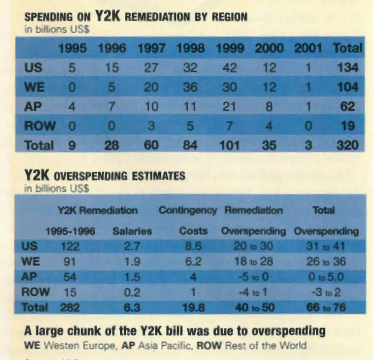
In its frenzy, the world will have spent an estimated $300 billion by the year 2001, according to IDC, a third of which is by the United States alone. Some of that amount is thought to have been wasted or overspent, and is attributed in part to companies paying employees overtime to monitor IT systems on New Year’s Eve. IDC estimates total overspending to be $66 billion to $76 billion for $282 billion in expenditures on Y2K remediation between 1995 and 1999 (see tables).

The saga does not end there, however. Hardware is just one aspect of it, but there’s more. IT experts warn against complacency, because next comes the risk of software malfunction. Business software that relies on dates, like accounting and time management, runs the risk of either processing the wrong data or not working at all.

The problem is further propagated by pirated software. So check and double-check all your utility bills for the rest of the year. Several dates have been identified when programs will require monitoring. January 10 (1/10/2000), the first seven-digit date, passed with no trouble locally, while October 10 (10/10/2000) will be the first eight-digit date to watch out for.

The next date to watch out for is February 29, since 2000 is a leap year. Many programmers who worked on the Year 2000 bug were not aware that this was a leap year. Companies will have to watch the first quarter reports and billing dates, since one day may be missing from programs and the last day of February may appear as March 1.

If all or most hardware and software found locally were upgraded in recent years, the Y2K bug could have been a “good” bug in the final analysis. Nahle says: “Y2K forced institutions and people worldwide to upgrade their systems to the latest technologies. A very positive step whose effects will doubtless be felt in the next few years.”

February 28, 2000 0 comments
0 FacebookTwitterPinterestEmail
Money Matters

What happens when the party’s over?

by Peter willems February 28, 2000
written by Peter willems

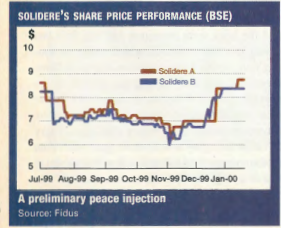
“There’s a good chance that Lebanese stocks will jump 40% to 60% if there is a peace agreement this year,” proclaims Philip Khoury, vice president at Merrill Lynch in London. Ask a local broker and he’ll say the same. And we’ve already seen some action. With negotiations almost building up steam, Solidere’s A and B shares jumped 40% from their November 1999 lows through January.

No analyst doubts that Solidere shares will benefit; investors expect more money to come in to gobble up Lebanon’s prime real estate once there is peace, bringing brighter days to the company’s earnings. An increase in Solidere’s shares would lift the entire market as its market cap alone accounts for about 70% of the Beirut Stock Exchange (BSE). Bank shares might follow. “Even though their earnings are not as good as before, price/earnings ratios are at fair levels,” says Jean Riachi, chairman and general manager of Financial Funds Advisors. “You’ll get an increase.”

But once prices reach higher levels and excitement settles down, will peace support stocks for the medium term, pushing prices higher?

Looking at the fundamentals, investors have to consider how much Lebanon’s economy will benefit from peace. According to Marwan Iskandar, a leading economist, the market will get a decent boost from a deal. He believes tourism will improve once Lebanon, Syria and Israel complement each other as destinations. There is a good chance that Lebanon will normalize its economic relations with Israel in a fairly short period, forcing the private sector to become more competitive, and Arab countries will have more freedom to consolidate their economic policies to create a common market. “The most important change will be a boost of confidence. It will give more incentives for foreign investors to come onto the scene in the Middle East, including Lebanon,” says Iskandar.

Others have doubts about how much Lebanon will benefit. Paul Salem, a development and political analyst, thinks many expats will move money back home. “And the agreement could stimulate renewed interest by the US, Europe, and possibly Japan.” But Salem expects foreign direct investment (FDI) to trickle into Lebanon: “This is a very small country; you’re not talking about India or Egypt.”

Ziad Maalouf, vice president at Middle East Capital Group, is wondering if it will even be a trickle. “Why would there be FDI? We have the highest labor cost in the region, the highest price of land, the highest price of raw materials, energy, water and the highest cost of living. Why would anybody want to build a manufacturing plant here?”

Another analyst doubts that Arab nations will liberalize trade. “Harmonizing those relations never got to what it could have been and Israel was not really in that equation. It’s always been politics before economics in the Middle East. They can eventually pull it off, but it will take time.”

As for normalization between Lebanon and Israel, Salem says: “There might be formal clauses related to normalization and trade attached to the peace agreement, but if documents are signed, I don’t think those in Syria and Lebanon will be very open to it, just as we saw in Jordan and Egypt. I’d expect a cold peace at all levels.”

Maalouf draws a parallel between Jordan after peace and what could happen in Lebanon. “Before Jordan signed, you wouldn’t believe how much excitement there was in the market. But stock prices today are close to where they were when peace arrived. The benefits from peace they were hoping for never materialized.” From 1997 to 1999, Jordan’s GDP growth rate dropped from 2.2% to 0.5%. Despite better business opportunities in Lebanon, Maalouf says Jordan was better prepared. “We have to get our house in order.”

Lebanon is in dire need of administrative and fiscal reform. Debt-to-GDP reached 130% at the end of 1999. The deficit was reduced from 43.73% in 1998 to 42.41% in 1999, but missed its target of 40.5%. The Economist Intelligence Unit predicts that Lebanon will have the slowest growth rate in the Middle East this year.

“The peace agreement will not go down to the bottom line right away,” says Salem. “I’m optimistic in a limited, cautious way. You’ll have a country that’s not at war. It’s an essential building block for economic development and important for any investor who’s thinking of investing in Lebanon.”

Investors are still waiting for BSE reform. Riachi says open trading and a regulatory body are essential. “We have to have a real market to see stocks move.” He predicts that after an initial jump in prices, stocks will level off until investors see more positive results. A building block will be a good start, but it’s difficult to predict what will happen after the flurry.

February 28, 2000 0 comments
0 FacebookTwitterPinterestEmail
Money Matters

Quantitative Viewpoint

by Richard Bernstein & Kari Bayer February 28, 2000
written by Richard Bernstein & Kari Bayer

Relative breadth was again very narrow

Perhaps the most influential variable in determining the success or failure of a portfolio manager is the relative breadth of the market. This measure is not the absolute breadth used by technicians, the number of stocks up versus the number of stocks down; it is the percent of the S&P 500 companies that outperform the index. For example, if 300 companies in the S&P 500 outperformed the index in a given year, then the relative breadth would be 60%.

Normally, about 43% of the stocks in the S&P 500 outperform the index during a calendar year, based on data from 1986 to 1999. If we exclude 1998 and 1999, however, that figure rises to 45%. Note that the odds are still skewed against managers. That means that managers had only slightly better than a one-in-four chance of picking an outperforming stock. Multiply those odds by a 25- or 30-stock portfolio, and it becomes quite clear why most managers underperformed in 1998.

In 1999, the relative breadth increased to only 31%. Obviously 1999’s relative breadth was not as narrow as 1998’s, but it was still extraordinarily low. In fact, 1998 and 1999 were the two narrowest years in the last 14 when using our measure of relative breadth.

Little skill needed in 1999 to pick outperforming technology stocks

Although the relative breadth of the overall market was extraordinarily narrow again in 1999, the relative breadth of the Technology sector was extraordinarily high compared to that of various other economic sectors. This means it took very little stock-picking skill to invest in a technology stock that outperformed the S&P 500 during 1999.

Nearly 70% of the stocks in the Technology sector outperformed the S&P 500 during the year. That implies one could have figuratively “thrown a dart” at a universe of Technology stocks to pick a winner for the year, and that the skill needed to pick a winner was relatively small when compared to the skill necessary to pick outperformers in a number of other sectors.

This may explain why there has been a trend among individual investors to shift away from managed funds to self-trading. Individuals have focused primarily on the Technology sector. Our guess is they attribute their success to their superior skill relative to the diversified fund manager rather than to chance. Our guess is also that few compare their performance to Technology indices or Technology funds.

The percent of the companies that outperformed the market in the Basic Industrial sector was the closest to the Technology sector’s, and it was only 51%. Thus, while the probability of picking a stock that outperformed the S&P 500 from the Technology sector was roughly 70%, the best that one could have hoped for in a sector outside of Technology was 50/50.

The probability of picking an outperforming stock was amazingly low in certain sectors. For example, investors looking at Financial or Consumer Cyclical stocks had roughly a four-out-of-five probability of picking up a stock that would underperform the overall market. But investors in Consumer Staples stocks had a 92% probability of picking a loser.

We wrote a report several years ago highlighting that managers were going to have a difficult time outperforming during the second half of the 1990s if the profits cycle continued to decelerate. Market leadership tends to narrow when the profits cycle decelerates because the market becomes extremely “Darwinistic.” Only the fewer and fewer companies that can continue to grow their earnings tend to outperform during such periods, while the performance of the companies whose earnings suffer lags.

That description certainly fits 1998 because the profits cycle decelerated for the fourth straight year. However, that does not help one understand why there was narrow leadership in 1999 because the profits cycle actually re-accelerated. Typically, when that happens, both relative and absolute breadth widen.

We continue to believe that 1999’s narrow leadership was the result of a speculative bubble in the “Nifty 50” and Internet stocks. Both interest rate and earnings fundamentals during the year did not support their outperformance. See “Ignoring the Catalyst,” Quantitative Viewpoint, December 15, 1999. We expect relative breadth to widen in 2000, and expect an increasing number of active managers to outperform their bogeys.

C&Ds and relative strength were the best performers for 1999

If we look at the annual performance of the roughly 45 strategies that we regularly monitor, the best performer for 1999 was our C&D Index, which was up more than 71% for the year. It was the strongest year for lower-quality stocks since 1991, when the C&D Index was up more than 90%.

The second-place finisher for 1999 was our Relative Strength Model, and it was up 64.3%. It should not be surprising to most investors that this particular model performed so well, given the “Nifty 50” environment that was so pervasive during the year.

Third- and fourth-place finishers should also be no surprise: High Five-year Projected Growth (+60.6%) and High Beta (+60.3%). Technology stocks are often characterized as high-growth, high-beta stocks, so it seems natural that these strategies should perform well during a year in which Technology dominated the market’s performance.

The two worst-performing strategies were our A Index and High Dividend Yield. This makes sense given that the A Index typically has the highest dividend yield of any of our proprietary “Quality” Indices. The A Index was down 6.5%, and High Dividend Yield was down 7.7%.

If one negates the “Nifty 50” effect, as our “Quality” Indices do by nature of their equal-weighted construction, then equity market performance in 1999 did indeed reflect that the profits cycle was re-accelerating. Lower-quality stocks handily outperformed higher-quality ones. The constituents of our “Quality” Indices are equal-weighted, and thus, 1999’s “Nifty 50” effect is somewhat negated by their construction, i.e., large-capitalization stocks and small-capitalization stocks have the same influence on the index’s performance.

Thus, our B+ and A- Indices performed relatively poorly despite the fact that many of the “Nifty 50” Technology stocks are contained in those indices.

GARP: growth at a reasonable ridiculous price

The Alpha Surprise Model is a GARP-based, growth at a reasonable price, strategy, and has historically been one of our most popular stock selection strategies. The model has outperformed the S&P 500 ten out of the last 13 years. As a blend of growth and value, it has been able to outperform during “growth” markets and “value” markets.

Given the narrow leadership of the market the past two years, it has become increasingly difficult for our strategy to outperform. It appears that growth at a reasonable price has been replaced by growth at a ridiculous price.

In 1999, our Merrill Lynch vs. Consensus Positive Earnings Surprise Model was up 20.6% compared to the S&P 500, which was up 19.5%. This performance was particularly impressive because we equal-weight the model’s portfolios, and hence the model only had a 31% chance of outperforming the S&P. This model comprises 75% of the Alpha Surprise Model.

The Dividend Discount Model, which comprises the other 25% of the Alpha Surprise Model**,** was up a mere 4.2%. This is not surprising, given that most value-oriented strategies performed poorly during the year.

However, adding just 25% value to an outperforming strategy in a market that does not care about valuation killed the overall Alpha Surprise Model’s performance. The Alpha Surprise Model was up 8.4%, underperforming the S&P 500 by 1,110 basis points.

Further demonstrating the efficacy of our EPS Surprise Model, our Merrill Lynch vs. Consensus Negative Earnings Surprise Model was among our ten worst-performing strategies in 1999. The model was up 3% for the year. However, adding 25% overvaluation or using the bottom S&P 500 companies by Alpha Surprise Model, one would have outperformed our traditional Alpha Surprise Model by 62 basis points.

Searching for overvalued stocks in 1999 appeared to be a good idea. As mentioned, our top-performing strategy last year was our C&D Index. It was up 71.4% and its current portfolio trades at 70 times current-year earnings. Our second-best-performing strategy was our Relative Strength Model. This model was up 64.3% and its portfolio trades at 87 times current-year earnings.

The “Nifty 50” by market capitalization, which we have been underweighting since the end of April, was up 20.1% in 1999 and currently trades at 78 times earnings. In contrast, the “Not-So-Nifty 450” was up only 7.7% in 1999 and trades at a relatively mere 26 times current-year earnings. Based on the performance of our Dividend Discount Model and the “Not-So-Nifty 450,” it actually hurt managers to search for undervalued stocks in 1999. This is an important point for GARP managers who may have underperformed this year.

We expect 2000 to be a better year for active management

As we have repeatedly stated, the more optimistic one is about the rejuvenation and expansion of the global economy, the more one should emphasize active management over passive management of one’s bogey. Active managers have had difficulty outperforming their benchmarks not because they suddenly became idiots, but rather largely because of the global deflation and recession, and the resulting decelerating profits cycles. As stated, market leadership tends to narrow when profits cycles decelerate, and markets become very “Darwinistic.” The narrower the leadership, the lower the probability that an active manager will outperform.

We expect global profits cycles to continue their present upturns. Accordingly, we believe that 2000 will be a better year for active managers. The time to index and constrain tracking error was in 1995. Today, investors should be encouraging managers to deviate from their benchmarks.

February 28, 2000 0 comments
0 FacebookTwitterPinterestEmail
  • 1
  • …
  • 701
  • 702
  • 703
  • 704
  • 705

Latest Cover

About us

Since its first edition emerged on the newsstands in 1999, Executive Magazine has been dedicated to providing its readers with the most up-to-date local and regional business news. Executive is a monthly business magazine that offers readers in-depth analyses on the Lebanese world of commerce, covering all the major sectors – from banking, finance, and insurance to technology, tourism, hospitality, media, and retail.

  • Donate
  • Our Purpose
  • Contact Us

Sign up for our newsletter

    • Facebook
    • Twitter
    • Instagram
    • Linkedin
    • Youtube
    Executive Magazine
    • ISSUES
      • Current Issue
      • Past issues
    • BUSINESS
    • ECONOMICS & POLICY
    • OPINION
    • SPECIAL REPORTS
    • EXECUTIVE TALKS
    • MOVEMENTS
      • Change the image
      • Cannes lions
      • Transparency & accountability
      • ECONOMIC ROADMAP
      • Say No to Corruption
      • The Lebanon media development initiative
      • LPSN Policy Asks
      • Advocating the preservation of deposits
    • JOIN US
      • Join our movement
      • Attend our events
      • Receive updates
      • Connect with us
    • DONATE