• Donate
  • Our Purpose
  • Contact Us
Executive Magazine
  • ISSUES
    • Current Issue
    • Past issues
  • BUSINESS
  • ECONOMICS & POLICY
  • OPINION
  • SPECIAL REPORTS
  • EXECUTIVE TALKS
  • MOVEMENTS
    • Change the image
    • Cannes lions
    • Transparency & accountability
    • ECONOMIC ROADMAP
    • Say No to Corruption
    • The Lebanon media development initiative
    • LPSN Policy Asks
    • Advocating the preservation of deposits
  • JOIN US
    • Join our movement
    • Attend our events
    • Receive updates
    • Connect with us
  • DONATE
ProfilesSpecial ReportWomen's empowerment

All in a day’s work

by Nabila Rahhal March 12, 2019
written by Nabila Rahhal

To paraphrase a popular saying: You cannot truly understand someone until you have walked a mile in their shoes. Even with all the research and theorizing on the plight of working moms, fully grasping the experience of raising children while maintaining a career requires actually living it, or the next best thing—truly listening to those who do. Executive spoke with working moms from different industries, at different career stages, and with children of varying ages, and asked them how they manage to do it all. While these mothers only represent a fraction of the working moms in Lebanon, we hope that there are enough shared experiences for our readers to identify with or learn from.

What emerged from our conversations with these women is that all of them rely on their extended family for childcare. This is not surprising given the tight familial fabric that exists in Lebanon, but could also be a symptom of the lack of easily accessible and available childcare options, such as babysitters or support from employers.

All of the moms Executive profiled also noted that their husbands share the responsibility of raising the children, perhaps an indicator that the traditional image of the Lebanese man who believes his wife’s place is at home with the kids is gradually changing. This is not to say that the women we spoke to do not feel that there is still a long way to go before working mothers can be as free to pursue their careers as their husbands are, but at least the conversation has started.

MOTHERHOOD ON THE ROAD

  Greg Demarque | Executive


Name: Dalal Mawad

Profession: Middle East video producer at UNHCR

Children: A daughter, aged two 

Dalal Mawad travels on average five to 10 days per month for her work, despite the fact that she has a two-year-old daughter. “I’m not going to lie; I do miss out on moments [of my daughter growing up] because I’m not there, but it’s a choice I made, and I don’t see why a dad can have a career, and a mom can’t,” Mawad says. She personally hates the term “working moms,” arguing it should be a given that mothers work—just as it is given that fathers work and are not labeled as working dads.

Mawad says she counts on family support when she is away for work. Her mother lives far from the family, so Mawad relies on her mother-in-law to pick up her daughter from the nursery at 2 p.m. and care for her until she (when in Lebanon) or her husband comes back from work. “My daughter is very fond of her grandmother. It’s been easy because I get along with her grandmother when it comes to [child] education and upbringing, so we don’t clash. If we had clashed, it would have been much harder. I feel very comfortable and at peace with myself when I am away,” Mawad says.

Her husband—who is self-employed but works long hours—is also integral in taking care of his daughter when Mawad is away. “He’s there for her bedtime routines, and on the weekends he’s with her all the time. We are very equal at home when it comes to child rearing and other responsibilities. This is why I’m able to do what I do, and he’s very supportive of what I do. We found a system where we are both comfortable,” she says.

Speaking of being away from her daughter when she’s traveling, Mawad says: “It’s not easy, and I won’t lie to you that I don’t feel guilty sometimes, because I do, but I’m not one of those mothers who are control freaks and worry about their children all the time. When I’m at work, I focus on my work and I’m at ease because I know she is in good hands. I check on her once a day in the evening when we Skype or FaceTime.” Mawad explains that her daughter has gotten used to this lifestyle because she has been traveling since she was still breastfeeding.

When Mawad is in Beirut, her schedule is much more flexible and she spends a lot of time with her daughter. “I try to leave the office early as we don’t have stringent hours,” she says. “I see her in the morning and dress her up before her dad takes her to school. My job also allows me the flexibility of working from home, so on those days I pick her up from nursery and stay with her all afternoon. I kind of feel that I make it up for other days where I’m gone all the time.”

Mawad says she hopes she is providing her daughter with the role model of a woman who is passionate about both her career and her family, and with the example of a father who is engaged in raising his family too.

A TALE OF CHILDCARE IN TWO CITIES

[media-credit id=1966 align=”aligncenter” width=”640″][/media-credit]

Name: Eveline Hitti

Profession: Chairperson of the Department of Emergency Medicine and deputy chief medical officer at American University of Beirut Medical Center (AUBMC)

Children: Two daughters, aged 14 and 15, and a son, aged 10

Eveline Hitti’s three children were born in America. She had her first daughter during her second year of residency—a stage of graduate medical education where one practices medicine under the supervision of a licensed practitioner—at Johns Hopkins Hospital in Baltimore, Maryland, and her second daughter a year later. “This is a bit unusual, because in a three-year residency program it’s hard to have one child, but I ended up having two,” Hitti says. “In hindsight, it was probably not a bad thing because in a residency you can plan to some extent. After residency, and especially for emergency medicine, vacation becomes a bit challenging because you always have to find someone to cover for you.” She had her third child while she was working and says she went back to work five weeks later because she “felt the pressure of having to go back to work, both financially, and from the burden on the [team],” whereas with her daughters, she was able to take two months off after each of their births.

In America, Hitti says she was the primary caretaker of the children. During her residency, the couple outsourced childcare to a nanny (her husband was a PhD student at the time), and Hitti would take care of the children when she was home. When she finished her residency, she says she intentionally chose a nonacademic hospital so she could have control over her hours because she knew she was going to shoulder most of the responsibility of childcare. As such, she chose to work three full nights a week, despite that being considered a tough schedule.

When her children were aged one, four, and five, she and her husband decided to move back to Lebanon, and she began working at AUBMC. “The big difference I felt in this transition is that, in Lebanon, there is more family support, but my job changed a lot from the US to Lebanon. In the US, I was working full time, but in a place that was not academic, so I had only my clinical responsibilities, and I feel that helped a lot in that I spent a lot more time with my kids when I was there,” Hitti says. “But with AUB came the extra load of teaching, research, and administrative service, which has a high-impact potential, of course, but also a higher time commitment—the spillover into personal and family life is a lot more when you have all these responsibilities. Adjusting to working at AUBMC was a big challenge, as was adjusting to negotiating the responsibilities at home as a result.”

Before all of her children started going to school, Hitti says they outsourced childcare to their families and daycares, but there was also a little shift toward her husband—currently a professor of communications at the Lebanese American University—becoming more engaged in childcare.

Hitti became interested in researching the gender gap in careers and shifting the perception of childcare  being a mother’s responsibility to it being a shared responsibility for two reasons. The first was her personal experience with childcare, the second was attending her 13-year reunion at Johns Hopkins and discovering that four of the eight females who had graduated with her are no longer practicing emergency medicine, while four men in the class had high-level positions in their field.

It TAKES A SUPPORTIVE ENVIRONMENT

[media-credit id=1966 align=”aligncenter” width=”640″][/media-credit]

Name: Ghina Ramadan

Profession: Communication manager at Resource Group

Children: A daughter aged four and a half

When Ghina Ramadan was pregnant with her daughter, she was hired by the marketing department of a bank. She recalls telling them that she was pregnant at the time and their reaction being nonchalant, which she found unusual given the stories on corporations shying away from hiring pregnant women.

She returned to the bank after her 70-day maternity leave, which she found too short. “You are still not ready, physically or mentally, [to go back to work]. At that point, the baby still does not have a set sleeping schedule and wakes up at night. After I gave birth, I moved back to my mother’s house for six months so she could help me with the baby, and we would alternate waking up with her at night. I felt like I was doing hard time,” Ramadan recalls, adding that a fair maternity leave would be six months, in her opinion, although a year off would be ideal.

For the first year and a half of her daughter’s life, Ramadan would drop her at her mother’s while she was at work, before finally enrolling her in daycare. By that time, Ramadan had left the bank and was working at an advertising agency. Her husband, who worked in the nightlife business and was flexible during the day, would pick up his daughter from daycare at 4 p.m. and drop her at Ramadan’s office in downtown. “By its nature, an [advertising] agency job is more flexible with working hours—maybe because we often stay late working on deadlines—so it is beneficial for working mothers. I could even bring my daughter to the office for a bit, which does not happen often in the corporate world,” Ramadan says. “My boss had a daughter close to my daughter’s age, so she was very understanding and would say that children come first. I would often continue working from home after my daughter slept.”

For personal reasons, Ramadan left her work at the agency and was out of the workforce for six months. “It was the first time in my life that I had been without work, and I felt that my life was empty. I felt I was not evolving at the same rate, intellectually or socially, and was not a productive member of society,” she recalls.

In early 2018, she began working with her current employer, Resource Group, an investment company. Here again, she benefited, as do all mothers in the company, from the option of working from 8-5 p.m. instead of 9-6 p.m, and from flexible working in case of family emergency. “This is very important, and I recommend that all companies do that. When a woman feels supported, she is more productive and dedicated to the job,” Ramadan says. “I know some women whose work did not provide them with this flexibility and they left their jobs. In our society, mothers play the bigger role in raising their families and should be supported at their work so they can do that.” 

Ramadan believes such flexibility in work conditions requires that employees have a strong work ethic and good time management skills. She often has a quick lunch on her desk or continues working from home so that she is never behind on her workload.

THE GREENER GRASS

[media-credit id=1966 align=”aligncenter” width=”640″][/media-credit]

Name: Layla Shatila

Profession: First grade teacher at International College (IC)

Children: A son aged nine, and a daughter aged five and a half

Teaching was traditionally perceived as an ideal job for a mother. While today all career options are—or should be—open to women, teaching still has undeniable benefits for those balancing work and childcare, Layla Shatila says. “The children get to go and come back from school with me, so I don’t have to worry about who’s going to pick them up and drop them off. While other career options usually have late working hours, teaching allows my children to be with me most of the time, and so I don’t have to leave them with the nanny while I am working late.” Most days, Shatila leaves school with her children at 2:30 pm, and when she has after-hours meetings they wait for her in her classroom.

Teaching is also convenient for mothers in that—apart from the occasional professional development conferences abroad—no work-related travels are expected. Shatila says teaching also helps her raise her children, since she often uses the same behavior management strategies she uses with her students to discipline them.

She says, however, that teaching is an all consuming job that sometimes leaves her with little energy for her own children. “Teachers are drained physically and mentally from dealing with children all day. I wake up at 6 a.m. and have to be full of energy welcoming the students at 7:30 a.m. and spend the day with them until 2:30 p.m,” Shatila says. “We also have meetings twice a week until 4 p.m., so by the time I’m done, I’m drained, but still have to help my son with his homework and spend time playing with both my children.”   

Before the kids reached the age of two (when they would be allowed to enroll at the daycare located a few steps away from the school she teaches in), Shatila was like any other mother figuring out the best childcare options for her family. With her son, she was lucky enough to be granted an academic year off work and returned to school when he was eight months old. She then left him with her in-laws, who lived near the school in which she taught, and would spend her breaks with him. With her daughter, she was refused a year off work and so she quit. “I felt that I can’t leave my children before they are at least eight months old. I stayed with her until she was a year old and then I started work at IC,” Shatila recalls. The daughter spent the following year home alone with the domestic helper before being enrolled into daycare. “I would worry about her, but I had no choice. Once she started daycare, and my son was in school already, things got much easier.”

Although Shatila is not at work in the afternoons, she still has a lot going on and has to manage her time efficiently. “I have to be very thorough in organizing my time between my lesson planning and work responsibilities, and my children’s activities, wellbeing, and homework,” she says. “I also need ‘me time,’ which is usually spent at the gym, while the children stay home with their father or with the helper. I also have to think of my time with my husband, which we barely have because one of us is usually with the children.”

A HECTIC YET FUN LIFE

[media-credit id=1966 align=”aligncenter” width=”640″][/media-credit]

Name: Mireille Korab

Profession: Head of business development and communication at FFA Real Estate

Children: Three sons aged two, four, and seven

For Mireille Korab, juggling a demanding career while raising three boys is a challenge she relishes. “It is overwhelming, but I love it. Everybody asks me how I manage, and the answer is that I don’t manage, I do my best and try to manage,” Korab says.

Speaking about the experience of having three boys while growing a career, Korab says: “With each child, it got easier emotionally because you get used to the idea that you have to leave the house to come back to work, and that you have to separate the working hours from the mothering and worrying hours. But it gets harder trying to fit in taking care of three boys and managing your job up to your standards and taking care of the house, the husband, and your social life, and trying to find time for your self-care, and even for shopping because there is no time for shopping—thank God for Instagram so that we can shop online!”

Korab says her job entails attending afternoon and evening engagements, such as gala dinners or receptions and openings for clients’ places, which takes time away from her family. She feels the hour and a half during which she carries out bedtime routines with her boys is a crucial time for her, so she has taken to leaving the office early, if possible, when she has evening commitments, even if she spends extra time commuting.

Korab had a live-in Lebanese nanny, Angel, who moved in with her when each child was born and stayed for the first year. “Angel is an essential part of me being able to have three kids while working full time and commuting three hours to and from home in Adma[to Beirut],” Korab says.

Now that her sons are older, she relies on family support for childcare. “My husband and immediate family are really a big support in handling everything in terms of the children’s activities and commuting from school,” Korab says, adding that she would not have been able to do it without her husband, who is very helpful with the children, handling the logistics of their daily commutes and waking up with them when needed. She and her husband make sure they do not travel for work at the same time so one of them is always with the children.

When her first son was younger, he would ask Korab why she did not pick him up from school like most of the other mothers. She has since made it a point to highlight that each member of their family has an independent life. “I make it a point to share little events from my day with them, and I ask them about theirs. That way, I show them that they can have their own day without needing their mother to be around,” she explains.

Korab hopes that she and her husband are good role models for their boys. “I think that their dad and I giving them this model of working parents who really try to do their best for their kids, and who organize their time for them, should push them to find partners who have this same ambition, and are really helpful to their partners. This is when I will see if I did it or not, when I see how they will treat their spouses,” she says.

OF PASSION AND DELEGATION

[media-credit id=1966 align=”aligncenter” width=”640″][/media-credit]

Name: Nadine el-Khoury Kadi

Profession: Chief Operating Officer of Robinson Agri

Children: A daughter aged 15, and a son aged 18

To Nadine el-Khoury Kadi, being a successful working mother entails three main aspects: a good support team, delegation, and passion.

Khoury Kadi’s support team includes her parents who helped her with childcare and household tasks. “When my children were young, I would leave them at my parents’ [home] or my husband’s parents. When they started going to school, they would go to there afterwards,” she recalls.

Her husband provides unconditional support so that she may excel in her career and looks after the children when she has business trips. “In Lebanon, we are luckier than in Europe because we have an extended family support system. Also, all the husbands I know are supportive of their wives’ careers, and so the perception of the traditional Middle Eastern man is changing in my opinion. My father, for example,  equipped us with culture, education, independence, and thinking out of the box, ” Khoury Kadi says.

At work, Khoury Kadi is supported by her sister who shares her passion for innovation and sustainability. Together, they run a successful enterprise, leaving a special mark in the agricultural sector. As COO, Khoury Kadi has learned the power of delegation. “Alone we can go fast, together we will go far. The more a leader empowers her employees, the better they perform at the job. As such, we create an environment for the team where sharing knowledge and values is a source of strength,” she mentiones.

Being a working mother herself, Khoury Kadi says she knows what it means to balance work and home. Saturdays are days off, and she allows her employees—both women and men—to leave work early, or take time off if they have something related to their children. “But they all continue their work at home and meet their deadlines, even if they left the office early. This is because they know I trust them, and they are happy, so they produce more,” Kadi explains.

  Finally, Khoury Kadi loves her work. “I am passionate about agriculture and aim to develop smarter farming and solutions. This summarizes my moto in life: the three Ps of patience, passion, and perseverence” she says.

Khoury Kadi compares her brain to an excel sheet and says she has to be very organized to strike a healthy balance between work and home. “As a working mother, I have to always compensate and balance. If I’m traveling one weekend, I make sure to spend extra time with my husband and children the following weekend, for example,” she says.

Khoury Kadi says parenting her teenagers is a different experience than when they were children. “They are confused at this age, and you have to know how to approach them. It is a nicer age in a way, but harder for a parent,” she says.

Khoury Kadi has worked throughout her children’s lives and says this is very natural to them, especially since some of their friends’ mothers work. “When they see me on TV they are very proud that I work and am successful. My husband and I still make time for them, and we travel together as a family on an annual basis, no matter what happens,” she says.

LIVING WITH GUILT

[media-credit id=1966 align=”aligncenter” width=”640″][/media-credit]

Name: Nayiri Manoukian

Profession: Head of Human Resources at Bank Audi

Children: Two sons, aged nine and 13

To Nayiri Manoukian, being a working mother is perfectly summarized in this quote: “Women are expected to work as if they don’t have a family and raise their family as if they don’t have work.”

Manoukian believes the core issue facing working mothers today is an intrinsic feeling of guilt that they are not doing enough for their families. In her opinion, this is related to the way women are raised. “I come from a family where my mother never worked and would always have lunch prepared when we came back from school.  So I come from this background of a traditional mother who raised me to always put family first,” Manoukian says. Her father, however, raised her with a different perspective, supportive of a working woman. “He was insistent I obtain higher education, something he was deprived from, and continue to learn as long as I am able to do so,” she says. “He was also insisting on financial independence, continuously preaching to spend with caution and be in control of my financial situation.”

When she got married and had her first child, she continued to rely on her parents’ support.  “When I gave birth to my first child,” Manoukian recalls, “I used to work in oil and gas and would stay in the office until minimum 7 p.m. I would alternate leaving my son at my mother’s and my mother-in-law[‘s home]. You can imagine my mother’s attitude in regards to me picking up my son late at night, and she would berate me for not having time for my family and child! On the other side, I had the full support of my father and husband, who would remind me that my career is very important, and that I should focus on it.”

Although her husband has been very supportive of her career since day one, she is still expected to manage the household and childcare. “I delegate of course, or as my husband puts it, I subcontract. So I don’t do the cooking, but I am the one who has to make sure the cooking is done; I don’t clean the house myself, but I make sure the house is clean etc—this takes time,” Manoukian explains, adding that now that her kids are older, they are independent enough to stay home with the helper until she is back from work.

All this led to a feeling of “mom guilt,” which Manoukian feels all women share to some extent. “With my second son, I remember coming back from my maternity leave with tears in my eyes and thinking I had one (child) whom I never had enough time for, and now I have two. Why am I putting them through all this?” she asks.

When she shares her feelings of guilt with her husband, Manoukian says he reminds her that the boys will eventually leave them to start a life of their own, so all she can do is be an example for what they should look for in a partner. “I think I am raising my boys to expect their wives to be sharing with them the household expenses, as well as raising the children,” Manoukian says. “They should see women as equal partners. It is our generation that will raise the next one to have the right mentality, and that will go into the next generation.”

March 12, 2019 0 comments
0 FacebookTwitterPinterestEmail
Special ReportWomen in the workplace

Caught between home and the office

by Nabila Rahhal March 11, 2019
written by Nabila Rahhal

A typical week-day in the life of a woman with a career and children looks something like this: She gets out of bed at 6 a.m. to get her children ready for their day, then goes to work for at least nine hours (often working through her lunch break) before picking up her children from daycare or their grandparents and being fully engaged with them and their needs until they sleep at 8 p.m. She then spends the remaining few hours before going to bed either catching up on small household chores or work, spending some quality time with her husband, or doing things that interest her—and the next day she gets up to repeat it all again.

Although working women share the economic responsibilities of the household with their partners—or as single working moms, or with a partner who is unable or unwilling to contribute, take on the responsibility alone—societal norms still dictate they are the main caregivers of their children and the ones in charge of household affairs. According to the World Economic Forum’s (WEF) Global Gender Gap Report 2018, women tend to perform the majority of unpaid tasks—defined by the report as mainly housework and household care. In 29 of the 149 countries included in the report, women spend twice as much time on such activities than men. In Lebanon, a 2018 qualitative assessment conducted by the World Bank revealed that 70 percent of those surveyed said that the wife was responsible for domestic duties.

While the birth of a child is a joyous moment in a woman’s life, for women who work, it also comes with the worry of how to manage everything once their brief maternity leave ends.

Return on investment 

This dual role that women play once they become mothers has restricted their ability to build and sustain a career. Although more women are acquiring a university education than in previous decades—a 2013 report published by the Collective for Research and Training on Development-Action (CRTD.A) indicates that roughly 51 percent of university graduates in Lebanon are women—not all of them are utilizing this degree to get a job. The same report admits there is little national information on the participation of Lebanese women in the formal economy but says that various studies place it between 21 percent—which is the average for the Arab world—and 27 percent. Moreover, the report indicates that women are most likely to drop out of the labor force at childbearing years and beyond.

According to the World Bank survey, one of the major challenges for Lebanese women to enter and remain in the labor market is their home responsibilities, which include taking care of children and elderly relatives. The other challenge is societal pressure exhibited in the attitude of the community toward working mothers, and the mentality that a woman’s place is at home with her children. “We hear this time and again that there is pressure [on women] to be at home and take care of the children, and it is the man’s responsibility to be the breadwinner,” says Frida Khan, gender specialist at the International Labor Organization. “Definitely, there is pressure for this, and I’ve seen a lot of research, generally from the region, talking about cultural issues being a restraint in women’s participation in the workforce, especially after having children.”

Both these challenges are clearly at work among the women Executive talked to in this report. Some of the Syrian women working at Anamel, an NGO that works with Syrian refugees, told Executive that they are only working because they need to support their family and would stop doing so if they were financially secure; in their perspective, their main role is to be at home with their children. One of the Lebanese women Executive profiled, meanwhile, says her mother still criticizes her for not giving enough time to her children because of her work.

If taken from the perspective of the investment in education versus the outcome in productivity, then the economy suffers because there are not enough educated women in the workforce. “The economy needs women’s contributions, since half of the population and the majority of university grads are women,” says Nada Genadry, human resources director at Liban Post. “It would be a pity to have so much payment done on educating women for no return to the economy in comparison with the investment.”

Women on top

Childcare responsibilities are also one of the obstacles in the way of women reaching senior positions. The WEF’s Gender Gap reports that only 34 percent of global managers are women. Lebanon is one of five countries worldwide where the gender gap for managerial positions is at 90 percent.

While there are several factors at play for this, the responsibility of childcare being placed largely on women is a major factor. Speaking from her own research on the topic and from her experience as a working mother, Eveline Hitti, chairperson of the department of emergency medicine and deputy chief medical officer at American University of Beirut Medical Center (AUBMC), says that we need to change the way we look at childcare if we want women to grow in their careers. “After my experience, it became very clear: You can fix so much, but at the end of the day, if a woman is drowning between work at home and work at work, something has to give. This concept that we [women] are superheroes that can take 40 hours work weeks and put the same time at home is not going to work for anybody,” Hitti says. “I am not belittling the obstacles at work and glass ceilings and all that—there is still more that organizations do [in that regard]—but I think that even if you fix all this stuff but don’t change the way you look at childcare, and you don’t see it as a shared responsibility between the parents and not just the job of one person, namely the mother, I don’t think we will ever be able to close that gap.”

Genadry believes that it is the private sector and corporations that can jumpstart this mindset of childcare as a shared responsibility. “The theme of working women should be enlarged,” Genadry says. “It is time for us in Lebanon to think about educating men and women to share household chores, and I think we should rely on companies to do that. Even women need to be educated because they have difficulty delegating what they do, thinking that it is their responsibility, while in fact it is parenting.”

In January 2018, Lebanese labor law allowed for a three-day paternity leave, a move which the ILO’s Khan sees as positive—despite the absurdly short length of the leave—because it kick starts the conversation regarding the role of fathers in parenting.

The short leave

For the time being, parenting is still viewed as mainly the mother’s domain and so, if women are to be active contributors to the economy after childbirth, then they need support to do so. This support often starts with maternity leave which, in Lebanon, was extended to 70 days in April 2014. Khan says that while the extension is commendable, it still falls short of the 14-week leave that is recommended by the ILO convention. All of the companies Executive spoke to for this article agree that the maternity leave in Lebanon is too short. “I believe that maternity leave should be 90 days,” says Yara el-Ali, head of human resources at ABC. “Because if you take the normal evolution of babies, at three months old they would be more developed and could then be left at a nursery or with their parents.”

What Khan says is lacking from the Lebanese labor law, but found in the laws of neighboring countries, such as Jordan or Syria, is a woman’s right for an unpaid leave following her maternity leave—without the risk of losing her job. While this is not part of the law in Lebanon, some companies Executive spoke to say they do make exceptions if needed. “Maternity leave is 70 days, but if a mother wants to take more days, we give her the choice of unpaid leave,” Nayiri Manoukian, head of human resources at Bank Audi, says.

The big dilemma

One of the main thoughts on a woman’s mind while she is on her maternity leave is what to do in terms of childcare once she goes back to work. While in Lebanon reliance on family members, especially the child’s grandmother, for childcare is common—all the mothers Executive spoke to say this is what they did—this is not always an option. “The first problem she’ll face is who will take care of the child,” Khan says. “Before there used to be large extended families, and there was always a family member or another woman to take care of the child, but as we go more and more into nuclear families that’s not the case anymore.”

For mothers who do not have the luxury of having family help with childcare, options in Lebanon are limited. While Hana Jojou, president of the syndicate of nurseries and daycare owners in Lebanon, says daycares are allowed by law to enroll children at the age of 70 days, her own nursery, Dent De Lait, takes children in only when they can walk. “Very few daycares accept children at [70 days] because of the risks at that age—the average age they accept children is at four months,” she says. “Parents have to be very careful in selecting daycares for their newborns, and it is better to leave them with nurses in that case.”

Khan says Jordanian law mandates that if a company has 20 or more mothers with children, then it is the employer’s duty to provide an onsite childcare facility for them; in Lebanon this is still in discussion among private sector players. “Based on our work, we know that the conversation regarding onsite childcare facilities is increasing,” says Zeina Mhaidly, program manager at the Lebanese League for Women in Business (LLWB). “One of the main concerns voiced by companies regarding this is that it is a big responsibility, and they would need to train or hire staff for that. The extra cost was also a concern, and they said it would need a feasibility study.”

Ali says ABC has made an onsite daycare facility its second priority for 2020, as part of their internal corporate social responsibility goals. “The problem is that there is a high level of responsibility, and also we have three flagships which are geographically diversified, so it’s hard to find a good central location for one daycare,” says Ali. “We also have to do the financial study on how much it will impact us. But there is a huge benefit because daycares these days are very costly, and also it gives the mother peace of mind that her child is close by and in an environment she trusts.”

Some mothers who do not have the option of family childcare either hire a babysitter—though these are still in relatively short supply in Lebanon—or leave their child with their domestic worker.

A mother’s milk

When a woman returns to work after her maternity leave, she is often still lactating and therefore needs workplace provisions to pump her breast milk.

Khan says that Jordan’s labor law allows for two half-hour breastfeeding breaks for mothers who have returned to work after maternity leave but says she has seen nothing similar in the Lebanese labor law. LLWB’s Mhaidly says they worked with three pilot companies—LibanPost, Fattal, and Teknika—to assess their policies when it comes to gender equality and found that having provisions for breast pumping is very much up to each company’s policies and initiative.

Genadry says Libanpost allows lactating mothers to leave work an hour early so they can breast pump, as a mother’s milk is important for a baby’s development. Bank Audi has designated a breast pumping room in its headquarters. “Since a lot of mothers return from their maternity leave still needing to pump, instead of them using the bathrooms, we have created a lactating room in a private space, which is well equipped and clean for breastfeeding mothers,” Manoukian says.

The power of flexibility

Women need flexibility in their work environment to manage raising a child at the same time as pursuing their career. “Usually, the difficulty women face is in the time where they have small children and are stretched. Basically what they need most in that period is flexibility in time,” Genadry says.

The representatives of all the companies Executive spoke to say they have introduced a “flex-hour,” meaning employees can come to and leave work an hour early. This is mainly used to escape traffic, but it can also be used by parents to maximize time spent with their children. Samar Diab, head of human resources at the American University of Beirut (AUB), says that they have recently coordinated with the workers and staff syndicate at AUB to implement an alternative to the 8 a.m. to 5 p.m. working schedule. In certain cases employees are allowed to come to work at 7:30 a.m. and leave at 4:30 p.m. “Employees from several departments have asked for this as it helps them with commute, as well as those who have children and want to get back in time to help them with homework,” she says.

Liban Post recently introduced part-time work, but Genadry admits that the response has not been very favorable because it can come with reduced pay and benefits. Those who do use it are usually students.

Work from home, or a condensed work week are still not viable options in Lebanon. “You need to have the right culture and have employees who are responsible enough to be granted this privilege. We are not yet there,” Genadry says.

A woman who feels comfortable and trusted within her work environment will produce more. “If you give this motivational flexibility it will definitely increase the engagement for working moms and show her that we appreciate her role as a mother, which is as important as her job,” Ali says. “I can tell you from my team, when I am flexible with them they feel motivated to give me more.”

While it may still be a while before Lebanese women achieve the perfect balance between their role as a parent and their career, the conversation is underway, and there are signs that shifts in societal attitudes and steps taken by employers are heading in the right direction.

March 11, 2019 0 comments
0 FacebookTwitterPinterestEmail
LeadersOpinion

Time for a change

by Nabila Rahhal March 11, 2019
written by Nabila Rahhal

In most Arab countries, Mother’s Day is celebrated on March 21. On this day, a woman’s role as a mother, the giver of life and the nurturer, is suitably enough recognized on the first day of spring, the season which marks nature’s rebirth. This is a widely celebrated day in Lebanon, with queues forming outside of flower shops, and people rushing to show their mothers love and gratitude for their many sacrifices in raising them.

March 8 is also International Women’s Day, the day where all women are celebrated for their achievements. It is interesting that both these days fall in the same month, reminding us that women have other roles in society, besides the role of a mother. These days, more women are active participants in the labor force, thriving in their chosen careers. But these same women are also expected to prioritize raising their children to the point of neglecting their career when they become mothers. Domestic responsibilities (namely childcare) are the main reasons women leave the workforce—many women drop out of the labor market during the years of having and raising children.

If we want women to excel in their roles as mothers, as well as in their roles as economic contributors, then things have to change. To begin with, raising children and taking care of the household can no longer be perceived as the woman’s domain alone. It takes two people to bring a child into the world, and it should take two people to raise it—parenting must become a shared responsibility between the mother and the father.

While most of the women Executive profiled said their husbands are supportive of their career and play an active role in parenting, the responsibility of childcare still laid heavily on their shoulders—this is a symptom of the pressure society puts on women to place their mothering role above all else. Lebanon has taken a very small step in the right direction by instituting a three-day paternity leave, which has at least kick-started the conversation regarding the role of the father within his family. But there is still a long way to go, and more awareness needs to be raised before childcare can be shared equally by both parents.

Support needed

In the meantime, it should be acknowledged that mothers who also work are carrying a heavy load, and so measures should be put in place to lighten it thereby allowing women to excel in their careers and in raising their children.

As a start, civil society should support working mothers in demanding that the maternity leave law, which currently gives mother 70 days paid leave with no risk to her job, be amended and extended. All of the heads of human resource departments Executive spoke to, and the working mothers said seven weeks was simply too short a leave. Many countries allow for up to a year of parental leave recognizing the importance of mothers—and fathers—bonding with their child at the early stages. While giving a year off for maternity leave may not work within the Lebanese context, a six-month leave—during which the child would develop enough to be left at the daycare or with family, and the mother would be physically and emotionally ready to go back to work—should be implemented.

The private sector should also recognize its role in giving support to working mothers. Corporations should revise their internal policies in favor of their female employees who are mothers. As such, and in today’s digital world, flexible working measures, such as working from home, or a condensed work week should be discussed by these corporations and implemented where it makes sense to do so.

As we celebrate Lebanese mothers and all women this month, we should offer them more than lip service by having fathers step up and assume responsibility in the household, and by realizing that in order for women to continue to do it all, they should be given the right support.

March 11, 2019 0 comments
0 FacebookTwitterPinterestEmail
Editorial

Dismantling privilege

by Yasser Akkaoui March 11, 2019
written by Yasser Akkaoui

A friend of mine, an ex-minister, once told me, “The Lebanese system works perfectly, like clockwork—but in all the wrong ways.” The money pledged by the international community at CEDRE requires long overdue structural reforms on our part. Take the deficit caused through subsidizing the failing public utility Electricité du Liban (EDL). To actually fix EDL would require our politicians to dismantle a parallel industry of which they are the benefactors. The corruption that keeps sectors like telecommunications and electricity profitable for our elite is entirely of their own making; and only through self-inflicted wounds would they be able to reform these sectors for the benefit of all Lebanese. The frequent foreign delegations who come to Lebanon surely laugh as they come out of another pointless high-level meeting, knowing that the problems they have raised were caused by these politicians, and the reforms that are so desperately needed have been blocked by these same men—and it has been men—for decades. Meanwhile, the distance between our government and the private sector and citizens continues to grow. Our government is still trying to figure out problems that should have been solved in the past, while our citizens and the private sector are looking toward our future in the digital age. The worry is that the more they move into the digital world, the more their reality will be on screens rather than on the streets—leaving our politicians free to manipulate those who are left behind. Our survival depends on our ability to stay connected to the realities on the ground. And one reality that we cannot ignore, as we celebrate another women’s month, is that when it comes to gender roles, Lebanese culture has to change. And it is not our women who have to change, it is our men. Women are doing their best in a system designed against them. Men are doing their worst in a system geared to their every whim. Lebanese men have to cast aside their entitlement and make the necessary changes to push Lebanon into the 21st century. They must tear down the current system—one made by men for the benefit of men—so that all Lebanese, regardless of gender, are treated equal.

March 11, 2019 0 comments
0 FacebookTwitterPinterestEmail
Brand Voice

Can we talk about ‘better’ alternatives to cigarettes?

by Farah Makkawi February 22, 2019
written by Farah Makkawi

According to American Cancer Society estimates, cigarette smoking accounts for nearly one in five deaths in the United States alone, whereby deaths resulting—whether directly or indirectly—from smoking has increased dramatically over the last 50 years.

Relatedly, the U.S. Centers for Disease Control and Prevention estimates that smoking increases the risk of coronary heart disease by two to four times, stroke by two to four times, and lung cancer by 25 times.

Dr. Bernard Harbieh, Cardiologist at the Kesserwan Medical Center affiliated with the American University of Beirut Medical Center (AUBMC), provides his take on this topic. He says, “One cigarette is made of thousands of chemicals, including at least 70 of them that are known to cause cancer, also referred to as ‘carcinogens.’ The most toxic out of these substances are tar, carbon monoxide, nitrogen oxides, hydrogen cyanide, metals, ammonia and radioactive compounds, among others. He adds by saying that nicotine remains the main addictive compound that produces the effect people look for when they smoke.”

In other words, as Professor Michael Russell once said, “People smoke for nicotine, but they die from the tar.”

Dr. Harbieh explains that “the most important element in smoking cessation comes from the smokers themselves. They should be convinced and understand the risks of continuing to smoke.”

Furthermore, he speaks about a variety of ways and tools to quit smoking, among which:

  1. Behavioral therapy, which involves working with a professional counselor, or therapist, in order to address the psychological and behavioral attitudes that prompt the patient to smoke.
  2. Nicotine replacement therapy (NRT), which comes in different forms, including nicotine gum, patches, inhalers, sprays, and lozenges.
  3. Medications, such as Bupropion and Varenicline, that can help with cravings and withdrawal symptoms.

He adds that “in some cases, a combination of two or more treatments can be a necessity to help the patient quit.”

When asked about alternatives to conventional cigarettes, and whether some might be considered to be less harmful than others, Dr. Harbieh states that “there are several forms of tobacco products in the market, and people often think some forms are completely safe and do not cause health problems. This is simply not true, and the best way for those concerned about their health is to quit tobacco products altogether.”

Nevertheless, he speaks about a certain type of products, also known as “heat-not-burn” alternatives, which operate by generating a nicotine flavored aerosol, out of heating tobacco sticks consisting of tobacco and other ingredients without lighting them on fire.

Dr. Harbieh says this definitely could reduce the amount of some of the harmful chemicals, given that combustion—which is known to scientists to be the primary cause of smoke-related diseases—does not take place and tobacco is heated instead of being burned.

Nonetheless, he stresses that “currently, there still isn’t sufficient data out there to support such lower risk claims when it comes to these products,” adding that “we need long-term studies to show the benefits of such products, or conversely, the potential harm they could have on the lungs and immune system.”

A potential alternative to cigarettes?

Philip Morris International (PMI), the company behind IQOS—a heat-not-burn tobacco product that is currently gaining traction across several markets worldwide—states that there are currently around 6.6 million adult smokers worldwide, who have made the switch from cigarettes to IQOS. The latter consists of a device that heats specially designed tobacco units to specific temperatures (under 350 degree Celsius), which in turn enables the release of a tobacco vapor that caters to adult smokers’ sensory experience and rituals, while eliminating the combustion factor—therefore generating significantly lower levels of harmful chemicals compared to cigarette smoke.

Furthermore, PMI states that IQOS has other ‘functional benefits,’ such as no ash, fire, or smoke, along with it having less smell given the fundamental difference between IQOS’ aerosol and cigarette smoke.

On this note, the UK Committee on Toxicity (COT) released on December 12, 2017, the results of its assessment of heated tobacco products—conducted in at the request of the UK Department of Health and Public Health England to assess the risk of heated tobacco products relative to cigarette smoking.

COT analyzed available scientific data on IQOS, among other similar products. The assessment concluded that, while still harmful to health, heated tobacco products “are likely to be less risky than smoking conventional cigarettes.” COT also stated that “there would likely be a reduction in risk for conventional smokers deciding to use heat-not-burn tobacco products instead of smoking cigarettes.”

Subsequently, in February 2018, Public Health England (PHE), an executive agency of the UK’s Department of Health and Social Care, released a new report on the evidence behind cigarette alternatives. PHE’s analysis of independent evidence on heated tobacco products, which was heavily focused on IQOS, considered eight independent studies in its review. Among the report’s findings on heated tobacco products is a likely reduction in user’s exposure to harmful chemicals compared to cigarettes, and that: “The available evidence suggests that heated tobacco products may be considerably less harmful than tobacco cigarettes.”

More recently, on May 5, the German Federal Institute for Risk Assessment (BfR) published an article on IQOS in Archives of Toxicology. Their research analyzed IQOS aerosol using the Health Canada Intense Smoking Regimen, finding significant reductions in selected toxicants (80-99 percent), which was in line with PMI’s own research. These reductions “are likely to reduce toxicant exposure.” 

 The study states that while further studies are required to address the magnitude of exposure reduction, the measured reductions “lead to the relevant questions of putatively reduced health risks.”

February 22, 2019 1 comment
0 FacebookTwitterPinterestEmail
Economics & PolicyLegislation

Take initiatives to fix the state

by Jeremy Arbid February 20, 2019
written by Jeremy Arbid

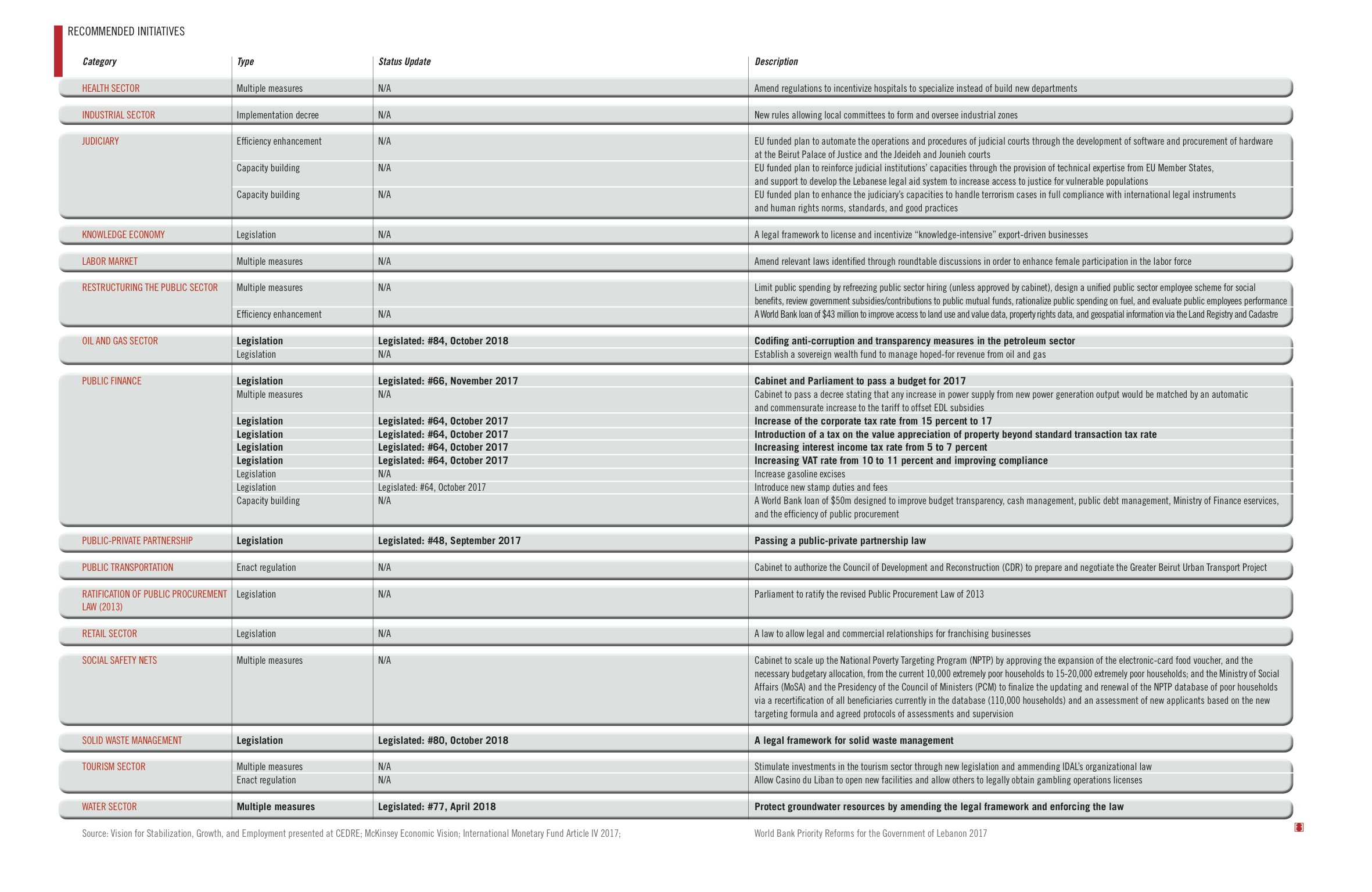
Executive has collected different initiatives recommended to enhance state output and economic performance, with the primary sources being the Lebanese government, multilateral development institutions, and the McKinsey economic vision. The corresponding table reflects the state of the initiatives roughly one year after Lebanon presented its Capital Investment Plan at CEDRE in April 2018. Some progress has already been made to address some of the initiatives, namely those related to improving the business environment, shoring up public revenue through new taxes or tax increases, and by passing legislation concerning protection of groundwater resources, transparency in the oil and gas sector, and a new legal framework for solid waste management. However, the initiatives presented, whether related to legislation, regulation, digitization, capacity building, or other efficiency enhancements, may not capture all the measures out there, nor be categorized in a perfect way—Executive cannot claim that this is a comprehensive list. The initiatives that Lebanon has addressed should also be considered starting points: As with all initiatives, their adoption is just the beginning and sometimes they require implementation through additional measures or legislation, so those that have already been addressed should not be considered complete, but rather at the beginning of the process of improvement.

Click on table to enlarge.

Click on table to enlarge.

February 20, 2019 0 comments
0 FacebookTwitterPinterestEmail
Economic roadmapSecond draft

Economic Roadmap

by Executive Editors February 20, 2019
written by Executive Editors

Building on the first draft of the economic roadmap published in the December 2018/January 2019 issue of Executive, this second draft includes an additional 261 measures and three entirely new national priorities that address judicial reform, labor, and how best to preserve national heritage. As was the intent from the beginning, we took a participatory approach in creating the first version of the roadmap, and that is especially true of the second draft. Over the last seven weeks, we have met with 60 individuals and civil society actors from all over Lebanon and sought their feedback on the roadmap and gathered their contributions for this revised draft.

This was done in an effort to truly understand what Lebanese sought for the future of their country. We were surprised to find that most agreed on measures to be taken in many areas including gender inequality, transportation, pollution, education, health, poverty, and corruption. Contributors added their own ideas to these measures, making them stronger, but little disagreement existed on the main challenges in these national priorities.

One of the biggest matters of debate is privatization, which is understandable given the broad spectrum of economic thought. Countries around the world have adopted systems best-suited to them, whether that includes a heavily privatized economy, or not. Ultimately, Lebanon has to decide what kind of system it wants to implement and move forward collectively. While the country is debating and deciding what kind of system it wants, Executive will be here to help facilitate the debate.

February 20, 2019 0 comments
0 FacebookTwitterPinterestEmail
Last wordOpinion

Misplaced trust

by Aya Majzoub February 19, 2019
written by Aya Majzoub

Through discussions with Lebanese citizens about the space for free speech in the country, we have found that many Lebanese say they take solace in the belief that despite the government’s failure to provide even the most basic services, they at least are free to say, write, and joke about their predicaments, and criticize those they think are responsible.

Then-Justice Minister Salim Jreissati said in a February 2018 interview, “We are proud that in this murky, desert region that surrounds us when it comes to freedoms, we are a country of freedoms par excellence.” But many Lebanese citizens would be surprised to discover that they could not only be sued, but could be sent to jail for up to three years for a Facebook comment.

Although Lebanon’s constitution guarantees freedom of expression “within the limits established by law,” the Lebanese penal code criminalizes defamation against public officials and authorizes imprisonment for up to one year in such cases. It also authorizes imprisonment for up to two years for insulting the president, flag, or national emblem. The military code of justice criminalizes insulting the flag or army, an offense punishable by up to three years in prison. Other laws outlaw speech deemed insulting to religion or speech that incites sectarianism.

In recent years, there have been alarming developments in the use of these laws, with scores of people arrested, interrogated, detained, and prosecuted for peaceful speech, particularly social media posts. SKeyes recorded more than 90 prosecutions against journalists, artists, and activists since October 2016, with 62 in 2018 alone.

According to digital rights group Social Media Exchange (SMEX), the number of cases brought over online posts more than quadrupled between 2017 and 2018. In 2018, SMEX recorded at least 38 cases, with the majority over posts critical of politicians, security agencies, or the president—an increase from 11 cases in 2017 and five in 2016. Human Rights Watch has documented several other cases over defamatory speech in traditional media forums, including television shows and conferences.

In the latest instance, on January 9, then-caretaker economy minister, Raed Khoury, filed a criminal defamation lawsuit against Bechara Asmar, head of the General Confederation of Lebanese Workers, for comments accusing the minister of corruption. Asmar was called in for interrogation by the Internal Security Forces’ Cyber Crime and Intellectual Property Bureau.

On November 21, State Security summoned and arrested Abdel Hafez al-Houlani, a correspondent for the Syrian opposition news website Zaman al-Wasl, following the publication of an article alleging 20 pregnant Syrian women living in Arsal had miscarried after drinking polluted water. Al-Houlani was held for three weeks and referred to a court on charges of “inciting sectarianism.” The court only released him after he paid a $700 fine, and the website published a clarification that his article did not accuse any Lebanese party of responsibility.

However, it is not only public figures and journalists who are vulnerable to prosecution. On June 19, Army Intelligence brought in a 15-year-old boy, Youssef Abdullah for questioning, over the dissemination of a photo on WhatsApp allegedly mocking President Michel Aoun. Abdullah was released the next day after signing a pledge promising to refrain from insulting the president.

A particularly troubling trend is that people summoned for questioning by security agencies often are not told why they are summoned. Asmar says he was not given a reason for his summons to the Cyber Crimes Bureau, and Houlani says State Security held him for several days without informing him of the charges against him.

Further, interrogating agencies are taking measures against people accused of defamation prior to them being brought before a court, violating their right to due process and their right to free speech. Several of those detained have reported that during their initial questioning they were pressured to sign pledges promising not to write defamatory content about the accuser again or to remove their offending tweets or Facebook posts.

Lebanon’s courts rarely issue prison sentences for peaceful speech (which does not incite to violence)—except in absentia. But the use of pre-trial detention and lengthy trials have had a chilling effect on freedom of speech, as many journalists and activists now say they self-censor to avoid charges.

The laws that criminalize peaceful criticism of politicians are incompatible with Lebanon’s obligations under international law. Parliament should ensure that freedom of expression is upheld, including by clearly defining what constitutes “libel,” “defamation,” and “insult,” and repealing laws that criminalize criticism of authorities or national symbols.

February 19, 2019 0 comments
0 FacebookTwitterPinterestEmail
Hospitality & TourismLebanese gins

The juniper way

by Nabila Rahhal February 19, 2019
written by Nabila Rahhal

It was only a matter of time before the Lebanese got into gin production; as unexpected as that sounds, it actually makes perfect sense. The world is witnessing a “gin boom” especially in the premium and craft gin category, and, according to a report produced by just-drinks.com and the IWSR (International Wine and Spirits Registry), global gin sales rose by 7.4 percent between 2016 and 2017, to just under 35 million cases. Gin is forecast to be the second fastest-growing international category of liquor by 2021 (behind whisky), with this growth driven by the premium categories, according to the same report.

The Lebanese gin producers Executive spoke with cite several reasons for gin’s increasing popularity. One, it is thought to contain the least number of calories among the white spirits (vodka, rum, tequila, gin)—an advantage in today’s health-conscious world. Another reason cited was that the production of artisanal and craft gin meshes well with consumers’ demands for the authentic.

When it comes to spirits, Lebanese consumers tend to follow worldwide trends, and spirit distributors Executive has spoken to confirm that premium gin is indeed gaining market share in Lebanon.

The main botanical needed to produce gin—without which it cannot be classified as gin—is juniper berries (the seed of the evergreen juniper tree). A species of juniper trees, the Juniperus excelsa, known in Arabic as lezzeb, grows in abundance on the western and eastern slopes of northern Mount Lebanon, and is one of the main species of tree in Lebanese forests.

Put these two facts together and it is no surprise that four Lebanese with entrepreneurial minds decided to get into gin production. Executive profiled these local gin producers to learn more about their operations, and the responses their gins have been evoking.

Gata

Jamil Haddad, founder and brewer of Colonel Beer, says he announced his intention to produce Lebanese gin and vodka in 2016, during his acceptance speech for the BLC Brilliant Lebanese Award.

Two and a half years later, towards the end of November 2018, he released a dry gin called Gata into the Lebanese market. According to Haddad, Gata is named after the story of a queen who lived in a castle close to Batroun’s Phoenician wall, and who would escape through an underground tunnel to go swimming in the sea. “I wanted to name my gin after a woman and have a female character to go with it,” he says.

Two moments inspired the idea of gin production for Haddad. The first was identifying it as a trend while in London: “Four years ago the trend of gin distilleries boomed in London—in the UK and the US the gin industry is still booming like crazy. These days the worldwide trend for everything is in the experience—gin is the lowest calorific white spirit, and at the same time has good flavors and different tastes.”

The second moment was when, on one of his hiking trips, Haddad realized that Lebanon has an abundance of juniper trees, with berries ideal for gin production. Gin has a certain character that appealed to Haddad and, as he explains, he already had the brewery, so he decided to go into distilling.

Right from the start, Haddad was aiming to produce a gin that would stand out worldwide, so he took his time developing the project. The imported bottles, for example, took five months to arrive in Lebanon, while it took one year to just receive the still. “It is a custom made, high-end still from Germany,” he explains. “It’s a very professional machine made of European food-grade copper, since copper is very good for distilling and reduces oxidation. Even if it took a year, I waited because I wanted the best machine and the best ingredients to have a consistently good product.”

Haddad invested $460,000 into his gin and vodka production, mainly on the equipment, and says he plans to return this investment in three to four years.

While the equipment is imported, the ingredients used are locally sourced. For the juniper berries, Haddad works with the Mamlaket El Lezzab organization in the Bekaa, that plants juniper trees, harvests the berries, and sells them on to him. Other ingredients include: lavender, which he buys from the same organization, lemons, which are common to Batroun, and mint, which also grows in abundance in Lebanon.

Haddad says he has the capacity to produce 800 bottles of gin per day but has not done so yet—he plans to increase production when he begins to export. Since its launch at the end of November, 3000 bottles of Gata gin have been sold, each at a retail price of $29. It can be found in several liquor stores, including Aziz and The Malt Gallery, as well as at the Colonel brewery, and in several bars and restaurants. Haddad is still biding his time and says that come April he aims to have Gata gin available across most of Lebanon and begin his export plan.

Haddad sees a future for gin in Lebanon. “Consumption per capita of gin in Lebanon is increasing significantly year-on-year, so this local product will take the market share of medium to high international gin, since Lebanese gin is positioned as such,” he says. “Lebanese, especially the younger generation, support local production and so will support gin.”

Jun

For Maya Khattar and Chady Naccour, the couple behind Jun, it all started with their love of nature and a “cheerful spirit” (their gin’s tagline).

The duo was working in advertising in Dubai, and would spend their summers in Rechmaya, just above Aley, where Khattar is from. Khattar’s family owned a property in Rechmaya that her grandparents once used as a small silk factory. Following the civil war, Khattar’s parents partially restored this structure and used it as a storage facility for the produce from their adjacent garden. Khattar and Naccour would spend many an enjoyable summer night with friends and family in that space.

They eventually grew restless in the fast-paced and hectic corporate world and longed to reconnect with nature in Rechmaya. Khattar also wanted to help her family manage the garden, but knew that she and her husband could not live off the produce alone. So they started thinking about financially viable projects they could develop in conjunction with the garden. After crossing off several options, they decided to enter the alcohol production business.

“We thought of wine, but there are too many wineries in Lebanon nowadays—same thing for arak, which the villagers themselves produce as well,”Khattar recalls.

The couple eventually opted for gin production. “We decided on gin because it is trendy and creative as a product since you can come up with several recipes. We already have a garden in which we grow the botanicals we need for gin. That way, we are benefiting the garden and benefiting ourselves,” she explains.

The space gin allows for creative recipes suited Naccour well since he had studied in a culinary school while living in Australia and loves to work in the kitchen. Following their decision, he took a course on distillation in South Africa while the couple was still living in Dubai. At the same time, they were restoring the property to eventually become their artisanal distillery, complete with a still they named Matilda, after Khattar’s grandmother.

After several experimentations with recipes and tastings, Khattar and Naccour launched Jun online in June last year and opened the distillery to visitors that July. Jun’s name comes from its main botanical juniper berries and also from its launch date, the month in which Rechmaya comes alive with music and cheerful energy.

Jun is an aromatic gin made out of nine botanicals, which include Juniperus excelsa berries, mastic, rosemary, orange, lemon, bay leaves, and coriander—all of which are flavors reminiscent of a traditional Lebanese kitchen, Khattar says. The couple sources their juniper berries from a reserve in Hermel and handpicks the rest of the botanicals from their garden themselves. Only the corks in Jun bottles are imported—the rest of the equipment and ingredients are all from Lebanon.

Khattar describes Jun as an artisanal gin, explaining that they can produce 130 bottles per day and that they do almost everything by hand, even painting the bottom of the bottles. They have sold 4,000 bottles since their launch in June.

The couple invested $100,000 from their own funds but say they have faith that they will return their investment and more. “We were financially safe in Dubai in that we were employed and so took a big risk leaving everything behind to start our own business, which was not a guaranteed success,” Khattar says. “But we believe in it and we see a big potential for gin in Lebanon and we know how to grow it—we have our vision.” She notes that during the summer they will have special events on their premises—such as gin and tonic nights or barbecues—to promote gin consumption in Lebanon

Jun is available on the Rechmaya Distillery website, on 209 Lebanese Wine’s online platform and in 29 liquor stores, restaurants, and bars across Lebanon. It is sold for $23.30 everywhere except for the distillery itself, where it is sold for $20 to encourage visitors to Rechmaya. Khattar also notes proudly that it is available to first-class passengers on Middle East Airlines flights and in the Cedar Lounge. “We are happy with our clients who are very supportive, especially since we are newcomers to the industry,” she says. “Our story is inspiring in that we came back to the village and are using our resources.”

The couple is planning to export Jun starting in the MENA region, and has already completed the required paperwork to do so.

Junipium

The Riachi family has been in the spirits and beverages business since 1839, and lately produced mainly private label wines after their own brand distribution was hindered during the civil war. Ten years ago, Roy Riachi, a member of the family’s eighth generation, decided to revive the family brand’s name, focusing on wine and spirits production, including arak, liquor, and honey whisky.

Riachi’s experience with the beverage business through the family trade, as well as his career as a restaurateur, familiarized him with the trends in the spirits industry, so he saw the potential for gin production. “Gin is trending worldwide these days, and in my work as a restaurateur I experienced the concept of the gastropub, where gin was highly in demand, especially for cocktails, so the idea of producing gin came to me then,” Riachi recounts.

He decided on the name Junipium because of the juniper berries, and also because of the phrase mysterium tremendum, which he translates as “the great mystery.”“[Junipium’s] flavor profile is different from commercial gins, and so it is mysterious. It is very aromatic and has a potent smell and taste, but yet is not harsh,” he says.

Junipium’s main botanical is Juniperus excelsa berries, which Riachi says grow in abundance next to the distillery in Khenchara, Metn. Eleven other botanicals are used in Junipium, including woodruff, aniseed, nutmeg, rosemary, cardamom, licorice, and basil. Riachi describes its flavor as floral and unique.

Riachi’s investment was minimal since he already had the still, thanks to his plans for whisky production. He uses a gooseneck still, the same kind used to produce single malt whisky, which he plans to launch next.

Junipium was launched into the market in early October 2018. Although Riachi has produced only 500 bottles to date, he says his operation is easily scalable, as the still can produce a few thousand bottles per batch. It is available on 209 Lebanese Wine, on Riachi’s website, and in select liquor stores in Lebanon, where it can be purchased for $25 a bottle. Riachi is eying the export market for Junipium, where he believes it will be a success.

The Three Brothers

It was only natural that the Malak brothers, who tend bar and own and operate seven bars across Lebanon, would want to produce a spirit of their own. “By the nature of our job as bartenders, we drink on a daily basis, and so we thought of producing a spirit that we can drink dry and enjoy. We discounted whisky because we had been drinking it for 15 years, and thought of gin, which we had been enjoying a lot lately,” says Ralph Malak, one of the producers of The Three Brothers.

Producing gin also came to the brothers’ mind because, six years ago, they had met a producer of bathtub gin. Bathtub gin was originally an amateur method of producing gin—through a maceration (soaking) process—that was popular during Prohibition era in America, when alcohol was illegal. Ten years ago, says Malak, some distilleries revived this method of gin production but in an ultra-premium way. “They revived it because bathtub gin is full of flavor—it’s not a dry gin but a cross between liqueur and gin—and can be drunk alone. There are only 10 distilleries worldwide that produce bathtub gin, so we are filling the market for that,” Malak explains, adding that many do not know about this type of gin, and thus he makes sure to share the history of bathtub gin with the bartenders who will be using Three Brothers, and to train them on how to best serve it.

What sealed the deal for the brothers, in parallel to their discovery of bathtub gin, was their finding out about the abundance of juniper in Lebanon. They chose to source their berries from the Bekaa. “We saw it as an opportunity for the landowners in the area, since they were cutting the trees thinking there was nothing they could do with them,” Malak says.

Other than juniper, The Three Brothers has 21 botanicals, including dehydrated apples, rose, grapefruit peel, cinnamon, and jujube (ennaab in Arabic). Only the cinnamon is imported, from India, the rest of the botanicals are sourced locally. Each botanical has a different soaking time, but the maximum maceration time is 48 hours, after which the gin rests for a month before it is charcoal filtered and bottled, explains Malak. Everything is done by hand, with a team of eight people in production, making The Three Brothers a craft gin.

The brothers experimented for three years before they came up with the recipe for The Three Brothers, and Malak recalls that those experiments started at his home using a 20 liter still he typically used at the bar to create drinks. Today they have a small distillery in Smar Jbeil, Batroun, with a 100 liter still, and plans to get a 200 liter still to replace it.

At first, says Malak, they planned to produce small quantities to use in their bars, but the response was so favorable that they decided to increase production. “People would taste it and ask for a bottle, so did our bartender friends, and then two companies,” he says. “We realized that we are going big even though we did not have enough production for that, and so we decided to increase production, although we will remain craft.” Each batch of The Three Brother produces 2,200 bottles, and Malak says the second batch is almost depleted, meaning they have sold almost 4,500 bottles since its launch on May 5, 2018—international brothers’ day.

Because of their connections in the spirits industry, distribution has been fairly easy. The Three Brothers is available at almost 100 points of sales, between liquor stores, restaurants, and bars, and costs $34 a bottle. Once they have bottles available across all of Lebanon, the plan is to export.

February 19, 2019 1 comment
0 FacebookTwitterPinterestEmail
Hospitality & TourismSpirit Industry

(Not) drowning their sorrows

by Nabila Rahhal February 19, 2019
written by Nabila Rahhal

Although it is commonly believed that in hard times people turn to alcohol to ease or forget their problems, this does not seem to have been the case this past year in Lebanon. Despite all the issues the country has faced, 2018 did not translate into greatly increased sales for the country’s spirit distributors.

In fact, Lebanese spirit distributors mainly complained about the same challenges that were affecting many industries in 2018, namely low purchasing power among local consumers and a decrease in high-spending tourists.

Growth in spite of everything

While all distributors Executive spoke to reported some growth in revenues from their spirits portfolio, this gain was not achieved without struggle. For Ziad Nacouzi, head of the spirits distribution division at Neo Comet KFF Food and Beverage, 2018 was a difficult year. “We invested a lot [in marketing the brands] to reach only a slight increase from 2017—a 2 to 5 percent increase, depending on the spirit brand,” he says.

Some distributors acquired brands or portfolios in 2018, and so were able to achieve growth through new avenues. Carlo Vincenti, the owner of G. Vincenti & Sons, explains that his company acquired the distribution of several brands of premium mixers (non-alcoholic drinks that are added to spirits) and of Mancino, a premium artisanal brand of vermouth (a type of aged dry wine, typically mixed with gin). He explains that these beverages strengthened his company’s premium spirit brands, as consumers wanted to enjoy their high-quality spirits with a mixer of the same caliber, rather than ruin the taste with low-quality mixers.

The business manager ofEtablissements Antoine Massoud (EAM), Joe Atik, says the company acquired the Monin portfolio of beverages in August 2018. The portfolio’s products are used as flavor enhancers in many cocktails, which helped increase EAM’s margins for the year. Atik adds that since Aperol, which is distributed by EAM, was both a global and local trend in 2018, the company benefited in terms of growth in its spirits division.

Mountain expansions

EAM’s The Malt Gallery, a specialized liquor shop, opened a branch in Fakra in August 2018. Atik says the new Malt Gallery has been a successful experience that they plan to expand further. “We have a very good relationship with specialists, such as cigar or liquor sellers, and we didn’t come as competition, but to widen the consumer base. Clients of The Malt Gallery are limited in number, but they are regular customers, and they drive value,” he explains.

Meanwhile, Vincenti’s Cask and Barrel, a showcase store for the company’s spirits brands with an extensive portfolio of single malt whisky, opened in Kfardebian in August. “It is a great alternative because a lot of the chalet owners or people who spend time there struggle to source premium spirits, whether for their consumption or for gifting at the many dinners and house parties that happen there,” Vincenti says. These expansions helped both distributors’ growth despite the difficult year.

Empty stools at the bar

As Vincenti explains, the spirits industry is dependent on the on-trade (consumption of spirits in bars, restaurants, and clubs) and the off-trade (purchasing of spirits from retailers), both of which suffered in 2018.

In the on-trade, Vincenti says they are witnessing an unprecedented level of payment defaults. “We’ve had some accounts that we’ve been working with for 20 years who have never defaulted on a payment the way they are now. This is really a big problem, and it will be a bigger problem in 2019 if we don’t get back the tourists with high purchasing power and those who go out and spend,” he explains.

In fact, all spirit distributors told Executive that they have been suffering from defaulted payments, which has made them much more cautious in choosing which hospitality operators to work with. “Because of the many defaults, we have limited distribution by choice. You need to know where and who to sell to, so you know if you will be able to collect your money or not,” Atik says.

Nacouzi, citing feedback from pub and club owners, says that there was a 20 to 22 percent decrease in sales in the on-trade in 2018, as compared to 2017, which makes the struggle to keep up with payments less surprising.

According to Samer Nassar, head of marketing at beverage company Diageo, high-spending tourists are no longer coming to Lebanon in the same numbers as before, which is negatively affecting the on-trade. “You see that the expensive Monaco style clubs with the big formats are fading away because of the decrease in the number of high-spending tourists—the Lebanese cannot alone keep such clubs operational year round,” he says, referencing, for example, $1000 bottles of champagne that came with fireworks and a team of waiters when ordered.

Nassar also explains that the nature of clubbing in Lebanon is changing. “Millennials prefer clubs with DJs as the main focus. These clubs [often] have no minimum charge, so you only pay for what you consume, which may be one glass at the bar,” he says. Both types of clubs generate profit, but in different ways, he says. The luxurious clubs have more turnover on premium brands and spirits like champagne, which bring more value, while the DJ style clubs have a higher turnover in terms of volume, where the more accessible items, such as beer or straight drinks are in demand.

Nacouzi says consumption in bars and clubs among locals has decreased, which also contributed to the downward spiral of the on-trade in 2018. “The number of new clubs that opened in the last few months of 2018 is not an indicator, because the consumption per person in clubs and bars has decreased from say, three years ago. These days a group consumes one bottle per table at a club, and then opts for an additional individual drink before they leave the party,” he says.

“What we hear from our on-trade clients is complaints about less turnover of their spirits, meaning that while it seems people are still going out, they are consuming less in bars and restaurants,” Jeanine Ghosn, managing director of Gabriel Bocti says, echoing the views of other distributors.

When less is more

Meanwhile, the closure of major supermarket chains (such as TSC and several outlets of BouKhalil) in the past 18 months shook up the off-trade spirits distribution. “We are still waiting to see how we can get our money. Collecting receivables is what is most difficult for us in this situation,” Ghosn explains.

The tough economic situation led to what distributors called “price-cutting wars” in the spirits sector, driven by the country’s top supermarket chains during the holiday period. Atik explains that traditionally during December spirit distributors develop gift boxes with added-value items, such as free glasses or carafes, to encourage sales of their bottles. However, in the past two years, as purchasing power has been low, consumers have been opting for tactical promotions—discounts—to save money. Price cuts are most attractive when applied to premium spirits brands and Vincenti says some brands of premium Scotch whiskies were discounted up to 40 percent this past December.

Nacouzi says supermarkets still benefit despite the price cuts. “If you visited supermarkets during December, you would have seen 30 to 40 percent price reductions on major spirits brands,” he says. For supermarkets, it attracts traffic because people come to buy the discounted premium brands of alcohol and end up buying other products; the higher the traffic in a supermarket, the higher the probability that people will buy other items, thereby benefiting the supermarket.”

Although distributors say such price reductions negatively impact a premium brand’s image, consumers are unwilling to fork out big bucks for their liquor anymore. “Price cutting is harmful to our brands, but this is a reality forced upon us by the consumer that we have to deal with. People don’t have money anymore, and they are choosing accessible brands. Distributors and supermarkets also have their bills to pay, and so they are forced to do those price cuts,” Nassar explains.

No money for booze

Some spirit distributors say that as on-trade consumption decreases, off-trade consumption is increasing, as more people are now drinking at home. “Home consumption in the form of house parties is growing, and we can feel that in our figures. Bar catering at private functions and weddings is becoming a trend and that helps grow off-trade consumption,” Ghosn explains.

However, Vincenti notes that from his experience, people are opting for cheaper spirit brands for their home consumption. “Domestic consumers were very affected by a lowered purchasing power—[in 2018] it was felt more because the economic crisis continued and so purchasing power was even lower. We see that across all FMCG divisions, not only spirits. They are shopping more toward promotions and are less loyal to brands. If we take the whisky category, for example, there was a big shift back toward the value-for-money brands, which are the lower-end brands, and their market share increased,” he explains.

The way 2019 has been going so far, it seems the problems of low domestic purchasing power and the decrease in the numbers of high spending tourists visiting Lebanon will continue to plague the country’s spirits distributors. They will have to adapt and innovate to keep growing their businesses.

February 19, 2019 0 comments
0 FacebookTwitterPinterestEmail
  • 1
  • …
  • 69
  • 70
  • 71
  • 72
  • 73
  • …
  • 691

Latest Cover

About us

Since its first edition emerged on the newsstands in 1999, Executive Magazine has been dedicated to providing its readers with the most up-to-date local and regional business news. Executive is a monthly business magazine that offers readers in-depth analyses on the Lebanese world of commerce, covering all the major sectors – from banking, finance, and insurance to technology, tourism, hospitality, media, and retail.

  • Donate
  • Our Purpose
  • Contact Us

Sign up for our newsletter

    • Facebook
    • Twitter
    • Instagram
    • Linkedin
    • Youtube
    Executive Magazine
    • ISSUES
      • Current Issue
      • Past issues
    • BUSINESS
    • ECONOMICS & POLICY
    • OPINION
    • SPECIAL REPORTS
    • EXECUTIVE TALKS
    • MOVEMENTS
      • Change the image
      • Cannes lions
      • Transparency & accountability
      • ECONOMIC ROADMAP
      • Say No to Corruption
      • The Lebanon media development initiative
      • LPSN Policy Asks
      • Advocating the preservation of deposits
    • JOIN US
      • Join our movement
      • Attend our events
      • Receive updates
      • Connect with us
    • DONATE