In 1994, Lebanon looked
like a gold mine to Apave.
The construction business
was booming and the French-based
company, which does
quality and risk management
for construction projects, had
just opened an office in Beirut.
Apave came to Lebanon with
two projects already signed,
together worth $480,000. The
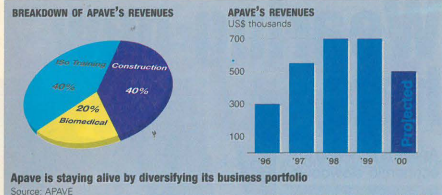
firm saw its revenues climb
from $300,000 in 1996 to
$700,000 in 1998. But by
1999, it appeared that fool’s
gold was all Lebanon had to offer. Total revenues
leveled off, while income from construction
projects declined by $50,000.
This year, the company is forecasting revenues
of just $500,000.
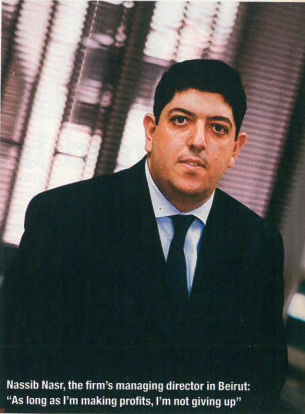
But Nassib Nasr, the firm’s managing
director in Beirut, is not fazed. “It took us
years to get into the Middle East. As long as
I’m making profits, I’m not giving up,” he
says, “even if I need to lay off employees.”
So far, Apave’s response to the building
slowdown has been diversification. Last
year, the company introduced a consultancy
and training service for companies seeking
ISO certification. Sales generated from the
new line of work compensated for losses in the
construction field. Some of Apave’s more
notable clients for ISO training are Khatib &
Alami, Laceco, Hammoud Hospital in Sidon
and St Joseph’s University. The training
costs a minimum of $10,000.
Apave is determined to get its turnover
back on track. Sales from ISO training are
projected to top $200,000 by the end of the
year. The company has recently added a
third dimension to its business: Apave
Biomedical, which does quality control in
the healthcare field.
Apave is already providing this service to
the Beirut Government Hospital, which is
looking to purchase between $25 million
and $30 million worth of equipment, including
scanners and beds. The possibilities for
expansion in this field are vast. Apave plans
to add a control and sterilization department
to its firm as well as a program to train medical
staff. The company is now planning to bid
on a contract to supply radiotherapy equipment
to Hotel Dieu. Revenues from its new
medical department are forecast to reach
$100,000 by the end of 2000.
But Apave is facing stiff competition. The
firm came to Lebanon at the same time that
two other French-based companies arrived,
Bureau Veritas and Socotec. While the latter
restricts itself to quality and risk management in construction, Bureau Veritas is diversified
into other fields. The bidding war between the
three has pushed down profit margins.
In 1999, when revenues were $700,000,
Apave’s profits were $157,000 (22.4% of
turnover). In the first quarter of this year,
with revenues at $180,000, profits were
only $27,000 (15% of turnover). Socotec,
which reported revenues of $1 million in
1999, claims to have profit margins of just
3%, while Bureau Veritas says that half of its
1999 revenues of $850,000 is pure profit.
Even in Apave’s new lines of business,
competition has been fierce. While Apave is
doing ISO certification training, Association
Francaise d’ Assurance de Qualite (AFAQ), an
associate company, actually grants the ISO
certificate to companies. AFAQ is scheduled
to open a local office this year. Similarly,
Bureau Veritas trains clients and Bureau
Veritas Quality International (BVQI) awards
the ISO certificates. Some of the companies
to which BVQI has awarded ISO 9000 certificates
include Obegi, C.A.T and DHL.
Socotec, a former partner of AFAQ, used
to provide ISO training but stopped. “Competition is ridiculous when you are
going up against a company that trains and
gives the certificate, so I don’t want to go
into this field,” says Claude Julliot, director
of Socotec Lebanon and area manager of
Socotec International.
As far as diversification is concerned,
Bureau Veritas has a head start on Apave.
On top of ISO training and certification, it
has ventured into the marine services sector,
where it deals with the control and quality
management for boats. This department
alone generated around $250,000 last year.
Another problem for Apave: Many of its
services are simply not in demand. The
firm provides technical risk management in
17 different fields, including electricity,
fire safety and security systems, environmental
protection and system quality, but
there are very few buyers.
Apave faces plenty of challenges in these
recessionary times. As long as it keeps seeking
out new fields of business, Nasr should be
able to keep the company alive. If that doesn’t
work, he may have to make good on his
word and start handing out pink slips.