W hen Toufic Tasso bought a faltering business school
five years ago, he never dreamed of the financial
windfall the investment would bring. “I didn’t imagine
that there could be such potential in operating a business school
in Lebanon,” says Tasso.
Over the course of nearly two decades, the 88-year-old Pigier
business school had lost its reputation as one of the Middle
East’s foremost centers of business studies. The high caliber teaching
staff that worked at the school before the war was gone; many
had fled the country. Neighboring universities – such as
Lebanese University, American University of Beirut (AUB),
Haigazian, Lebanese American University and Notre Dame –
developed strong business programs of their own, therefore
increasing competition tremendously. Pigier’s student population
dwindled from 1,300 in 1975 to less than 200 by 1995. Tasso’s
arrival on campus marked a turning point. During his first year,
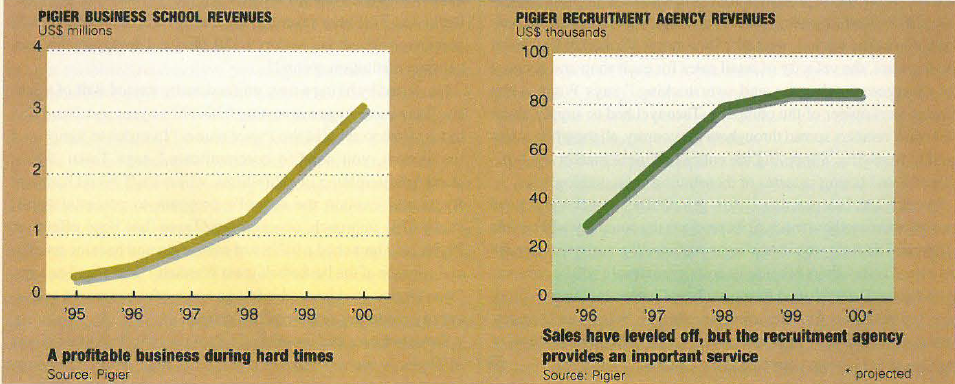
the school broke even on revenues of $320,000 after years of making
losses. This year, revenues stand at $3 million and the student
population is back to a healthy 1,150. How did Tasso tum this educational
institution around?
He started by hiring a new, professionally trained staff of teachers.
Tasso also began investing $300,000 a year in adverti sing
in an effort to rebuild the Pigier name. “In order to jump-start
the system, you need to communicate,” says Tasso. Pigier
started participating in exhibitions, where staff would hand out
flyers and explain the school’s program to potential applicants.
This approach, according to Tasso, has been effective.
Pigier also launched a billboard campaign and became an official
sponsor of the basketball team Wardieh. ”The idea,” he says,
“was to give students, who felt unsuccessful compared to university
students, a sense of challenge.”
Tasso believes that, ironically, one of the most important pillars
of Pigier’s success has been the poor state of the economy.
Many students can no longer afford the high tuition fees charged
by universities, argues Tasso. “If the country was at its best, people
would still be going to universities,” he says.
First-year tuition at Pigier costs $1,850, books included. Secondyear
fees range from $2,250 to $2,350, and third-year fees run from
$2,600 to $2,700. In contrast, a full semester at AUB costs $4,500
on average, while Haigazian’s three-year business program, which
begins during the student’s sop1¥:>more year, costs around $18,000.
Onl)’ Lebanese University, with tuition fees of just $100 per
year, offers a better-priced business education. “We are considered
second as far as a reasonably priced and acceptable business
education in Lebanon is concerned,” says Tasso.
What’s more, Pigier does
not have an entrance exam
and accepts over 80% of new
students. The school also
earns revenue from its
recruitment department,
which, for a fee, offers assistance
to both students and
non-students in tracking
down new jobs. In 1999, the
recruitment department alone
earned $85,000.
Pigier has been so successful
that it is now
expanding. It recently
opened a branch in Antelias and another in Sidon, while two others
are being planned for Tripoli and Zahle. The school has also
signed an agreement with Lyon University to allow 15 Pigier students
a year to continue their studies in France. They will be
charged a fixed tuition of $150 per year, including accommodations.
Lyon University is also helping Pigier to implement a DESS program,
the French equivalent of an MBA.
Since Pigier has prospered because it provides an affordable education
for cash-strapped Lebanese, Tasso might be the only businessman in
Lebanon who has little reason to hope for an end to the recession.