• Donate
  • Our Purpose
  • Contact Us
Executive Magazine
  • ISSUES
    • Current Issue
    • Past issues
  • BUSINESS
  • ECONOMICS & POLICY
  • OPINION
  • SPECIAL REPORTS
  • EXECUTIVE TALKS
  • MOVEMENTS
    • Change the image
    • Cannes lions
    • Transparency & accountability
    • ECONOMIC ROADMAP
    • Say No to Corruption
    • The Lebanon media development initiative
    • LPSN Policy Asks
    • Advocating the preservation of deposits
  • JOIN US
    • Join our movement
    • Attend our events
    • Receive updates
    • Connect with us
  • DONATE
Editorial

Growing pains

by Yasser Akkaoui August 7, 2017
written by Yasser Akkaoui

As they campaign for re-election, our politicians are trying to capitalize on the economic mess we’re in, which they created. We need growth, the leaders of various parties keep insisting. We need jobs. We need support for the youth. Seriously? Do they have a target based on a comprehensive economic policy? Have they devised key performance indicators to measure progress toward that target? Perhaps our politicians should learn about inflation and fiscal policy before making decisions and promising a better future.

The new taxes agreed in mid-July prove that policy is one item absent from the government’s overcrowded agenda. The fact that there still isn’t a detailed list of which new taxes are coming even after cabinet endorsed them, proves these new revenue streams will not flow into a long-term vision for true economic revival. They’re opportunistic grabs at cash to appease voters before an election.

Political rhetoric aside, this country needs economic growth and a long-term economic vision — or it really does risk collapse.

Back in 1966, when Intra Bank crumbled, our banking sector didn’t come down with it. In fact, by May 1975 non-resident private sector deposits in Lebanese commercial banks had not only recovered from a brief fall immediately after Intra collapsed, but had more than doubled to around $554 million compared to the month before Intra fell in October 1966. If this memory is fueling hope among our politicians that we can weather any storm, they had better think again. Money meant to support militias during war will stay during a crisis. The non-resident deposits flooding banks’ coffers since 1992, however, are hard-earned savings that will disappear as soon as real country risk begins to manifest.

So what is growth? It’s the result of a properly functioning and sufficiently supported private sector. This month we highlight yet another opportunity for kick-starting growth in the local design sector. Our deepest pool of capital in the country is our talented men and women. Our designers need support. They need an ecosystem that can help them add value, scale, attract investment, and cement Lebanon as a regional design hub. We’ve missed so many opportunities, we can’t let this one slip away too.

Companies around the world have used design to create global brands worth hundreds of billions of dollars. Meanwhile, in Lebanon, we cannot even dream of birthing such a success if we continue pushing our talent abroad. We need a realistic and achievable economic vision. And we need it fast.
August 7, 2017 0 comments
0 FacebookTwitterPinterestEmail
Real estate

The real estate bubble has burst

by Matt Nash July 31, 2017
written by Matt Nash

In the absence of hard data, anecdotes and speculation become the basis of analysis. Take, for example, the question of whether or not there is a real estate bubble in Lebanon. From the results of a Google search for the terms “Lebanon real estate bubble,” the sector seems like it is in real trouble. The alleged bubble has a Wikipedia entry, and plenty of news reports — both local and regional — over the past couple years have claimed that disaster is on the horizon. Some even drew parallels between Lebanon and the United States circa 2007 (when banks in that market were handing out housing loans like candy to unqualified borrowers, who unsurprisingly began to default en masse, decimating both the US housing market, and the global financial sector in one fell swoop).

The undeniable truth is that between 2005 and 2010, the prices of built property in Beirut — and, anecdotal evidence suggests, the rest of the country — rose significantly. Exact numbers are difficult to find, but current asking prices in Beirut have not changed much since 2010. The average Lebanese young couple looking for their first home cannot dream of raising kids in the capital. The latest price-per-square-meter for residential units in the ground floor of a Beirut apartment building ranges from $2,180 surrounding the Beirut Arab University in Tarik al-Jadideh to $8,500 along the coast in Manara, according to Ramco Real Estate Advisors, which has been releasing price and units-under-construction data since 2013. Many advocates of the bubble theory point to these exclusionary prices as proof they are correct, although this aspect of the bubble argument often rings more of ideology than economics. Developers with exposure to Beirut — such as Michel Georr, CEO of GCI — argue London and New York (or any other major global metropolis) are similarly exclusive and that the scarcity of available land in Beirut (with a surface area around 20 square kilometers) means higher prices are normal, if not natural.

Bubble-backers pivot from Beirut prices to unsold units in justifying their cries of coming calamity. Again, numbers are elusive. Developers readily admit that sales have taken a serious hit since 2011, but quantifying this is difficult. Masaad Fares, president of the Real Estate Developers Association — Lebanon (REAL), told Executive in November 2016 that, a few years ago, he thought there were around 1,000 unsold units in the capital. However, he now estimates the total value of unsold units at between $3 and $3.5 billion (or around 3,000 to 3,500 units if the average new apartment costs $1 million, as Ramco reported in 2014). Both REAL and Banque du Liban (BDL), Lebanon’s central bank, conducted in-depth market studies on the subject, Fares said at the time, adding that the research will be available publically sometime soon. BDL did not respond to an interview request for this article. The Ministry of Finance published the number of real estate transactions, however, this figure includes property sales (residential and commercial) as well as inheritances, without any breakdown in figures. Further, “sales” are registered with the ministry when the built property is delivered, meaning that units “purchased” (i.e., buyer pays project owner) off-plan in a building that takes five years to be delivered can be recorded years after the physical transaction. Those caveats aside, 2016’s 64,248 transactions are down compared to the boom years (over 75,000 transactions at the peak in 2010), but still up compared with 2005 (48,847).

What’s in a bubble?

Real estate bubbles are inflated by unsustainable demand. Typically, economists blame bubbles on speculators. Speculation seems to have played a large role in the rise and rapid decline in prices in Dubai nearly a decade ago. In the US, it was arguably a mix of speculation and the abovementioned extension of loans to the unqualified (some of whom were also paying off multiple properties). When that demand disappears, prices plummet. Looking back on real estate market developments in Beirut over the past decade, it seems clear there was at least some unsustainable demand, even if it is impossible to pinpoint where it came from — speculators, Gulf Arabs turning a cold shoulder to Lebanon, Lebanese expatriates who saw wealth erased in the Great Recession, or some combination of the three. While asking prices in Beirut have only come down 1.8 percent according to the latest Ramco figures, developers are offering 20 percent discounts, the organization wrote in Executive at the end of 2016.

[pullquote] Developers readily admit that sales have taken a serious hit since 2011, but quantifying this is difficult [/pullquote]

Georr, of CGI, says that the Beirut upmarket is certainly hurting. CGI — a real estate investment company founded by Mario Saradar in 1998, which counts Bank Audi, the country’s largest lender, as a 20 percent owner — recently delivered one of the capital’s more troubled assets — the three-tower Abdel Wahab 618 in Ashrafieh near the ABC Mall. Georr says that CGI has a set development model: identify land and strike a deal with the owner to purchase it on-option; draw up plans for a project and secure investors; seal the land deal once investors are lined up, with the land owned by a special purpose vehicle (an sal company with shareholders reflecting the project’s’ investors). He admits investors will have to accept a decreased ROI from what they signed up for on projects that are completed but remain unsold (he doesn’t divulge the exact ROI, but uses 20 percent as a theoretical example), and says a planned mixed-use tower in Karantina is on hold (CGI will sit on the land until market conditions make moving forward with pre-sales and construction more appealing).

The increasingly loud talk of discounts in Beirut suggest the bubble has burst, with a price correction of 20 percent or more in the capital — even if the only semi-official index, Ramco’s, says asking prices have barely budged. What remains unclear and largely un-indexed is the price situation in the rest of the nation.

Will the country collapse?

Assuming the bubble has now burst in Beirut, what will be the impact to the market overall and the country’s future? The quick answer: Who knows?

Since the slump began in 2011, BDL has issued several initiatives aimed at helping the sector. Perhaps the most welcome was a recurring stimulus package launched in 2012, with an initial amount of $1 billion. Not all of the stimulus money was utilized, and the remainder rolled over for another gross $1 billion in stimulus available for 2013. That stimulus money is still available, but the total amount on offer (not to mention the total amount deployed to date) is not published on BDL’s website. What BDL officials have said publicly is that 75 percent of the stimulus money went to housing loans. There are stipulations on these loans, however. They must go to first-time home buyers and come with caps that developers interpret as meaning the middle-income market. BDL loans are largely being used on properties in the range of $250,000-$350,000 — which is what many are building outside Beirut.

Sacrificing on margins

These housing loans are clearly not meant to help developers struggling in Beirut. For real estate companies with too much luxury stock on their hands, BDL offered to let banks restructure their debt with local banks (circular 135 of 2015). The circular laid out in detail what a hat-in-hand developer needed to do in order to renegotiate “a new repayment schedule based on the client’s cash flow” if the client had loans from more than one bank. The request for clemency requires that banks must have “Identified the weaknesses that led to the deterioration of the client’s financial situation and the way to address them.” Two years on, developers say the circular is all but unutilized (despite a sweetener allowing banks to take ownership of built property that they can keep for 20 years instead of the legal two), and, with buyers getting 20 percent discounts on listed apartment prices in the capital, one guesses refusing to budge on margins that grew a reported 400 percent between x and y might have been one of the primary “weaknesses that led to the deteriorations of the client’s financial situation.”

No one knows if developers with too much exposure to Beirut are on the brink of bankruptcy. What is even less clear is how first-time home buyers who bought outside of Beirut are faring after the price correction in the capital. Without solid figures on prices, or the number of outstanding loans, it is uncertain how many people now own property worth less than they paid. What is clear is that while Beirut may be left with urban scars from the boom years (the abandoned Bab Beirut project in the heart of downtown, for example), evidence to support the notion that Lebanon is on the brink of a civil war sparked by the popping of a real estate bubble is seriously lacking.

July 31, 2017 1 comment
0 FacebookTwitterPinterestEmail
Economics & PolicyWater

The big Lebanese thirst

by Paul Cochrane July 28, 2017
written by Paul Cochrane

Not many consumer product segments have steady year-on-year growth regardless of the economic environment. Nor are there many products that are the same price as they were a decade ago. But as the marketing saying goes, water is life, and there is plenty of competition for consumers of bottled water.

“You can consider bottled water in Lebanon as a basic good. You don’t have any alternative for drinking water, so we’ve never really been affected by the political situation, nor the economic situation,” says Merched S. Baaklini, deputy general manager of Bev Holding, producer of Rim.

According to a 2016 Blominvest Bank report, the sector grew in volume by 2 percent in 2013 and 2014, and 5 percent in 2015. In value terms, it averaged 6 percent growth in 2013, 10 percent in 2014, and 6 percent in 2015. 

Sector players attribute the rising demand for bottled water to both the healthy lifestyle trend, with consumers increasingly opting for water over soft drinks, and government mismanagement of the water sector. This ranges from health scares related to the lack of oversight of water companies — especially unlicensed bottlers, — to shortages in government supply. When the taps run dry, consumers are left unsure about the quality of water delivered by truck to their apartments.

The trash crisis of summer 2015 caused another spur in business according to bottlers, fueled by mounting public concern about the government’s inability to deal with waste and environmental degradation. Tests carried out by the Lebanese Agriculture Research Institute (LARI) showed that, in March 2016 — nine months after the trash crisis started — leachate from dumpsites across the country entered the groundwater, with bacteria levels reaching 2,000 trillion per milliliter (ml) the accepted norm being less than 200 per ml.

The Class A bottlers — established brands licensed by the Ministry of Public Health (MoH) — account for an estimated 30 percent of the market, according to industry insiders, valued at around $160 million a year. The remaining 70 percent are more localized in distribution terms and unregulated, with just 42 out of some 1,000 bottlers licensed.

The surge in bottlers is most evident in the supply of 10 liter containers, which, other than the water stores typically found in the suburbs and countryside that fill up 10 and 20 liter jerry cans, are the most economical, costing from LL1,000 to LL1,750. “The big companies never had the 10 liter bottles as part of their portfolio, typically having the 330ml, 500ml, and the 1, 1.5 and 2 liter bottles, then jumping to the 18.9-22 liter size [known as the ‘gallon’]. Today, these companies are tackling the 10 liter market, as it’s an attractive and growing market,” says Roy Hage, manager of Petform, one of the country’s top three manufacturers of consumer grade plastic bottles. Petform produces some 70,000 bottles per hour, and Hage estimates that there are over 250,000 10 liter bottles produced in Lebanon each day.

The water knife

While bottlers have largely dismissed concerns about depleting water tables and the unreliability of snow melt (the source of over 50 percent of the country’s water) Roland Riachi, visiting assistant professor at the Political Studies and Public Administration department at AUB, says that demand will rise due to the depletion of water resources, and that the number of wells has risen from 3,000 in 1970 to 80,000 today, or eight wells per square kilometer. “This will lead to a drop in tap water supply, so there’ll be more demand for water delivery, for drinking, and domestic use,” he adds. LARI estimates that the average depth of groundwater across the whole country has dropped on average by 70 to 80 meters, and projects it will fall further.

The problem is the lack of regulation in the water sector, be it from agricultural use, to tapping wells for drinking water. By law, water companies pay the government LL1,000 for every 1,000 liters extracted, and are limited to withdrawing 100,000 cubed meters a day from a depth of less than 150 meters. Most water companies stated that they pay according to a metered system, but others, such as Tannourine, said the water was free.

The lack of oversight of the overall sector and depleting water resources are already causing logistical issues for companies. Some bottlers concede that they stockpile during the winter months due to shortages in the summer, and even buy water off other bottlers when supplies run low.

“Most water companies are seeing a reduction in water availability. The illegal bottlers are about to cause a catastrophic disaster, as they’re drilling near the shorelines and emptying aquifers,” says Marcel Hage, chairman and CEO of Talaya. “If more people favor natural drinking water, and the supply is short, prices will eventually go up. But if the situation continues as it is now, of ‘water as water,’ no matter where from, prices will remain stable.”

Economics 101 teaches us that with demand outstripping supply, prices should go up. But the theory does not yet apply to local bottlers due to the low cost of extraction, the lack of government oversight, and high competition. “Prices haven’t changed because the price is the cost of the bottle, not the water inside. This is why you see different brands with the same price,” says Reine Berbery, marketing manager at Tannourine.

The number of new entrants into the market is difficult to quantify due to the number of unlicensed bottlers. But, at the higher end, there are still new entrants, such as a $7 million bottling facility in Bekaa’s Yammouneh, announced in May.

Just as Nestle shook up the sector when it bought Sohat and introduced Nestlé Pure Life, Pepsi’s launch of its global brand Aquafina in July 2015 has triggered what players call a price war. “Aquafina has made it harder for everyone, as they have the distribution model, and gave it out for free with Pepsi when they launched,” says Alain Tabourian, chairman and CEO of Interbrand, which owns Sannine.

According to SMLC Pepsi-Cola’s Executive General Manager, Bassem Ali, Aquafina has had “strong double-digit growth” due to the “largest distribution network in the country.” The top seller is the 500ml bottle, but the company is mulling entering the gallon market, which industry insiders estimate at around 25 to 30 percent of the licensed market.

Diversification

Competition to get on supermarket shelves is fierce, as that is where consumers have the most choice, and the best prices for licensed brands. This is down to distribution costs, with home delivery costing more, albeit ensuring more consumer loyalty. Industry players estimate distribution at 30 to 40 percent of operating costs. 

“As long as consumers can easily switch brands, and can’t tell the difference between one water brand and another, the higher the competition,” says Riwa Daou, a research analyst at Blominvest Bank.

Such competition extends to imported and sparkling waters. Nestlé had dominated the sparkling water segment with brands Perrier and San Pellegrino, but Rim introduced its own sparkling water brand in 2016, and Tannourine introduced San Benedetto earlier this year. The brands have also ventured into glass bottles to appeal to higher-end consumers, especially at restaurants.

“We consider selling under cost as part of marketing. This is the competition in the market, even to give the bottle for free (to restaurants) as it’s good for our image,” says Tannourine’s Berbery.

Other brands have also introduced glass bottles, but  only market newcomer Talaya has glass gallons, one of only three companies worldwide to do so. Talaya’s CEO and Chairman, Marcel Hage, says glass gallons have reached 25 percent of their overall sales in less than six months, with overall growth of 50 percent compared to 2016.

Glass gallons are only expected to appeal to a small number of consumers due to the high costs, at LL7,500 for 15 liters, and a $15 deposit fee, compared to LL6,000 for 18.9 liters in plastic gallons, and a similar deposit. Costs are high due to the cost of glass itself, imported from Europe, with the 300,000 gallons estimated to cost over $3 million. 

Bad mouthing

Competition is so acute that nearly every bottler had something negative to say about their competitors, ranging from illicit practices and mislabeling, to exposing plastic bottles to the sun, to burning trash during the 2015 crisis.

Sannine was accused of requesting the removal of the manufacturing date on gallon bottles to not be constrained by longevity issues. Tabourian denies this. “There’s no law that states you have to put the date on the container, only for production. We were asking to amend our traceability code in case there’s a problem with a specific lot of orders. It has nothing to do with the consumer, but was blown out of proportion,” he stated in an interview with Joe Maalouf on LBC.

Nestlé Pure Life was accused of not being correctly licensed, but Nestlé says that both Sohat and Nestlé are licensed by the MoH under the name Société des Eaux Minerales Libanaises, under Natural Mineral Water and Drinking Water respectively.

Such competition among players will continue as consumer demand continues to rise amid ongoing mistrust and mismanagement of public water sources. What may happen is consolidation, whether or not the government clamps down on the several hundred illegal bottlers. “There are enough players in the market, so there will be consolidation. The name of the game is distribution, and moving a lot of product at a low cost,” says Tabourian.

July 28, 2017 0 comments
0 FacebookTwitterPinterestEmail
Economics & Policy

Fit for Growth

by Thomas Schellen July 24, 2017
written by Thomas Schellen

Breaking out of stasis is neither easy nor instantaneous. Examples of temporarily suspended existence and reemergence in popular fiction range from space travel to medical miracles. Nobody has ever tried it of course, but in theory it makes sense to suspend a body in some sort of stasis for the duration of an interplanetary flight and revive it upon arrival — at least according to countless movie scripts and Hollywood logic.

Much rarer than a cold sleep sci-fi movie plot is the condemnation and rescue of an entire economy from stasis. Economic stagnation and revival has been associated with a single fairytale trope — Sleeping Beauty — many times since the tale was first committed to paper in 17th century France, and further popularized 100 years later as Dornröschen by the German Brothers Grimm. The falling of a whole kingdom’s economy into a deep sleep is only a collateral effect of the young heroine’s affliction, the solution as simple as a kiss that breaks the curse.

In this magic story, the economy-wide reawakening is portrayed as a seamless return rather than as a slow and gradual process of reanimation. This is indubitably more charming than depicting a struggle through a complicated and lengthy recovery, but leaves unresolved the intriguing matter of how one would actually go about reviving a dormant economy.     

Lebanon’s society and economy has not been comatose in recent years, nor has its government been fully paralyzed. Still, it seems that the economy urgently needs to wake up. This makes it prudent to consider the perils that companies will face from an administration that has been stuck for several years in the closest thing to a freeze imaginable in the warmth of the Beirut sun, while the world around kept moving.

While the first Cabinet debates after the adoption of the new electoral law did not hint at a uniform position on economic policy, signs point to a rise in government activity with regard to budgetary decisions and taxation.  Thus, the question is not whether there are new pressures on the horizon, but merely to what extent these pressures will be caused by new taxation, international economics and interest rate environments, increased energy costs and other factors. 

For local companies, this means that new cost pressures will be compounded with existing pressures on profits, which they have felt from domestic and international markets for the past six or seven years. In parallel, the Lebanese body politic, with all its administrative organs, must — if the functioning of state entities is to improve at all — engage in some serious body building, from the activation of dormant fiscal policy muscles to the detoxification of corrupted cells.

These challenges have been on the table since the beginning of the year, piquing Executive’s interest in sustainable business solutions. Cost-cutting is one avenue that companies tend to take when pressures build. But while cost-cutting is a necessary measure  under the capitalist mandate of competition, it also is one of the thorniest undertakings in an economy in need of job creation. It involves taking steps made no nicer by the various euphemisms employed — corporate restructuring, workplace rationalization, personnel efficiency enhancement — and their implied result: redundancies and involuntary separations.    

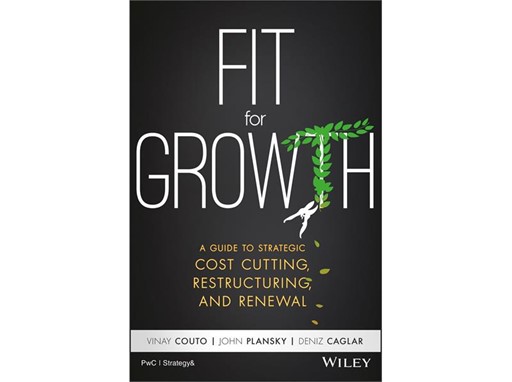
While considering the prospect that many Lebanese companies may soon face higher taxes and other cost pressures, we were attracted by a new book by Strategy&, a PWC consulting arm known in an earlier incarnation as Booz & Co. Subtitled a “Guide to strategic cost cutting, restructuring and renewal,” we wanted to find out if a book with the title Fit For Growth (FFG) could offer answers to Lebanese companies that might soon face the need to cut costs.

A closer look at FFG showed very quickly that it does not propose a new or revolutionary solution. Rather, the FFG framework is something that Strategy& has talked about for quite some time. Karl Nader, a partner in the company’s Beirut office who leads the FFG practice in the Middle East, quickly confirms that the book was authored by three of the firm’s principals to describe the result of “an evolution” in their work.

The book does not offer — even by the standards of books on management — a particularly gripping narrative. In short, it is a reference guide in three parts (a brief introduction to the concept, a manager’s guide, and a few afterthoughts on the “human element” and keeping up morale) that offers decision-makers access to insights and practices which Strategy& developed over years of strategic consulting. “What we realized over the last couple of decades is that you can’t cut costs independently. We have been doing a lot of work on strategy and on cost, and when the two come together, you get the most value,” Nader says.

The baseline proposition is simple: The book argues that contenders in the globally connected and disintermediated marketplace need to focus on managing cost as much as on growing revenue. “Companies across industries and geographies are realizing that the only way to unleash profitable growth is to cut costs,” it claims.

The trick, however, is how to do this right. Cost reductions are often done under duress, in undifferentiated fashion, and driven by reduction targets or benchmarks focused on matching the competition. In contrast to this blind slashing of numbers, the FFG approach is backed by a strategy; it “protects ‘good costs’ and reduces ‘bad costs.’”

Good costs in this framework are those that strengthen a company’s ability to differentiate itself. All other costs are either “lights-on” costs (needed to keep the company in operation, but that do not distinguish it from the competition), or costs which are not related to the company’s priorities. According to the authors, companies that embark on cost-cutting often focus too much on cost reduction targets, and too little on the development of “differentiating capabilities,” while a better path lies in achieving a balance between the two.

In defining and developing their differentiating capabilities, organizations need to understand what they are really good at, or what they want to be really good at, Nader explains. This is where consultants can help companies with complex organizations and many stakeholders to prioritize and work through the opportunities they identify.

“The role of a consultant is [to put together] an unbiased view of what is the best model for you as an organization,” he says, citing several examples of large companies in the Arab region that have come under pressure from dropping profits, in areas from luxury retail to distribution. “Across the entire region there are retailers, distributors, and manufacturers who are under pressure.” 

While conceding the existence of economic pressures across the Middle East and the need to cut costs, Nader reiterates that cost-cutting can mean things other than laying off employees. “The economy here is challenged, and companies are challenged, so it’s very easy to conclude that you have to cut costs or optimize operations, but there’s a need to really understand what I’m good at, and what [I’m] not good at, or not so good at, [to ask], ‘Where do I need to further invest to differentiate myself?,’” he says.

The FFG approach emphasizes that such a transformation is not immediate. “With FFG the journey is very long. Working on restructuring is not a one-day event,” Nader confirms. Moreover, it certainly does not appear to be painless, given the book’s references to the need to cope with organizational fears and affirmations that “a Fit for Growth transformation asks a lot from all the employees in the company.”

Finally, the question remains how far the concept is applicable in a small economy in the Middle East. While hiring a large consulting firm to help seems to be the more feasible road for companies in the Gulf region — according to Nader, some 50 percent of Strategy&’s FFG activities are with organizations in Saudi Arabia, and another 25 percent with organizations in the United Arab Emirates — he says SMEs in a smaller economy like Lebanon can apply the FFG approach on their own initiative and do it in-house.

Nader points to a Fit For Service (FFS) advisory practice that is parallel to the FFG approach. According to him, the method is designed to reduce headcounts and improve efficiencies in organizations that are part of public administration (see box).

Executive sadly did not find any evidence of a magic-kiss solution to revive the fortunes of the country’s private or public sector stakeholders, but it seems that available lessons clearly hint that approaches that cut costs in conjunction with the development of productivities and competitive capabilities are preferable.

Explainer:

Fit For Service components

According to comment text by Strategy& partner Salim Ghazaly, the public administration in Lebanon could engage in a four-step process to improve performance and enhance efficiencies:

1) Develop a national socio-economic plan to identify national priorities and mobilize government efforts and expenditures accordingly. This exercise should be structured around the competitive positioning of the Lebanese economy (such as in professional services, tourism, and potentially a new oil sector) and dropping sectors in which the country is not competitive.

2) Focus the role of the government on policy making, regulation and enforcement, and transition its other operations to the private sector — this could be achieved through implementing a national private sector participation program (privatization and PPP). This could result in a leaner and more efficient government, while spurring growth within the private sector. It could also result in Capex and Opex savings, and potential revenue from the sale of selected existing assets. The Lebanese government is well positioned to do this, as it already has a regulatory framework through the Higher Council for Privatization and a PPP law (currently being revised).

3) Launch a culture/management change program across ministries to instill a citizen-service culture — a good example is General Security.

4) Implement cross-sector enablers that contribute to higher efficiency and economic growth, such as digitization.

July 24, 2017 0 comments
0 FacebookTwitterPinterestEmail
Book ReviewEconomics & Policy

Explaining Middle East Insecurity

by Riad Al-Khouri July 19, 2017
written by Riad Al-Khouri

The Middle East faces an increasingly complex and fragile security situation. The region (defined by authors Swain and Jägerskog to include all Arab countries in Asia, plus Egypt and Occupied Palestine — though I personally might also add Iran and Anatolia) suffers from strained water supplies and limited arable land, along with increasing populations, stagnant agriculture and lacking food supplies. Another issue is large-scale labor migration, along with the huge numbers of forced migrants and refugees coming from the region (not to mention millions of internally displaced persons). The book analyzes such emerging challenges comprehensively and systematically, looking at these Middle East issues from a security perspective, as well as their global context.

Security is increasingly on people’s minds after the Western reaction to the September 11 attacks on the United States exacerbated violence across many parts of West Asia and North Africa, of which the Middle East is the strategic heart. Following 9/11, the US attacked Afghanistan and Iraq, and abetted or otherwise became involved with fighting in Yemen, Libya, and Syria. The legacy of intervention was several failed wars and a lot of other meddling that inflamed an already troubled region, intensifying problems such as forced migration and food insecurity. In their wake, the uprisings of the Arab Spring swept across the Middle East  from late 2010, leading to political transformation.

All of this further eroded stability throughout the Middle East, exacerbating existing long-term security problems. In turn, as the authors note, outside forces, including globalization and climate change, are interacting with this mess, leading to even greater insecurity in a vicious circle. Subtitled ‘The Impact of Climate Change and Globalization,’ the book’s strength is in its linking of the region’s woes with wider international themes. Climate shifts and the impact of globalization are examined in some depth and with critical evaluation. An interesting example of this is the purported connection between the crisis in Syria and that country’s drought of the last decade, given that the Syrian problem now has a strong geopolitical dimension.

The book was published last year, and so it does not account for recent international policy developments on climate change and globalization, such as the US withdrawal from the Paris climate agreement. The new American course cannot bode well for the Middle East, if only because unchecked climate insecurity combined with war may lead to more famine in broken states (as is already the case of Yemen today), with mass migration from and through warzones exacerbating global tensions. The post-9/11 wars led by America took scant account of local interests, with few serious plans for what to do once the fighting ended — ultimately letting chaos reign. In a curious parallel, the new US climate policy also seems to invite chaotic events, which could be problematic for the region.

Globalization has also had a major impact in the Middle East. Global forces have unsettled established politics, altered labor markets, and created more international economic connectedness, shifting the costs and benefits of established socio-economic policy. These problems, some of which are considered by the authors, cannot be solved by any one country alone, but need collective and collaborative action — something that the countries of the neighborhood need to work on if these issues are to be addressed.

The West’s global dominance has been halted with the failure of American economic and security policy over the last two decades or so. The trend regionally, as elsewhere, is toward multipolarity, with the West no longer ascendant. Meanwhile, the integration of refugees and asylum seekers on both sides of the Mediterranean, and the specific barriers such people face, represent a growing challenge. I for one look forward to seeing more on such topics from Swain and Jägerskog.

July 19, 2017 0 comments
0 FacebookTwitterPinterestEmail
Climate changeEconomics & Policy

C’est la vie

by Jeremy Arbid July 17, 2017
written by Jeremy Arbid

The decision in early June by the United States to withdraw from the Paris Accord, the latest global effort to combat climate change and adapt to its effects, sent shockwaves of uncertainty around the world. The agreement, which entered into force in November 2016, has the goal of limiting the global temperature rise to two degrees Celsius this century. But there is no reason to panic, says Vahakn Kabakian — Lebanon’s climate change portfolio manager at the United Nations Development Programme (UNDP). Instead, he points out that the American withdrawal may have served to strengthen the resolve of other countries and the international community to reach the commitments they promised toward mitigating climate change.

One of the key takeaways from Paris has been the role the private sector will play in financing the renewable energy projects that governments want to build to reduce greenhouse gas emissions from electricity generation. Lebanon is now awaiting a joint Ministry of Finance (MoF) and Ministry of Energy and Water (MoEW) recommendation to the Council of Ministers for the latter to license the construction of some 200 new megawatts (MW) of wind-generated electricity. In mid-August the MoEW will also begin evaluating offers from companies to construct up to 180 MW of solar-generated electricity. The cost estimates for the construction of these renewables projects have not yet been publicly disclosed, but financing may not be so difficult to find (see story). The new projects would bring Lebanon close to achieving its commitment of having 12 percent renewable energy in the national energy mix by 2020.

E   From what you’ve heard within Lebanon, and from its counterparts regionally and internationally, what has been the reaction to the United States withdrawing from the Paris Accord?

It varies. For the people who are really not into it, they all saw it with an ‘Oh, you guys are screwed’ sort of a reaction, which might be true if you really look at it from a planetary perspective. At Paris we agreed on a target below two degrees Celsius, and that’s in jeopardy if the US is out. Effectively, they won’t be out before November 2020, because there’s a clause in the agreement that you can’t withdraw until three years after it enters into force — [which was] November 2016. So 2019 [would be the earliest the withdrawal could start], and then the process takes around a year, so that’s November 2020, which would probably be after or around election day in the US. And then the incoming president, once they take office, could reverse this in 30 days or so. Now that’s procedure.

E   Has this had a big psychological effect?

No [not just a psychological effect], because if the US re-enters the Paris Agreement in 2020 or 2021, they would have essentially lost four years of efforts toward meeting their 2030 target — 25 to 28 percent below their 2005 emissions. So that lag time, plus if the US actually locks in investments in new fossil-intensive technologies for the coming 20 or 30 years — [that’s] money not spent in the right direction, if in four years time you’re going to reverse [Trump’s decision] and re-enter [the accord].

E   Has the American president’s decision to withdraw from Paris eroded political will to meet climate change commitments?

Now what’s good, and what no one really expected, is that globally there was this amazing solidarity on the Paris Agreement from think-tanks, NGOs, governments, and coalitions of governments, thinking of doing more than what they’ve already committed. France is trying to do that, the EU went to China — there was a summit.

The EU is much more strongly committed now than it was probably before. That’s why there was an EU-China summit — I think it was the next day or so — followed by a French-Indian sort-of summit.  [Everyone], especially China and India, were very much trying to send a message that that’s not true (that America’s withdrawal has scuppered the accord): ‘We’re fully committed.’ That’s on the international level. At the US level, California is leading and Hawaii just passed a climate change law — they’re saying to the federal government, ‘We’re in.’

E   One of the key takeaways from Paris is that this is going to be a big private sector opportunity. So when you see all the huge corporations in the US — the EXXONs and these sorts — stepping up and pledging to reach Paris commitments, does that reassure?

Definitely, the key players in the Paris Agreement are the non-state actors, which, in the US case, are doing what they want to do irrespective of the federal government funding-wise and action-wise. Huge corporations are deciding to go 100 percent renewable, and imagine airlines going for 100 percent biofuel — that’s where we’re heading.

E   Lebanon is now ready to license contracts to build some 200 MW of wind generation and will be licensing up to 180 MW of solar generation. Is Lebanon on track to reach its 2020 goal of having 12 percent of its electricity generated by renewables? 

Existing hydro power is roughly 200 MW. It varies per year depending on how much water we have, but last year we started seeing 0.1 percent for 2015 as a renewable part of the mix other than hydro. That’s in 2015. It was mentioned in the UNDP’s Small Decentralized Renewable Energy Power Generation report for photovoltaic (PV). What we had in 2015 almost doubled by end of 2016, the PV. So that’s good. We installed 10 MW of solar in 2015 and in 2016 installed over 10. And I guess 2017 would be a bit more than that, so, on a yearly basis, we saw those decentralized PVs being installed more and more. If by 2020 we install the wind and we install the 180MW and we end up having around 100 MW of decentralized PV, in terms of MW we [would be] around roughly 200-300-480 MW renewable. Installed capacity-wise that’s good, but generation-wise it’s not 12 percent because we’re still [trying to reach] the 12 percent. Ten percent out of 480 — I hope I did the right calculations — that’s 4800 MW total generation. You know it’s roughly 10 percent if we install the thermal power plant by then. But obviously generation-wise it won’t be 12 percent.

E   So we’re a bit behind schedule is what you’re saying?

Yes and no, because in the 12 percent the Ministry of Energy and Water will be taking into account the solar water heaters because that’s also renewable — you’re generating heat in this case. I don’t have the latest numbers, but the national target is that 1 million square meters of solar water-heating panels, which is roughly 250,000 units I think, will be installed by then, and I don’t know how much that would make in equivalence out of the total 12 percent. So maybe not by 2020, but with the hydro — not upcoming, existing — with solar and solar water heaters it’s a good bet. I would say yes.

E   Lebanon still has not ratified the Paris Agreement. Is that because our politicians have been so focused on finding a new election law and sorting out their own political futures?

Primarily that, yes. The draft law was sent in August-September 2016 to the Parliament. Somewhere at the beginning of the year, the foreign committee at the Parliament very quickly approved the draft law. I don’t think there’s any issue with this draft law, but there’s no clear cut process or procedure for legislation in general. We don’t even know which parliamentary committees will need to approve this. We assume it’s foreign affairs, the finance committee, and environment at least.

E   What is on your wish list for legislation to help Lebanon reach its climate change commitments?

Definitely the ratification of the Paris Agreement into law, because it contains a lot of articles that we would be basing our work on locally. At the end of the day, when the law passes, the articles are binding, and we need those articles to issue decrees and operationalize the entire law gradually. So that’s one thing that I want to see. Another would be having stability in the country, [which] would allow us to take on the environment — but also climate change, at a more serious level.

July 17, 2017 0 comments
0 FacebookTwitterPinterestEmail
Hospitality & TourismSpecial Report

Sustaining Lebanon’s rural tourism

by Sunniva Rose July 13, 2017
written by Sunniva Rose

There is a growing local clientele in Lebanon hungry for a more “authentic” experience of the country. Through word of mouth and social media, rural activities, such as fruit picking and hiking, are slowly moving from small groups of connoisseurs to being embraced by a broader public. Guesthouses across the country, once informal, are becoming a stay-cation preference for Lebanese. In the words of Kamal Mouzawak, founder of Souk El Tayeb — which operates several guesthouses, restaurants, food festivals, and markets throughout the country — more and more Lebanese are seeking “the same experience as going to their grandmother’s house.”

Leaving the capital to visit one’s family home in the mountains may be an age-old tradition in Lebanon, but the institutionalization of rural tourism, with guesthouses, tour guides, and proper signage, is a relatively recent phenomenon.

Fostering rural tourism

In the past, guesthouse owners had been accommodating tourists on an ad hoc basis. Around 2010 they came to the realization that they could turn this activity into a profitable business, according to Martine Btaich, president of the Lebanese Mountain Trail Association (LMTA).

Help and training came from USAID, through Diyafa, a network of rural guesthouses that last year launched an upgraded online booking site, and through the Lebanon – Industry Value Chain Development (LIVCD) project, which began in 2012. Initially billed as five year, $41.7 million project  — “aimed at improving Lebanon’s economic stability and providing income-generating opportunities for small businesses while creating jobs for the rural population, in particular women and youth” LIVCD was recently given a two-year extension till 2019. The hope being that by then, the activities that received funding and support will have become self-sustaining.

From humble beginnings, the number of guesthouses in Lebanon has risen to around 80, per LIVCD figures, though as of yet, no centralized data on guesthouses exists. Petra Obeid, who is in charge of rural tourism at the Ministry of Tourism (MoT), told Executive that figures are currently being collated.

Obeid says that the MoT supports rural tourism through a national strategy developed in tandem with LIVCD and launched in 2015. Among its aims were to promote awareness of rural tourism destinations, institutionalize rural tourism at the community level of local communities, improve and enforce environmental, cultural, historical, and agricultural protections, diversify and modernize rural destinations, improve data collection, develop a culture of rural tourism among the younger generation and improve networking with the diaspora.

According to Btaich, so far the strategy has validated the efforts of tourism stakeholders. “Many new initiatives at the level of municipalities have been done, creating a snowball effect,” she says. “The challenge now is for the strategy not to sit in a drawer.”

Guesthouses: a reasonably profitable venture

The cost of rooms is varied. If booked through L’Hôte Libanais, a website with a network of 16 guesthouses, prices can range from $80 to $250, with the average room going for $100 – $120. Guesthouses that are part of the Diyafa network, tend to be cheaper. According to LIVCD figures, they cost $60 per person on average, and start as low as $40. Orphée Haddad, L’Hôte Libanais’ founder works at the higher end of market, only listing guesthouses that interact with the local community, serve local food, are environmentally friendly, and that, in his eyes, have “character.”

The popularity of guesthouses shows no sign of waning, both for those looking for a place to relax outside the city and for entrepreneurial types eyeing the opportunity to reinvent family property. Philippe Germanos, who co-runs Guita Bed and Bloom, left corporate life a few years ago to return to his family home and develop the declining farming business that he inherited from his great grandfather.

The five rooms of the guesthouse, which cost from $50 to $75 a night per person, were opened to the public in late 2015. Like many other guesthouses, Germanos claims that he is fully booked on weekends during the tourist season (April-November). To help generate income, and tap into a growing market for rural activities, he decided to include agrotourism and recreation into his business, such as yoga retreats.

Reinventing the family home as a rural getaway does not come cheap. To finance these various projects, Germanos took out two loans, totalling $100,000. “I benefitted from special environmental banking loans (subsidized by Lebanon’s central bank) that allowed me to add solar panels, install low consumption taps, and build a warehouse,” he says. 

Other guesthouses resort to private funding, such as Al Haush, which opened its doors a few months ago in the Bekaa. An old family farm, Al Haush mixes luxury guestrooms ($200 a night) with activities such as rosewater making and cherry picking. The owners, the Saab family, invested $60,000 to build their guestrooms. However, the rest of the infrastructure, such as the swimming pool, gardens, and tennis court, were already in place. Like Guita, Al Haush is banking on the public’s interest in agrotouristic activities.

Municipalities aren’t missing out

Private individuals are not the only beneficiaries of the surge in rural tourism. Municipalities are also involved, mostly due to LIVCD funding, which so far has  amounted to $2.25 million and has benefited nine different sites, reserves, and associations in Lebanon.

All the municipalities that Executive spoke to which recieived support from by LIVCD, such as Ehmej and Hadath el Jebbeh, have noticed increasing numbers of visitors over the last few years. Jbeil’s Bentael Nature Reserve is hoping to receive 5,000 visitors this year, a 60 percent increase relative to last year.

Though not funded by LIVCD, the manager of the Chouf reserve, Nizar Hani, has noticed the same trend. “Around 90,000 visitors were recorded last year, which is an increase of 14,000 people in comparison to 2015,” he says. Reserves are the only stakeholders in the rural tourism industry that actually manage to keep track of visitor numbers, through the entrance fees that they charge (under LL10,000 on average).

Lack of a legal framework

Guesthouses are regulated by the only decree that exists regarding rural tourism. Published on September 9, 2011, decree number 6298 describes the conditions that a guesthouse must meet, such as being built in a traditional style, having between one and 10 bedrooms, and respecting health and safety conditions. However, the conditions are not specified further, leaving much room for interpretation. While the MoT sends out a team to inspect guesthouses during registration, and conducts follow-up visits, Obeid notes that the variables  — such as owners having other employment, or guesthouses being seasonal  — make this more difficult.

Regulations are slowly being put into place, but one major obstacle still stands in the way of the sector’s development: the lack of a legal framework. “One cannot promote Lebanon as an alternative tourism destination, or adventure tourism destination, if there’s no work on the law,” argues Gilbert Moukhaiber, director of the tour operator 33 North. “Alternative tour operators that work in any sector outside classical tourism — that is, ecotourism, agrotourism, or adventure tourism — are registered with the MoT as commercial companies, not tour operators,” because no specific licence exists for them. 

As a result, responsibility for training local guides rests on grassroots initiatives, such as 33 North or the LMTA. External donors support some of these training events, but they are commercial activities that need to turn a profit. For example, a three-day course with 33 North on mountain safety costs a little under $250. When asked whether this price excludes guides who cannot afford that kind of expenditure, Moukhaiber maintains it is “equivalent to two-and-a-half-days of work as a guide,” which he believes is reasonable.

Despite its growing popularity, recognition from the government and the increasing know-how of professionals, rural tourism in Lebanon still lacks the proper framework to compete with other international destinations. Should the lack of data and a legal framework remain unchanged, its development will inevitably be undermined. Till now, its growth has been dependent on foreign support, an important part of which has recently been diverted to responding to the Syrian crisis. As the LIVCD project winds down, the next few years will be crucial to determining whether the sector can be self-sustaining.

July 13, 2017 3 comments
0 FacebookTwitterPinterestEmail
Hospitality & TourismSpecial Report

Lebanon: A new destination for religious tourism?

by Sunniva Rose July 10, 2017
written by Sunniva Rose

Mosques, maqams, cathedrals, monasteries, zawiyas, madrassas, a synagogue … the list of 83 historical religious sites selected for an imposing new coffee table book, published as part of the government’s “cultural religious tourism” project, is as varied as Lebanon’s religious landscape. “The book’s title, ‘Lebanon: Celebrating Our Diversity,’ is a message in itself,” says Roula Ajouz, project coordinator of the Cultural Religious Tourism (CRT) unit created by the Prime Minister, which includes representatives from the Ministry of Tourism (MoT) and other ministries. “Enough with the expression ‘inter-religious dialogue.’ It sounds like we’re living together because we have to,” adds Ajouz, who is also the general manager of Cedar Wings, Middle East Airlines’ inflight magazine.

The book was published in English and Arabic, and distributed during the official launch of the religious tourism program at the Grand Serail on May 16. Six regional maps of Lebanon, which pinpoint 250 religious sites of interest, were printed for distribution across the country. A website was launched (www.sacredlebanon.com), and a six-minute documentary produced. All of this work was funded by the Italian Agency for Development Cooperation using $328,000 of a $462,000 grant. “It’s an initiative that can also generate important revenue for local communities and for the state. By developing this particular sector, Lebanon will improve its infrastructure network and create new job opportunities for hostels, museums, craftsmanship, artisans, small shops, and other tourist related activities,” Massimo Marotti, the Italian ambassador, wrote in an email to Executive.

Needs and impact still unclear

There has been no study yet on how many jobs the CRT project will create, but its second phase is already scheduled. “In phase two, which will be completed by the end of October, the experts will focus on two pilot sites: Qana, in south Lebanon, and a mosque in Tripoli. For this phase, Italy will contribute $69,186,” Ambassador Marotti said. According to him, “It’s understood that an approximate budget of $1.3 million will be needed over a period of two years to promote [an] additional 500 religious sites. Additional investments should come from private and public institutions.”

The total amount of such investments remains unclear. Executive was able to consult partial estimates provided by Qabas, a Shiite association that promotes religious tourism. Qabas compiled a list of 24 sites that needed rehabilitation or additional infrastructure, with the total bill amounting to $7.2 million. The only other study that Executive was able to locate was a rural tourism strategy prepared by the United States Agency for International Development (USAID) for the village of Maghdouché near Saida, which houses the popular Christian sanctuary Our Lady of Mantara (Our Lady of Awaiting). The study was compiled after the World Tourism Organization officially declared the site an international religious tourism destination in May 2016. Currently, “Maghdouché lacks the basic tourism services and facilities, especially in terms of accommodation, lodging, and F&B services,” USAID wrote in its report. Among other expenditures, USAID estimates that the renovation and embellishment of the town would cost between $250,000 and $750,000, the creation of a museum would amount to $100,000, and the opening of new restaurants would range between $50,000 and $250,000. One can only speculate how much money would be  needed to rehabilitate the thousands of religious sites scattered throughout Lebanon.

Though it is too early to evaluate the total economic needs and impact of the program, Walid Hussein, a consultant on the CRT project, has compiled the average number of visits to the 39 most visited religious sites in Lebanon. They amount to 5 million, with the top destination being the Shrine of Our Lady of Lebanon in Keserwan’s Harissa, at 2 million visits per year, followed by the sanctuary of Jbeil’s Saint Charbel, which attracts 400,000 visitors per year. The number of  unique visitors was estimated at 4.5 million per year for these same 39 sites.

Out of the 39 sites, 25 are Christian — mainly Maronite sites including St. Rafqa and St. Hardini — and 14 are Islamic (Sunni, Shiite and Druze). According to Pierre Achkar, head of the Syndicate of Hotel Owners in Lebanon, approximately 20,000 foreign tourists visit Lebanon every year for religious purposes. When compared with Hussein’s figures, one can only conclude that the overwhelming majority of visitors to religious sites are Lebanese residents.

The CRT unit believes that increasing the visibility of religious sites will encourage locals to go visit places that are not affiliated with their own religion. “It helps Muslims and Christians understand each other better,” says Ghassan Lakkiss, a mufti from Jbeil who helped the CRT research the history of the city’s mosques. Should this strategy succeed, its economic implications would also be important, argues Hussein. “More than 153,000 Lebanese traveled abroad to visit religious sites last year, according to statistics that I gathered from the Higher Islamic Shiite Council, the Hajj affairs committee, and the (Christian) tour operators Lebanon Roots and Emmanuel Travel. They spent over $300 million in 2016,” says Hussein. According to him, these figures include all Muslim travelers who visited Saudi Arabia, Iran, Iraq, and Europe, but not all Christians travelers, which is why he believes that the Lebanese people probably spent even more than this sum.

Centralizing data

The reason why a lot of data on religious tourism is still missing is that its collation has never been attempted before. Promoting religious tourism, both domestically and abroad and, is normally in the hands of religious associations or tour operators. As a result, sites that are a little off the grid can be difficult to find for inexperienced visitors, as signage is sparse and often in Arabic, and informational brochures are rarely available. Even relatively important sites, such as the imposing Shiite maqam of Sayyida Khawla in Baalbek, which attracts 180,000 visits per year according to statistics gathered by Hussein, does not have brochures onsite in languages other than Arabic. The daunting fortifications and armed guards that surround it also do not help create a tourist-friendly atmosphere.    

“It’s a real problem,” said Father Marwan Saidy, from the monastery of Paulist fathers in Jounieh. He accompanies tourists several times a year to religious sites, both in Lebanon and abroad. “In Lebanon, you need a local to be with you. Foreigners find it difficult to drive if they rent a car. Agencies only organize seasonal tours, not year-round visits,” adding that it is harder to find tours in the winter.

Lebanon as part of the

Holy Land

In addition to attracting tourists and developing local infrastructure, the CRT project is a political statement, argues Ajouz. “For example, we all know that the site of Qana is controversial,” she points out. The village claims to be one where Jesus performed his first miracle of turning water into wine, though it is widely accepted by scholars that the location referred to in Bible is a little further south, in Occupied Palestine. The answer to this question matters little to Ajouz. “Jesus and his apostles walked this land. So how come we are not ready to fight for this on the marketing side?” she asks, pointing to a 1942 map of the Holy Land that she has hung in her office. It includes certain areas of Lebanon, Palestine/Israel, Jordan, and Syria. Local experts like to stress that there are over 96 references to Lebanon in the Bible. “Despite these biblical references, and the many stories of pilgrims and orientalists, the designation of ‘Holy Land’ has been almost exclusively reserved for Palestine/Israel,” wrote one of the CRT unit’s consultants, Nour Farra, in a 2015 article titled, “Case Study 8: Pilgrimages toward South Lebanon: Holy places relocating Lebanon as part of the Holy Land,” published in the book Religious Tourism and Pilgrimage Management, An International Perspective.

Presenting Lebanon, in particular the south, as part of the Holy Land is important for local communities that want to benefit from religious tourism. Qabas printed 25,000 brochures in English, Farsi, and Arabic on the maqam — a site closely associated with the life of a saint in Islam — of Chamoun al-Safa, or Saint Peter for Christians. “Chamoun al-Safa is important for the Shiites because Prophet Muhammad said to Ali, ‘You represent to me what Saint Peter represented to Jesus,’” explains Ali Zreik, program manager at Qabas. “The wife of the 11th Imam Hasan al-Askari was also directly related to Saint Peter.” Other shrines, such as the sanctuary of Our Lady of Mantara in Maghdouché and the maqam of Nabi Omran, said to be the father of the Virgin Mary, have the potential to attract higher numbers of both Muslim and Christian tourists.

The Virgin Mary is a favorite for inter-religious tourism, as she plays an important role in the Quran in addition to being a central figure in Christianity. “She is quoted 36 times in the Quran. No other woman is mentioned by her name,” says Muhammad Nokari, consultant for the CRT unit and ex-director of Dar al Fatwa. In Lebanon, Muslims and Christians celebrate the announcement by the angel Gabriel to the Virgin Mary that she would become the mother of Jesus on March 25. As a result, maqams such as Chamoun al-Safa and Nabi Omran “are the subject of a campaign by the local Shiite communities who preach for their integration into the biblical trails, and hope for their official development. So far, the unstable security situation in the region has impeded the resurgence of tourism, and as a result these maqams are barely promoted at all,” Farra wrote in 2015.

The situation has changed little since the publication of Farra’s article. The main obstacle to developing religious tourism remains the ongoing war in neighboring Syria and the closure of its border with Jordan. The number of tourists has plummeted as a result, and Lebanon has disappeared from regional package tours. “Figures from the Ministry of Tourism show that in 2010, there were 2.2 million tourists, and in 2015, only 1.5 million,” remarks Hussein. The numbers of tourists who come specifically to visit religious sites cannot be analyzed, as official figures don’t exist, but it seems logical that they would have also decreased. “Qana, for example, received 50,000 visitors per year before 2010. Now, they probably have less than 1,000,” Hussein says. According to tour guide François Hobeika, “Some pilgrims still come to Lebanon, but not many. So far this year, I’ve only worked with two groups.” .

Italian Ambassador Marotti, argues that in the meantime, “Lebanon can develop its own itineraries … In the future, Lebanese itineraries could be integrated in regional tours.” The Secretary General of the Federation of Touristic Unions, Jean Beyrouthi, adds that he has been working with the Jordanian Ministry of Tourism to bring down the price of flights between Lebanon and Jordan. The aim is to encourage tourists visiting Jordan to also come to Lebanon. “Currently flights costs between $250 and $400, depending on the season. We would like them to be under $200,” he says. Should the plan succeed, it could be implemented by October.

All the professionals Executive spoke with agree that Lebanon has the potential to develop its religious tourism, and that doing so is important. However, a lack of investment and security problems have historically confined religious tourism to a small number of visitors, mostly pilgrims. With this new project, the government hopes to expand its appeal to tourists interested in Lebanon’s cultural history in a broader sense, and to encourage Lebanese to discover sites of religions other than their own. The government has already reached out to local stakeholders to start centralizing data in order to efficiently promote Lebanon’s varied religious history. However, further developing religious tourism will depend, in great part, on foreign donors’ and private investors’ willingness to contribute to a volatile region.

July 10, 2017 0 comments
0 FacebookTwitterPinterestEmail
EditorialOpinion

Thanks, but no thanks

by Yasser Akkaoui July 4, 2017
written by Yasser Akkaoui

The long-awaited electoral law is out. And it’s rigged. The law that was supposed to be our hope for a better future was designed to keep our political class in power. Our democracy is in jeopardy, and we must fight back.

Our political class is comprised largely of killers and thieves. They destroyed this country once. Not with their bullets and bombs — although those claimed far too many victims and left deep scars. They destroyed it by letting our currency collapse, watching our national wealth sink down to hell with it. Despite these unforgivable sins, we let them stay in power. In return, they’ve offered insult and humiliation.

Greed is the only explanation for the sorry state of our country. It kept the internet slow. It keeps the lights out most of the day in the majority of the country. It keeps water scarce and garbage on the streets. This country has limitless potential that is simply squandered. Our best and brightest take the first ticket out because Lebanon is increasingly unlivable. If tourists return, who among them will not be disgusted enough never to return by the trash piles marring nearly every spit of undeveloped nature in this country.

Our killers and thieves should have written a new electoral law by their original deadline, 2013. Instead, they extended their term in office and instructed their goons to assault anyone who dared protest. After four long years of doing almost nothing, we’re insulted with a law designed to keep anyone with a real vision for this country out of office. The battle lines are drawn, and our killers and thieves have made sure their positions are very well fortified. This will be a very, very dirty fight.

But it’s a fight we can’t avoid, no matter how distant victory seems. We must not forget who we’re fighting. We must unite, be smart and elevate the discussion. We cannot approach the coming election with romantic and naive notions that winning will be easy. Since the war ended, our political class has been poisoning the national discussion with ugly sectarian rhetoric that — whether we admit it or not — has influenced each and every one of us. The first step in preparing for the coming fight is thoughtful self-inspection. We must rid ourselves of any closed-minded visions of this country’s future in order to engage all of our fellow citizens.

The strongest weapons our political class will use are fear and lies. Ours is the miserable slog of our daily lives. They’ve ruined this country, and we must not let a moment pass without pushing that message to the fore. Now is the time for strength and determination. We might not win, but we damn well have to fight.

July 4, 2017 0 comments
0 FacebookTwitterPinterestEmail
Hospitality & TourismSpecial Report

Lebanon is getting its tourism groove back

by Nabila Rahhal July 4, 2017
written by Nabila Rahhal

The holy month of Ramadan is traditionally a slow one for tourism in the Arab region, and the hot streets of Beirut have been somewhat subdued this June. But among those in the hospitality sector, the sense of expectation and excitement for a busy July and August is so palpable one can almost taste it.

For the past six years, tourism in Lebanon has suffered from local insecurity and regional instability, which have caused the number of tourist arrivals drop from 2.17 million in 2010 — considered one of the golden years for tourism in Lebanon — to 1.5 million in 2015, though a tourist bump at the tail end of 2016 brought numbers back up to 1.7 million.

But with internal security now more or less under control, there are solid indications that summer 2017 will see a significant improvement in terms of tourism — albeit not at the levels of summer 2009 or 2010. 

Back in business

With a new president and government in late 2016, the Lebanese hospitality sector finally saw progress on the internal instability it has blamed for sluggish tourism these past six years.

Indeed, tourism numbers from December 2016 to date reflect a sector starting to get its wings back. According to EY’s Middle East Hotel Benchmark Survey report, room occupancy rates at Lebanon’s five star hotels during December 2016 were at 64 percent, the highest they have been for that month since 2010.

Hotels Executive spoke to noted this uptick as of December last year. “Things started improving in the last quarter of 2016, and that improvement continued over to the first quarter of 2017. So from January 2017 until end of May 2017, we have been way above last year and way above our expectations for this year as well,” says Ramzi Sayess, regional vice president and general manager of the Four Seasons Hotel Beirut.

A bright beginning

This positive momentum has spilled over, with many hotels saying occupancy has been markedly better so far this year.

The Phoenicia Hotel has already added several million dollars in revenue year-on-year from 2016, despite 2016 being “a not bad year all in all,” according to Peter Edholm, cluster director of sales and marketing at Le Vendome and Phoenicia Intercontinental Hotels & Resorts.

Le Gray also started 2017 on a positive note. “The first quarter of 2017 was definitely better than same time last year. We’ve witnessed an increase in occupancy of 18 to 22 percent from first quarter 2016. The first quarter 2017 was positively influenced by the election of the president and the improving security conditions in the country,” explains George Ojeil, general manager of Le Gray Lebanon.

O Monot, a luxury boutique hotel in Ashrafieh, saw a 158 percent increase in room revenue year-on-year from June 2016, according to Michel Boulad, the hotel’s director of sales and marketing. While the Four Seasons’ Sayess says comparing 2017 to 2016 is like comparing day and night, and that the results for the first quarter 2017 are almost double what they were last year.

The newfound sense of security and safety in the country seems to have played the biggest role in these results. “The improvement is because the whole country is now deemed to be safe, as we saw at the Arabian Travel Market (ATM), the perception of Lebanon in terms of the security situation among visitors is changing,” says Boulad.

Sayess notes that it was Egyptian tourists who increased room occupancy at the Four Seasons, both as corporate travelers and as leisure groups. “We had a lot of social groups and weddings from Jordan, Syria, and Egypt … we also had big corporate accounts from Egypt that came to Lebanon for the first time. I assume they used to go to other places such as the GCC or Turkey, and now they’ve shifted to us,” he says.

Phoenicia’s Edholm also notes the positive trend of increased Egyptian leisure and corporate guests in 2016, but cautions that Lebanon might see less of them this summer due to the challenges facing the Egyptian pound.

Take back the gulf

The successful first half of 2017 has brought optimism and positive energy to preparations for the summer season, which effectively started after Eid el Fitr.

Prior to 2012, summers in Lebanon were full of GCC nationals escaping the desert heat in favor of a milder climate, but security incidents over the past six years have caused their visits to dwindle to next to nothing as a result of travel warnings and restrictions.

Hoteliers Executive spoke to are hoping to regain those tourists. “I think with the Gulf markets we’ll for sure recover [from a potential decrease in Egyptian tourists], and add even more. The ban is more or less lifted, although some Gulf countries have more restrictions than others,” says Edholm.

The Gulf countries are Lebanon’s most logical tourists, Pierre Achkar, head of the Syndicate of Hotel Owners, explains. “Across the globe, the best tourists for your country are your neighbors because of the proximity between you means [a] short travel time. Therefore, the Gulf — which is between two to three hours away by plane — has historically constituted the biggest percentage of visitors to Lebanon, and they would come more than once a year and even had investments in the country,” he says.

Ojeil explains that Lebanon holds a unique appeal for GCC nationals, which makes re-attracting them easier. “We don’t need a great effort, if they give us security and safety, it’s enough. In Lebanon, you can live the European experience while speaking Arabic, and this is what the GCC nationals like. They’re always welcomed in Lebanon. We know their habits and can cater to them, and we know the royal families and how to deal with them,” he explains.   

Hotel sales teams have been touring the region ahead of the summer season, promoting Lebanon properties  to tour operators and agents in the GCC. “We worked very actively with our worldwide sales and the regional office, and our sales team was traveling the globe up until two weeks ago. They either targeted new contacts, or touched base with existing ones. But really, the number one goal is to let people know Lebanon is safe, it’s a great place and it has a lot to offer,” explains Sayess.

For O Monot, now in its second year of operation, the GCC is an untapped market which they are exploring for the first time this year through their participation in ATM and other events. “We didn’t go last year because it didn’t make sense to approach the Gulf market when there was a travel ban. Now, they are trusting Lebanon as a destination again, which is what I heard from several airlines that are increasing their flights to Lebanon. So there is much more demand in the country and at the end [of the day] these tourists need hotels. So our expectations are that much [higher] for the summer,” says Boulad, citing Kuwait Airlines, which has scheduled 14 flights per week to Lebanon this summer.

Don’t forget the expats

While the hospitality sector’s efforts may be focused on GCC nationals, they are still keeping their eye on Lebanese expats who may be eager to visit their homeland, now that calm prevails and the garbage is off the streets.

The Phoenicia is predicting that expats who had delayed their visits to Lebanon may choose to come this summer. “Who comes first when a destination comes back? It’s those who are familiar with it, for example, the Lebanese diaspora, and we are seeing a trend there. Maybe they previously postponed their trip due to the garbage crisis or conflicts, but they can’t postpone forever, and now is the time to come back,” says Edholm, predicting that there is going to be an increase in visits to Lebanon from Lebanese expats in South America and Africa.

For O Monot, focusing on attracting GCC nationals and expats makes more sense during this period than working on new markets. “For the moment, our main focus is on reviving the local market of business travelers and that of leisure travelers from the Gulf. Now is not the best time to look at new markets because we can already get a lot from what is available, but which was not accessible to us for a very long time,” explains Boulad.

All are welcome

Gulf tourists and expats are not the only ones visiting Lebanon this summer. The hoteliers interviewed say interest from Europe and America has increased so far this year — and hope that it will continue in the summer.

Speaking for Le Gray, Ojeil says that although they have been making an additional effort to promote the hotel in the GCC region, it is against the hotel’s policy to focus on one market feeder. He explains that they have had more international journalists as guests than they did previously. “Our strategy doesn’t focus on one main market. We’re actually receiving a lot of journalists from many parts of the world, such as the US, Latin America, and Europe, who are reaching out to us to write about the hospitality market in Lebanon,” he says.

The mix of European and Gulf tourists is interesting for a hotel, explains the Four Seasons’ Sayess. “We have bookings from the GCC, from Europe, and from expat Lebanese who come for the holidays. People coming from the Gulf are looking for different accommodation than people coming from Europe — it’s nice to have this balance. You have more suite business for the Gulf tourists and more room business from Europe, but sometimes that can change as well,” he adds.

Exercise cautious optimism

Optimism for a successful summer 2017 is indeed high. Many hotels were already fully booked for the week of Eid el Fitr and are experiencing high demand for July and August, although bookings in the region are usually made last minute. “In this part of the world, we don’t book many months ahead as they do in Europe. In some part, it’s because of the security situation and what is happening in the region, so people fear planning their trip ahead, and then we, in this part of the world, are not planners. It’s always last minute in this region,” explains Le Grey’s Ojeil.

However, no one in the hospitality sector is blind to the fact that the situation both locally and regionally is very different than it was in 2010. Their optimism is mixed with a healthy dose of caution.

To begin with, the Gulf region itself has changed in terms of purchasing power, and its nationals can no longer spend as they used to. “You have to balance the positive trend in the market with the decreasing oil prices and the overall situation in the Gulf, which wasn’t the case when they used to visit Lebanon before,” says Edholm, explaining that although GCC nationals will still visit Lebanon this summer, they will probably book less lavish rooms. “I think we’ll see much more volume than 2016, but I think we’ll sell less champagne bottles than we want,” he adds laughingly.

Ojeil also cautions on the GCC’s purchasing power. “Let’s be conservative in our expectations. I think we will have a good summer but we won’t notice a boom for many reasons. First, back in 2010, as I recall, the oil barrel was at $150, and there was no war in Yemen, Syria, or Iraq. I think the purchasing power of the GCC feeding market is exhausted and that they are not going to spend like they did back in the day,” he says.

There are also repercussions from past years of instability remaining in people’s minds and affecting their perceptions of Lebanon, Ojeil says. “We need to promote more positive news in the country. Lebanon is fantastic and could be a destination for all kinds of tourism from medical to culinary, and it is safe now, so we should be promoting it,” he adds.

Boulad also speaks of the perception of Lebanon among an international audience as the main difficulty he faces in promoting O Monot and Lebanon. “Perception of the security situation is improving, but will always remain a challenge because people don’t see Lebanon as just Lebanon, they see it as part of the region,” he says, adding that negative media focus is a hindrance.

It is with all this in mind that those in the Lebanese hospitality sector are expecting a much improved season — but not a miracle. “For me, if hotels are running at an average of 80 percent occupancy for the whole summer, then I would consider that very good,” concludes Edholm.

July 4, 2017 0 comments
0 FacebookTwitterPinterestEmail
  • 1
  • …
  • 101
  • 102
  • 103
  • 104
  • 105
  • …
  • 685

Latest Cover

About us

Since its first edition emerged on the newsstands in 1999, Executive Magazine has been dedicated to providing its readers with the most up-to-date local and regional business news. Executive is a monthly business magazine that offers readers in-depth analyses on the Lebanese world of commerce, covering all the major sectors – from banking, finance, and insurance to technology, tourism, hospitality, media, and retail.

  • Donate
  • Our Purpose
  • Contact Us

Sign up for our newsletter

[contact-form-7 id=”27812″ title=”FooterSubscription”]

  • Facebook
  • Twitter
  • Instagram
  • Linkedin
  • Youtube
Executive Magazine
  • ISSUES
    • Current Issue
    • Past issues
  • BUSINESS
  • ECONOMICS & POLICY
  • OPINION
  • SPECIAL REPORTS
  • EXECUTIVE TALKS
  • MOVEMENTS
    • Change the image
    • Cannes lions
    • Transparency & accountability
    • ECONOMIC ROADMAP
    • Say No to Corruption
    • The Lebanon media development initiative
    • LPSN Policy Asks
    • Advocating the preservation of deposits
  • JOIN US
    • Join our movement
    • Attend our events
    • Receive updates
    • Connect with us
  • DONATE