• Donate
  • Our Purpose
  • Contact Us
Executive Magazine
  • ISSUES
    • Current Issue
    • Past issues
  • BUSINESS
  • ECONOMICS & POLICY
  • OPINION
  • SPECIAL REPORTS
  • EXECUTIVE TALKS
  • MOVEMENTS
    • Change the image
    • Cannes lions
    • Transparency & accountability
    • ECONOMIC ROADMAP
    • Say No to Corruption
    • The Lebanon media development initiative
    • LPSN Policy Asks
    • Advocating the preservation of deposits
  • JOIN US
    • Join our movement
    • Attend our events
    • Receive updates
    • Connect with us
  • DONATE
AdvertisingEconomics & Policy

Complementary or contradictory

by Majdi Al-Ayed April 3, 2012
written by Majdi Al-Ayed

Public relations and advertising seem to have similar aims. As a result, there is a perception in the market that they compete with or replace one another — that one is better than the other or, worse, that they are somehow the same — that PR is advertising in sheep’s clothing or a cheap form of promotion. This misperception persists, particularly in underdeveloped markets. In the developed world the practice of public relations was given a place at the adults’ table some time ago, to a large extent on the strength of its evolution into a diverse and sophisticated set of practices – public policy communications, social impact campaigns, lobbying, government relations, crisis and issues management and now social media. 

In the Middle East and much of the developing world these misperceptions are entrenched because PR emerged from advertising. One of the early pioneers of the Middle East PR industry confessed to a colleague, “When we started up in the 1970s we honestly didn’t know the difference between public relations and advertising. We thought advertising was the same as PR. It took us a while to understand the difference.” Twenty years ago, advertising companies would leverage ad spending to get free editorial placement to please existing clients, with editorials written by advertising copywriters. The first PR agencies in the region were corridor companies of advertising groups.

As late as the 1990s obsequious articles celebrating a CEO’s latest trip to Europe or America or “press releases” extolling the wonders of some product or other, garnished with ad copy hyperbole, passed for PR editorial in much of the Middle Eastern media. Thankfully, those days are fading but the image of PR as a poor relation of advertising has persisted with both clients and the media and is reinforced by advertising and PR agencies and clients. 

The benefits of PR

Advertising groups try bundling PR services into “integrated communications” packages, and it is no surprise they tend to be skewed toward advertising where the big bucks are. Back in the ‘90s one of our managing directors served as COO in one of these Middle East advertising-cum-PR groups and would sit by helplessly at a pitch for PR and watch the CEO spend the whole presentation trying to convince the client to advertise. Even today there are still one or two advertising groups that win business by providing free or heavily discounted “PR services” as part of the overall advertising and media placement offering. Needless to say, the “PR services” they offer are inherently limited. This situation exists because many clients remain clueless as to what the practice of public relations actually is and to a very great extent this is the fault of the PR industry.

Too many PR agencies become reactive press release factories with event management on the side, living up to the old stereotypes. Instead of educating clients as to what public relations is actually about and what the practice can do best (if they even know), these companies fall right into the reactive trap of churning out a stream of product placement and promotional releases on demand without any kind of sustainable strategy or coherent planning. Many clients insist their agencies distribute stories that have absolutely no news value. This has led to the idea that a good agency is one that can get anything into the media through personal relations. This is bad practice, which alienates media already inundated with press releases.

Clients, ad men and PR agencies all need to understand what PR can do. PR can build a brand by telling a story — we are storytellers. We develop key messages that define an organization and drive awareness. We can address complex issues and handle crises. We invest communications with credibility through genuine business news and can cover multiple aspects of an organization cost-effectively. We can influence public policy and advocate social change. 

Public relations and advertising are both essential elements in the communications mix but they are entirely distinct disciplines that need to be separated at the hip in order to function effectively. Once separated, the two disciplines at their best can build and sustain brand awareness for the organizations they serve.


April 3, 2012 0 comments
0 FacebookTwitterPinterestEmail
AdvertisingEconomics & Policy

The rewards of risk

by Rayya Salem April 3, 2012
written by Rayya Salem

Rizkgroup, a Beirut-based communications and advertising holding, has played a high stakes game in recent years that few other firms have dared follow. Since 2007, the Rizkgroup has expanded in four markets: First, they opened in Damascus; then they plotted a course to Sanaa in 2008, and from there leapt into Khartoum the next year. To top off their lineup of new territories, they ventured in 2010 into Kabul. From 2010 onward, Rizkgroup has also launched a new group company, Rizk Public Relations (RPR) and this year, engaged into a corporate match-to-be-married with Havas, the French communications conglomerate that carries the name of the world’s oldest news agency and has major international interests in advertising, digital, and corporate communications services.    

Afghanistan, Sudan, Yemen, and Syria are among the most risky places a company can get into in this period of history. But while Syria’s implosion in 2011 was an unexpected setback for Rizkgroup’s business, the group achieved five-fold growth of its turnover in venturing into the peripheral markets on the advertising globe.   

“The higher the risk, the higher the reward,” said Alain Rizk, chief executive of the group which was founded by his father, Andre, in 1965. 

Rizkgroup declined to provide Executive with figures that would substantiate the growth claim, volunteering only that turnover increased from “a few million [dollars] to many millions.”

According to Mark Daou, chief operating officer for the group’s overseas business units, the company took a long-term view when it began international expansion in 2007 to transform itself from a mid-sized Lebanese agency into a global network. “In 2008 when everyone was locking down, we invested in emerging markets and we gained size and ability because of that,” he said. 

As Rizk explained it, the group’s base of clients in the Lebanese market is comprised of about 60 percent domestic companies, reflecting its corporate view that advertising has to be local. “The more local clients an agency has, the more sustainable it is.”

A number of these local clients, however, have far-flung market interests in the Arab world and Africa, and this was a factor in setting the direction of Rizkgroup’s path of territorial expansion.

“The reason why we go to Africa, or other ‘dangerous’ territories, is that our clients take us there,” Rizk said, adding that networking in these markets worked in favor of growth more than the Lebanese connection that opened the door. “One thing leads to another. The Lebanese connection perhaps gets you there and then you meet local clients and this is how you network.”

Changing dance partners

The regional expansion and shifting ambitions of the venture resulted in Rizkgroup reassessing its regional affiliation whereby it represented the global clients of the TBWA network in the Lebanese market — TBWA being an agency owned by the US-based Omnicom Group which in 2011 was the world’s second largest advertising conglomerate by turnover and profits. The affiliation also allowed Rizkgroup to access some of TBWA’s global resources such as training and client contacts. 

The Beirut partnership between TBWA and Rizkgroup had been in place from 2001 until the end of last year. As Rizkgroup managers implied in their conversations with Executive, synergies decreased during the latter part of the relationship and divergences of interest grew. The group and TBWA terminated the partnership on “fairly amicable terms” after Rizkgroup explored new affiliation opportunities and found what they were looking for in the Havas Group. Havas, which has been in expansion mode since 2011, is in the second size tier of global communications conglomerates, one notch down from the quartet of mega groups WPP, Omnicom, Publicis and Interpublic which all commanded annual revenues above $7 billion in 2011, whereas the second tier raked in a mere $1.7 billion to $3.8 billion. 

Rizk said the fit of client typologies and locations with Havas is to its advantage. The current affiliation was devised to sell an equity stake of no more than 51 percent to Havas if both sides are satisfied with the development of the relationship in the coming two years. For the time being, the affiliation, which involves fees and profit sharing aspects that Rizk did not want to explain in any detail, gives Rizkgroup access to offices and creative teams of Havas and spans markets in central Asia, the Middle East, and North and East Africa. 

According to Rizk, the affiliation with Havas will allow the Lebanese group to service its clients in Qatar via the offices of its new partner. On this trajectory, Rizkgroup could become more active in places where TBWA’s presence excluded expansion under the previous partnership. This could also mean that Rizkgroup may find itself competing against TBWA in Gulf and Levant markets. 

Although Havas did not publish a statement to news media on its rationale and target of the affiliation with Rizkgroup, growth in emerging markets and in digital communications seems to be the fit that makes the Lebanese group interesting to the French conglomerate. 

While, according to Havas’ March 1 announcement of 2011 results, more than 50 percent of the group’s 1.65 billion euros in revenue ($2.2 billion) were from Europe and only about 16 percent from emerging markets, growth last year was weakest in France and other European markets and strongest in emerging markets, led by Latin America. Highlights of 2011 in terms of newly established units, network takeovers and acquisition of new clients by Havas did not mention the Middle East and Africa regions. 

“We are still true to our original position that we are a local company but we are bringing in an international company. When I say local it means we work our clients locally in every country we are in.” Rizk said, adding: “When you own 49 percent of the company you still care for profits, you still wake up early every day and work for your clients.”

Daou, who is one of two non-family shareholders in Rizkgroup, expects business logic and ambitions of expansion to determine the details of any equity sale and shareholding agreement. 

He said that the company’s business doubled in Lebanon in the past five years but all other growth originated from its international operations. He also said that the advertising market in Lebanon is unlikely to expand in the near future and that growth prospects lie abroad, including long-term growth of the client base in Syria. 

In Yemen, the group is maintaining and servicing its clients while anticipating new business to emerge possibly from next year on. Advertising markets in Sudan are poised for growth in the nearer term and Rizkgroup is looking at setting up a presence in the young Republic of South Sudan, along with mulling expansions into North African markets in Egypt, Libya or other countries. 

Another geography on which the group has set its risk-friendly sights is the Horn of Africa. This region entails the countries of Ethiopia, Djibouti, Eritrea, and Somalia. Apart from this, Rizkgroup is pursuing diversification of its capabilities in the rising public relations side of the regional communications industry by investing in and expanding the PR offerings to all offices in the network.  

“In the public relations work, the growth rate is especially excellent and we are forecasting 80 to 90 percent growth,” said Daou. “We are looking at transferring the PR service properly to our entire network, developing new revenue streams in all those offices.”

Thus, for the moment the Rizkgroup seems to have no intention pulling out of the highs stakes game — whether the payoffs continues will likely depends on how well they can keep track of the wild cards.

April 3, 2012 0 comments
0 FacebookTwitterPinterestEmail
AdvertisingEconomics & Policy

A direct line to the big time

by Thomas Schellen April 3, 2012
written by Thomas Schellen

Digital has dominated the discussion in the world’s advertising industry recently, but in the Middle East, the economic adoption of cyber marketing has occured haltingly: spending on electronic advertising in 2011 still thrashed about in low percentages of marketing budgets.  However, this did not void the region entirely of success stories in the digital marketing sphere. The acquisition of a Dubai-based specialist digital communications agency, Flip Media, by French communications company Publicis, shows that digital marketing in the Middle East could finally be catching fire.

Flipping through crisis

Although it does not give out financial performance numbers, Flip boasts clear indicators of success: after some eight years of operation, the company numbers more than 100 employees in the United Arab Emirates and India, and its UAE client base includes some of the biggest local brands. “We have worked with big UAE real estate brands such as Dubai Properties, Emaar, Nakheel, and Sorouh,”  CEO Yousef Tuqan told Executive. The Abu Dhabi-based media zone ‘Twofour54’ was another high-profile account and Emirates Air was the company’s largest client for three years. Moreover, a substantial total number of projects testified to Flip’s broad appeal in the market. “I believe we worked with 109 individual clients last year,” Tuqan said.  

The fact that Flip, despite depending on real estate developers for a very significant portion of its business, survived the 2009 crash of UAE real estate advertising budgets with only moderate downsizing — which Tuqan said was a reduction from 160 to about 150 employees — also speaks for the company’s acumen. An even weightier indicator of Flip’s potential is the process by which the regional leadership of Leo Burnett, core advertising agency in Publicis, developed an interest in the company.

Digital partners

After taking the first initiative to transform Leo Burnett into a digital agency five years ago, Chief Executive Raja Trad sought to progress the agency even further: “I wanted to strengthen this offering even more and so I came to the [Publicis] group and suggested that we would like to buy Flip Media. The group took our recommendation and we have Flip as part of Leo Burnett today. We did it first of all because we believe in digital and secondly we believe in Flip Media.” Trad explained that the group approached Flip “under an initiative of the management of Leo Burnett in the MENA region because we understand the market very well.” The initiative was further based on good experiences with the digital agency’s performance in some assignments which Leo Burnett had farmed out to them. “There are common beliefs between us and them. The culture is there, the chemistry is there,” he said. Flip had geared itself pretty much from inception toward teaming up with a big player. “What we knew very early on when we started our business was that agencies have a trajectory where they grow very quickly in the first few years and then, if they don’t make a significant leap between six and eight years of age, they go stale,” Tuqan said. “We have grown very rapidly in the last few years but we have always known that to take the agency to the next level, we need to be integrated into a larger communications company.”

How that next level will be shaped in operational detail is still “quite an open-ended requirement,” he added. “Right now, there is a lot we need to do in terms of aligning our people and aligning our businesses before we can put a very clear and definite answer on how that is going to go.”

According to Trad, the next steps in hammering out collaboration with Leo Burnett are now being sorted out in intense strategic communications, mainly between Trad and Tuqan, but the new relationship is already economically productive. “Flip is already engaging in serious engagements with clients of ours in Saudi Arabia because we have extended the services of Flip to our clients in Saudi Arabia and to one of our major multinational accounts,” Trad said. 

“We have a very clear strategic thinking planned with Flip,” Trad said, elaborating that this thinking entails learning from each other and progressive integration between the two organizations, with Leo Burnett taking the creative lead.  Trad and Tuqan both emphasized that Flip will remain a standalone digital brand agency for the moment, but Tuqan signaled expectations that this duality of names could last for some period. “I think we got a few years,” said Tuqan. “The thing for us is that the Flip brand is very strong and well known; we worked very hard to build a very good reputation for ourselves over the last eight years. It would be foolish for us to throw that away in order to be swallowed up by another advertising agency.” 

He also pointed out that continued separation would help avoid conflict of client interests.   Dilemmas regarding contradicting client interests are a common factor behind the multiplicity of agencies and units with similar operating profiles in the big communications conglomerates. However, the trend currently seems to point in the general direction of some simplification and streamlining of the convoluted global networks. For example, the Havas Group last month simplified its structure and dropped the Euro RSCG name, with chief executive David Jones giving as a reason that the group wanted to demonstrate that it was better integrated than its larger rivals. In Trad’s description, potential conflicts of client interests in the Leo Burnett-Flip setting are not likely and there is presently only one scenario of competing clients, as Flip works for Sony and Leo Burnett handles Samsung.    

One enticing sideline aspect of Flip’s beginning as a Dubai-based startup is that it did not involve a UAE or Gulf-based financial investor’s eminence in the background. The founders were Indian and German, focused on tech and business, respectively, who hit the market before they were 30. Together with Tuqan, who joined Flip as CEO in 2005, the company builders combined three distinct skill sets and meshed strengths of three diverse cultures, merging successfully into a high-growth venture in the Dubai business laboratory under the economic benefits of the emirate’s Free Zone formula. 

According to Tuqan, the cultural mix of the founding period crucially helped the company in combining Indian tech ingenuity and rigorous German business processes with his market understanding as an Arab, as well as with the company’s uncommon success operating on bi-local terms, with currently 40 employees in the UAE and about 75 in India.

Spreading the business

The founders of the company, included in the new structure as non-executive directors, have already reduced their direct involvement in managing Flip over the past few years. The current core management team, however, has maintained a strong multicultural character and achieved notable gender diversity, with two women in Flip’s five-person management team. 

Neither Tuqan nor Trad would volunteer even the slightest information on the financial side of the acquisition deal, depriving entrepreneurs in the online communications space of another clear benchmark.  

However, as Trad sees it, the addition of the digital agency and investment in Flip by the Publicis Group comes as a winning formula and at a winning time. “In my opinion, there is natural growth [in digital advertising] and I would agree that in two to three years, one third of advertising will be in digital,” he said. If that pans out, the founders of Flip will have realized significant returns in flipping the venture.

April 3, 2012 0 comments
0 FacebookTwitterPinterestEmail
Comment

Hezbollah softer on Syria?

by Nicholas Blanford April 3, 2012
written by Nicholas Blanford

Is Hezbollah beginning to dampen its enthusiasm for the regime of Syrian President Bashar al-Assad? The answer is probably no, but that question is being asked in diplomatic circles after indications that Hezbollah has toned down some of its rhetoric on the Syria crisis lately.

Most notably, in a speech in the middle of March, Secretary General Sayyed Hassan Nasrallah declined to repeat accusations that the upheaval in Syria is the work of the West and allied Arab states to weaken a cornerstone of the anti-Israel ‘Axis of Resistance’, the pan-regional alliance that brings together Iran, Syria, Hezbollah, elements in Iraq and some Palestinian groups. Instead, he opted for a more conciliatory tone, stressing that only a political solution could end the bloodshed.

“Since day one, we have called on the Syrians to avoid carrying arms and adopt a political solution… It has been one year since the crisis began and no tangible results have been achieved,” he said. “There is only a political solution in Syria. That is [for both sides to] lay down arms simultaneously within an agreed-upon mechanism, in order to embark upon a clear political solution.”

Referring to a silent plurality in Syria that does not necessarily support the Assad regime but fears an alternative, Nasrallah said, “There are people who want reforms and not a civil war or partition. They want to continue [to resist Israel] and be loyal to Palestine. We are with them.”

When the revolt in Syria erupted a year ago, it posed a serious dilemma for Hezbollah, as well as Iran. Syria is a critical ally of Iran and Hezbollah, the geo-strategic lynchpin connecting the two that serves as a conduit for the flow of arms and provides strategic depth for the Resistance. The loss of Syria threatens the integrity of the alliance. However, offering unvarnished support for the Assad regime risked worsening already strained relations with the region’s Sunnis. Hezbollah has always championed intra-Muslim unity, believing that the schism between Shias and Sunnis distracts from the more pressing goal of confronting Israel. But the hostility of Syrian Sunnis towards Hezbollah has steadily grown over the past year as the uprising has taken on a more sectarian tone.

In dozens of interviews with Syrian refugees, activists and Free Syrian Army fighters, accusations have been leveled against Hezbollah for helping the Syrian government forces stamp out the rebellion. Some claim to have seen men “dressed in black with beards” kept separate from Syrian security forces. Others insist that the suspected Hezbollah men were speaking with Lebanese accents. Yet little concrete evidence has emerged that Hezbollah is fighting alongside Syrian troops to crush the protests.

In the early stages of the uprisings in Tunisia, Egypt, Bahrain and Libya, Hezbollah sided with the rebels. Indeed, Hezbollah officials could barely disguise their glee at the sight of Hosni Mubarak, former Egyptian president and arch critic of Hezbollah, carried into court on a stretcher after his downfall. But when the Arab Spring came to Syria, Hezbollah changed its tune, opening the party up to charges of hypocrisy. Hezbollah, however, makes no apology for its seemingly contradictory stance toward Syria. The argument runs that Syria is deserving of Hezbollah’s support because of its rejectionist stance toward Israel and its support for the Resistance, unlike all the other countries subject to the Arab Spring revolts, which were allies of the West.

Nevertheless, Nasrallah must surely rue the lost opportunity that was available early in the crisis when the Syrian regime could have staunched the protests by embarking upon a genuine reform program, which would have left the regime in place but addressed some of the demands of the protestors. There is an argument, of course, that the Syrian regime cannot implement meaningful reforms without fatally weakening its hold on power.

Either way, Hezbollah has little choice for now but to follow Iran’s lead and continue backing the Syrian regime in the hope that it can eventually prevail. If the Assad regime collapses it will upset the strategic alignments across the region. In the — admittedly unlikely — event of a smooth transition to a Sunni-dominated regime in Damascus that realigns closer to Saudi Arabia and Turkey, Iraq could emerge as the new regional fault line between Iran and the Gulf states. That would leave Hezbollah still domestically strong, but regionally isolated on the shores of the Mediterranean with its Iranian patron on the other side of the Middle East.

April 3, 2012 0 comments
0 FacebookTwitterPinterestEmail
Comment

Mainstreaming extremism

by Spencer Osberg & Ali Sayed-Ali April 3, 2012
written by Spencer Osberg & Ali Sayed-Ali

Last month a new player was born into the world of sectarian politics in Lebanon. Sheikh Ahmad al-Assir, the Imam of Bilal Bin Rabah Mosque in the southern city of Sidon, was for the first time given a national audience, his speech to a rally of some 2,000 Salafist Sunni Muslims in Downtown Beirut on March 5 broadcast across the spectrum of Lebanese satellite TV stations, his words printed in newspapers and websites affiliated with all the country’s sectarian power centers. Overnight, Sheikh Assir became the face of the Salafist movement in Lebanon.

Until last month, the strongest association most Lebanese had with the word ‘Salafi’ was the siege of Nahr Al Bared in 2007, when a group of heavily armed, mostly-foreign Sunni extremists waged a four-month war with the Lebanese army at the Palestinian refugee camp near Tripoli, leaving many hundreds dead and wounded, tens of thousands displaced and the camp leveled. Until last month ‘Salafi’ was synonymous with a vein of religious fanaticism most Lebanese find abhorrent.  

Not unaware of this, Sheikh Assir clearly made moves to legitimize and rebrand the Salafist movement and move it closer to the mainstream. Opening the rally before Assir took the stage was Fadel Shaker — the pop-culture icon most had previously associated more with Lebanon’s glitzy, Champagne-guzzling nightclubs than a literalist Sunni interpretation of the Quran — who crooned an Islamic anthem to bless the ceremonies. Then came Assir’s conciliatory words to the country’s Christians, emphasizing their essential place in a religiously plural Lebanon. He repeated this sentiment the following week in an interview on the nation’s most popular talk show “Kalam Ennas”, on the Christian-affiliated LBC channel. While on air he shrewdly went as far as he probably could to distance himself personally from the extremist label while not alienating his followers when he said that he is, in fact, not a Salafi at all, but at the same time to be a Salafi “is not a crime.”

During this interview, despite saying, “I am not a politician,” Assir made his political ambitions clear: he intends to replace Saad Hariri as the leader of the Sunni sect in Lebanon. That’s ambitious, as Assir’s movement is still small relative to other political parties in the country, with a support base focused mainly around Sidon and Tripoli, but it has gained momentum in recent years. 

Following Hezbollah-led fighters’ effective takeover of much of Beirut in May 2008, many Sunnis were left feeling humiliated and abandoned by their traditional leaders. The enduring absence of Hariri from the Lebanese political scene and the financial troubles battering his business empire have left much of the Sunni populace increasingly adrift for leadership — an opening Assir seeks to exploit.

Assir is also emboldened by the regional gains of the Salafi movement within the context of the Arab uprisings, with Salafi parties making public shows of force at the ballot boxes in Egypt and Tunisia, and the Syrian uprising increasingly becoming a regional rallying cry for Sunni liberation.

There is a fundamental incongruence, however, in trying to take an extremist ideology into the mainstream, and the more Assir’s movement is in the spotlight of scrutiny, the more these inherent contradictions will surface.   

While the rally in downtown Beirut was ostensibly a show of support for the Syrian uprising, the Salafi character of the demonstration played perfectly into the warnings of the Syrian regime that there is actually a sectarian conflict being waged by religious extremists. 

While there will also undoubtedly be a Salafi showing on the next ballot for parliamentary elections in 2013, can a group that explicitly believes non-Sunnis to be ‘infidels’ reconcile this with responsibility to govern fairly over a population as religiously diverse as Lebanon’s?

Perhaps the contradictions are no better embodied than by the man who opened for Assir at the rally, Fadel Shaker. Despite having sung his way out of a youth of poverty and being invited to open the rally precisely because of his famous vocal cords, Shaker said afterward in an interview on MTV’s “Inta Hurr” talk show that — in line with fundamentalist Islamic teachings — he considers singing a sin and was going to retire. He’d decided to postpone his professional exit, however, to use his immoral abilities to support the Syrian revolution — and introduce the nation to its newest religious icon.  

April 3, 2012 0 comments
0 FacebookTwitterPinterestEmail
Comment

Parched policies

by Sami Halabi April 3, 2012
written by Sami Halabi

As Lebanon edged closer to war in the early 1970s, an ambitious project to provide irrigation and drinking water to South Lebanon was launched. At the time what came to be known as the ‘Litani River Project’ (also known to water experts as the Canal 800), was to be the most expansive undertaking to tap Lebanon’s largest — and one of its few — major water storage facilities, the Qaraoun artificial lake. The project aimed to bring potable water to more than 300,000 residents and irrigate 15,000 hectares of farm land in Marjaoun, Bint Jbeil and Yaarin. It never happened.

When war broke out plans were abandoned, only to resurface again a decade ago, and just last month a decision was finally made: the Litani River Project is a go. But whenever Lebanon’s politicians finally agree not to disagree, most often the people end up paying the bill, even if they didn’t get served the drinks. 

At the announcement ceremony chaired by Prime Minister Najib Mikati and Parliamentary Speaker Nabih Berri were swathes of politicians from both sides of the aisle, lending their support to the ‘development of the south’. Amongst them was former PM Fouad Siniora, Future Movement Member of Parliament and Chairman of the Council for Development and Reconstruction (CDR) Nabil al-Jisr, as well as their arch nemesis Energy and Water Minister Gebran Bassil. Rarely, if ever, has their been such consensus in Lebanon; could it be our fractious politicians merely had a change of heart? 

Not likely. As much as the country needs to employ, not to mention develop, its scant water storage infrastructure, going ahead with it now, and in this way, puts politics over policy and does little but allow grandstanders to tout promises, soon to be followed by the distribution of hundreds of millions of dollars to their favorite contractors. In the end they will likely leave us all thirsty, more indebted and sick to our stomachs. 

While the Litani project may have been feasible in the 1970s, since then other projects that use the Qaraoun’s water have been completed and others newly approved. Due to a lack of environmental standards and enforcement, what has also happened is that the lake, and the Litani River that feeds it, have become among Lebanon’s largest sewage dumps. Any water used from it will probably have to be treated for heavy metals that have started to surface, with the cost of such treatment likely making the Litani project financially unfeasible.

Given the lack of alternative sources, the World Bank-funded Awali Project to bring water to Beirut will also draw from the Qaraoun — thanks to a recent cabinet decision. It may also need a treatment that is unaccounted for. Documents and research conducted by Executive all point to the probability that after hundreds of millions of dollars of public money is spent,  the people of Beirut and the South will still have limited access to water because, simply, there will not be enough to go around. That is unless more infrastructure for water collection and storage is built, for which funding and feasibility is questionable at best. It is also important to note that Lebanon’s most productive agriculture region, the Bekaa, is being passed over and the hydroelectric power plants that use the same water could also fizzle out. The entire plan would seem to make no sense, until you remember it is not about people; it’s about politics.

Speaker Berri and his cohorts have been pushing for the Litani project for years to keep their support base in the south happy, Michel Aoun needs to show that his son in law is doing something by bringing water to Beirut and Mount Lebanon, Saad Hariri and Siniora need to use the CDR to contract out projects to their friends, and Mikati, well he’s just the middle-man of Lebanese politics anyway. 

April 3, 2012 0 comments
0 FacebookTwitterPinterestEmail
Comment

Oil in Lebanon: sparring for margins

by Paul Cochrane April 3, 2012
written by Paul Cochrane

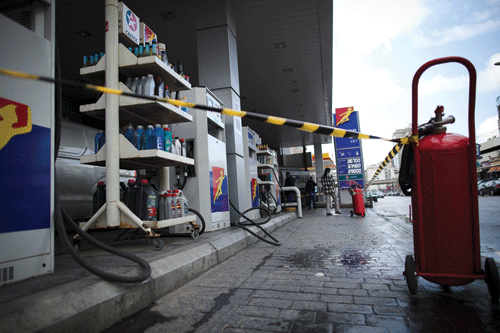
There are few sectors of the economy that elicit less sympathy than the oil industry. Thus one has to wonder whether there wasn’t more anger than pity generated last month toward oil-importing companies, truckers and gas stations after their one day strike left those who failed to fill up in time sucking on fumes. The oil industry was crying foul, however, over what it claims are profit margins that are plummeting due to government imposed surcharges and the minimum salary increase. The March 15 protest was the latest engagement of a long running battle with the Ministry of Energy and Water over price structuring. 

To judge whether industry advocates have a case or not, one must understand the basic dynamics of the sector. Every Wednesday the government sets the price for a jerrycan (20 liters of fuel); it is a crucial revenue stream for the country, with tax of 5,500LL ($3.66) and value added tax (VAT) of 2,500LL ($1.66) on every jerrycan ($23.16 as of going to print). For gas station owners, margins used to be 10 percent on a jerrycan, but has been whittled down as oil prices have risen (to $108 a barrel as of going to print) to 4 percent, or 800LL ($0.53), which they claim is not enough to cover infrastructure costs and the newly introduced minimum monthly wage, which went from 500,000LL ($333) to 675,000LL ($450). 

The government did not give in to the strike, saying if it did, prices would rise by $3.33 on every jerrycan. The argument put forward by the Energy Minister, Gebran Bassil, was that the oil sector's demands were “unrealistic and unjust,” he told reporters at a press conference. “How can they claim to be losing money when we see stations opening everywhere and given that Lebanon has the highest number of gas stations per kilometer in the region.”

The minister has a point but he seems to have overlooked the fact that a license freeze on new gas stations was put in place last year, and if new stations are springing up around the country, they have done so illegally, outside the remit of Bassil's own ministry. Indeed, what Bassil did not mention was that out of the 3,250 gas stations in Lebanon, only 1,450 have licenses. Perhaps the ministry itself should start a nationwide process of regulating, even fining, the 1,800 gas stations operating without licenses as part of a project to reform the sector.

Bassil also threw out a figure that the oil importers make $100 million a year. General Labor Confederation Union chief Maroun Khawli went even further by saying the country's 14 oil importers are acting like a cartel and generate $300 million in profits each year. 

However, Bahij Abu Hamzi, the head of Cogico — which owns Levant Oil and Nat Gas — and is the former head of the country’s oil importers syndicate, told me he had no idea where these figures came from. He claimed $1.2 billion in oil is imported each year and profits are 5 percent, or $60 million, which is around LL800 per jerrycan.

While something doesn't totally add up here given discrepancies in the tens of millions of dollars, there appears to be some truth in oil companies not having the high profits commonly assumed, as over the past several years five oil importation companies went bankrupt and the sector is struggling to fund necessary infrastructure upgrades, which has had negative knock-on effects. Safety standards are far from being up to par; there have been reports of oil seeping into the ground water and last year an explosion at a gas station in Beirut left seven dead.

A recent report by global accounting firm PriceWaterhouseCoopers has proposed that margins should be raised to 2,800LL ($1.85) for 20 liters. This is assuredly too high for the government to accept given how high oil prices already are for the public, and even oil importers acknowledge that this is not the right time to raise it to that level. 

A solution needs to be found that placates both parties, as the oil sector has indicated it will once again lock up the pumps if its demands are not met. But a viable solution is not likely unless there is transparency in what the oil sector's profits — or lack there of — really are. Addressing the prices at the pump is just the start of a much needed refinement of an industry that is as opaque as the oil it sells.

April 3, 2012 0 comments
0 FacebookTwitterPinterestEmail
Comment

Remaking Yemen’s military

by Farea al-Muslimi April 3, 2012
written by Farea al-Muslimi

Few in Yemen can remember the last external war their country’s national army fought. For the record, the last time Yemeni troops aimed their artillery at non-Yemenis was the 1934 war with Saudi Arabia. 

Since then, the army’s weaponry has been turned inwards, supporting successive regimes in the suppression of opposition movements across the country. The military, along with the tribes and religious leaders, make up the troika of power in Yemen, and therefore part of the axis of corruption and misery Yemenis have lived with for a very long time. 

Even after this past year of revolution and all the blood spilled, the majority of Yemen’s military to this day remains under the control of the son of Yemen’s former president Ali Abdullah Saleh, as well as his nephews, half-brother(s) and other close ties.  Statistics on the Yemeni military are rare and hard to find, yet there is some consensus that military spending hovers around 5 percent of the country’s gross domestic product, which in 2011 was roughly $36 billion. In 2009 alone, former President Ali Abdullah Saleh signed a deal to buy $1 billion worth of arms from Russia. The flow of American military assistance also increased in the last decade, topping $150 million in 2010. Seeing Yemen solely from a counter-terrorism perspective, American cash and blessings have found their way onto (and under) Saleh’s table since 2001. In return, the US has enjoyed free access to Yemeni airspace. A US diplomatic cable released by Wikileaks reported that Saleh told General David Petraeus that the Yemeni government would continue telling Yemenis, “The bomb is ours,” effectively giving the American military a free pass to launch drone missile strikes against targets it considered linked to Al Qaeda in the Arabian Peninsula — though often resulting in civilian casualties. 

Since the beginning of Yemen’s uprising in early 2011, one of the biggest demands of the protesters was restructuring the army based on national criteria, and replacing Saleh’s relatives with credible military leaders. During the uprising, Saleh relied on two segments of the army — the Republican Guard, led by his son, and the Central Security Forces (CSF), lead by his nephew — to put down peaceful protests. The CSF contains a counter-terrorism unit that had received American military training and equipment, resources it used to great effect against protesters. 

But armies founded on personal interests rather than national ones have indelible fault lines that splinter under pressure, as was the case in Yemen. The First Armored Division, led by Ali Mohsen al-Ahmar — another of Saleh’s relatives — in March declared its support for the revolution and its intent to protect the squares where protesters had set up camp. This lead to battles between it and the Republican Guard, dividing Sanaa into what seemed two different republics. Yemenis lived in a nightmare for months after, afraid that the clashes would lead to civil war, which at times seemed inevitable. 

Among the core provisions of the Gulf Cooperation Council deal that facilitated Saleh’s exit earlier this year was the restructuring of the army over a transitional period of two years. While little has been done, and the likelihood for meeting the timeframe seems slight, remaking the army has become the next popular grievance to target for the revolutionaries. Opposing them is an established military elite, with few of the elderly commanders inclined to cede power to the new structure. The precariousness of the situation becomes more apparent when one takes into account the several hundred thousand soldiers receiving salaries from the government, but who are not part of the regular army. These are salaries funneled through tribal Sheikhs and military leaders each month via a shady, pseudo-mafioso system, which has built and sustained fiefdoms of armed influence and a complex hierarchy of loyalties. 

Yemen faces a humanitarian crisis, more than half a million internally displaced people, multiple armed conflicts and a near endless stream of other imminent catastrophes. Yet the restructuring of the army is arguably the most complicated and crucial task the country must deal with. The hope is that attempting to do so does not simply make things worse for everyone. And even if, by a miracle, the reconstitution of the army occurs without major mishap, it will take decades for the Yemeni military to reconstruct its relationship and image with the people of Yemen. 

April 3, 2012 0 comments
0 FacebookTwitterPinterestEmail
The Buzz

Unbinding the books

by Youssef Zbib April 3, 2012
written by Youssef Zbib

A modest two-story residential apartment building in the city of Saida houses a Lebanese publisher far more optimistic than others in the industry these days; that the company is also a software firm and owns no printing presses is indicative of the fundamental transformation underway.

Sitting in his quiet office, surrounded by bound tomes published by some of Lebanon’s most prominent publishing houses, Nabih Barakat, a software engineer at Byblos Microsystems, which operates arabicebook.com (AEB), says that many of the paper volumes around him have already completed their digitalization into PDF files, after receiving the consent of respective publishing establishments. These books are now a part of the company’s growing database that currently holds 2,500 electronic books on offer, a process that began in 2001.

“A large part of our work consists of producing [academic] software, and sales of electronic books make up less than 50 percent of our total sales,” Barakat says, adding that there is a rosy outlook for sales growth of electronic books, given the increasing popularity of electronic reading devices, and online purchases in general. Sales in Arab countries other than Lebanon are still the main market for e-books sold through AEB, says Barakat, explaining that Lebanon accounts for 20 percent, while Saudi Arabia is the main market for AEB’s products.

The perspective of many of Lebanon’s 669 other publishers, (a number provided by the Ministry of Information), is markedly different. The quantity of printed books in Lebanon fell as much as 35 percent last year, according to Nabil Abdel Haq, vice president of the Lebanese Publishers Union (LPU), while Lebanese customs figures showed the total value of printed books, brochures, leaflets and other similar material exported fell from $83 million to $51 million between 2010 and 2011, marking a decrease of some 40 percent.

The unread uprisings

“The problems that are ongoing in Iraq, Syria and Egypt hit our exports to the Arab world,” says Abdel Haq.

Nizar al-Laz, a sales executive from the publishing house All Prints Distribution and Publishing (APDP), notes that: “Every year we participate in 15 book fairs, but [in 2011] we could not participate in book fairs that took place in Egypt, Tunisia or Bahrain… The shipment we sent to be displayed at the Cairo book fair was returned and we didn’t even understand why, so eventually we didn’t participate.”

The Arab uprisings also turned the public’s attention away from reading as they followed televised news coverage, according to Bassam Shbaro, owner of Arab Scientific Publishers (ASP). “People were preoccupied with these events because they felt that they affect their lives,” he says.

Long-term threat online

While publishers currently face difficulties due to their decreasing ability to market their products in an Arab world in turmoil, in the long term the adoption of online and digital means to access information — rather than paper mediums — is a trend that looks to permanently change the publishing landscape.

Shbaro did not hesitate to point the finger at online piracy as the main threat to his business, complaining specifically about the illegal trafficking of the Arabic translation of the “Da Vinci Code,” which is the copyright of ASP.

“The availability of pirated books in Arabic through websites such as Google is the real problem,” Shbaro complained. “If you search for Arabic books online you will find [thousands] of pirated electronic copies that are available for free, including our own. These websites don’t do anything about it because they benefit from advertising, and readers of course will not hesitate to download a free a copy if it is made available to them,” says Shbaro, adding that he has discussed this point several times with representatives from Google. Google failed to comment on Shbaro’s allegations despite promises to follow up on the matter from Maha Abouelenein, Google’s head of communications for the Middle East and North Africa.

Illegal physical reproductions of novels are also chipping away at sales. “We have sued several publishers in Lebanon, Syria and Egypt over piracy-related charges but [the legal framework] to prevent piracy in the Arab world is useless and there’s nothing much we can do about it,” Laz says cynically. “At the end of the day, all readers care about is getting a copy of the book for the cheapest price possible.”

The e-challenge

The online challenges facing traditional Lebanese publishing can only grow with increasing Internet access across the region. Along with piracy, competition will likely be felt from the increase of options available for readers of online Arabic that result from a cooperation plan, started in October 2011, between the Qatar Computing Research Institute (QCRI), part of the Qatar Foundation, and Wikimedia Foundation.

The cooperation aims to increase the number of articles in Arabic while guaranteeing high quality translations by using actual translators provided by QCRI, rather than relying on translation software, according to Barry Newstead, chief global development officer of Wikimedia Foundation, which manages the popular online user generated reference Wikipedia. While any improvement in the quality and accessibility of information will ideally benefit readers, publishers realize that sooner or later they have to play according to the rules set by electronic media.

One form of adaptation to this new reality is offering readers electronic books. While AEB in Saida may be among the forerunners, several Lebanese publishers Executive interviewed declared they have also started digitizing their publications, or are seriously considering the option — lest tomorrow see them turn the last page on their businesses.

April 3, 2012 0 comments
0 FacebookTwitterPinterestEmail
Economics & Policy

A poisoned chalice

by Zak Brophy April 3, 2012
written by Zak Brophy

In the midst of the incessant torrent of winter rains this year, it is hard to imagine that the country’s water resources are a serious cause for concern; but they are. A history of decaying infrastructure, poor management, rising demand and fetid politics has taken its toll. Lebanon is now blighted by seasonal rationing on domestic supply, farmers irrigating with raw sewage and roughly half of all the water entering the water network being lost in transmission and distribution. What is more, the cost of inaction in the water sector is estimated at $433 million every year. 

In an average year demand outstrips supply by around 100 million cubic meters (MCM) and that rises to around 300MCM in a dry year; approximately enough water to fill New York’s Empire State Building three times over. These are big quantities that demand big solutions. As the aquifers, rivers, lakes and reservoirs are replenishing during the winter, building a stock to feed the coming dry months, the government is pressing ahead with a number of strategies and projects that aim, in the long term, to plug the gap and keep the nation’s households, farms and industries watered. Huge quantities of money are involved and the implications, most notably for public health, cannot be understated.

Two costly solutions, one source

Since the beginning of the year two major water infrastructure projects have been officially unveiled that will fundamentally shift the state of play in the sector. The Canal 800 and the Greater Beirut Water Supply Project (GBWSP), also known as the Awali project, will feed expansive water networks to South Lebanon and Beirut, respectively. In reality the designs for both projects date back to the pre-civil war era but the plans inked on paper are now set to become a reality. However, as the politicians tout the vote-winning promise of an abundance of water for the faucets and farmsteads of Beirut and the South, concerns abound regarding the safety of the water we are being promised. May Jurdi, chairperson of the American University of Beirut environmental health department, warns, “You are building a problem. The issue is the quality. You don’t build on a problem, you need to solve the problem first.”   

What’s more, once hundreds of millions of dollars have been spent and the concrete and pipes are set in place, there are doubts that there will actually be enough water to fulfill the lofty promises now being made. In the words of a senior consultant working with the government on water management, speaking on condition of anonymity because they were not permitted to speak to the press, “As usual, politicians are over-evaluating volumes of water and over-allocating it.” 

The Canal 800 is slated to draw 110 MCM every year, from the Qaraoun reservoir in the Southern Bekaa, to the south of the country. The lions share of this water, 90MCM/yr, is intended for the irrigation of around 14,700 hectares of farmland, including the areas in and around Marjaoun, Bint Jbeil and Yaarin and the remaining 20MCM is destined for the household taps of some 100 southern villages. The first phase of this project alone carries a price tag of $330 million; $162 million in loans from the Arab Fund for Economic and Social Development and the Kuwait Fund for Arab Economic Growth, $38 million from Lebanon’s Council for Development and Reconstruction (CDR), the government body in charge of implementing infrastructure projects and $130 million dollars is yet to be secured.

As for the GBWSP, it will be drawing water in the opposite direction, from the Qaraoun Reservoir and Awali River south of the capital to the homes of 1.2 million people in Baabda, Aley, parts of the Metn and Southern Beirut, areas of Greater Beirut and Mount Lebanon region. Shifting such large quantities of water across such expansive tracts of the country is no cheap feat and the total financing requirements are estimated at $370 million. The bulk of the cash will once again come from foreigners, this time in the form of a $200 million loan from the World Bank signed last month. The government will stump up $30 million for land acquisition and the Beirut and Mount Lebanon Water Authority will cover the remaining $140 million. Whilst the two schemes are funded, planned and ultimately implemented independently of one another, they are also intrinsically linked at their source: the Qaraoun Reservoir, from which the Canal 800 is totally supplied and the GBWSP partially. 


The (not so) great lake

Built in 1959, the man-made Qaraoun Reservoir sits at the foot of the eastern slopes of the Mount Lebanon range in the southern Bekaa, collecting water from the Litani River before it snakes east on its ineluctable descent to the Mediterranean Sea. It is, in the words of Veronique Kaspard, professor of environmental and isotopic geochemistry at the Lebanese University, the “dustbin” of the Litani, Lebanon’s longest and most polluted river. For this reason there a number of specialists in the field who are deeply concerned about the prudence of taking 150MCM/yr of its water to the homes and fields of southern Lebanon and Beirut.      

Ismael Makki, agriculture and environment manager at the CDR, challenges these doubts, arguing that conventional treatment plants will suffice in cleansing the water from Qaraoun. “The water contains some contamination but it remains within the treatable limits, by conventional treatment,” he says.   

However, the government water consultant, a high-ranking source at the Litani River Authority (the body responsible for the management of the Litani River Basin), and Kaspard, were adamant in their rebuttal. Among the many pollutants found in the river and the reservoir are the recent findings of trace metals that are of greatest concern. As the LRA source explains, “There is a different kind of contamination and the concern is with trace metals. They are approaching the permissible levels but they only appeared in the past few years.”

Makki acknowledges that the trace metals have given cause for concern and points out that the World Bank sent a team of its specialists to conduct an independent examination. “This has been reviewed several times, and not just by the CDR, but by the World Bank itself, which appointed a committee to review the water quality and quantity for the greater Beirut project. This issue has been addressed from a highly technical point of view,” he argues. Whilst the World Bank report did conclude that the levels of trace metals were within the permissible limits, its findings are not enough to assuage the worries of everyone. 

Professor Kaspard explains that the mushroom in industrial and agricultural activity in the Litani River basin is creating a “pollution history” from which the outcomes cannot yet be known. “If you are at the appropriate time you can measure high trace metals, if you are not you will measure low. It is not steady. This is why we are now doing proper scientific work on the whole system,” she says. An environmental and social impact assessment for the Awali-Beirut Water Conveyor Project presented to the CDR in August 2010 suggests Kaspard is within reason to fear that the current situation will deteriorate before it improves, stating, “The possibility of a lower water quality both for the Awali and lake Qaraoun sources should not be ruled out.”

A 2010 USAID report on the management of the Litani River Basin further warns that the recent detections of trace metals, “renders water unsuitable for drinking and requires advanced treatment processes to deal with these types of contaminants.” 


What we’ll be drinking

The same report outlines many of the adverse health affects that can result from prolonged exposure to these trace metals, and it doesn’t make for comfortable reading. The three metals whose ascendancy is most pronounced in the basin are cadmium, manganese and barium, which are associated with a plethora of ailments including bone and cardiovascular disease, toxicity of the nervous system, swelling of the brain and liver and kidney damage. The USAID study report levels of cadmium more than double the national standard level and that manganese levels were increasing, with a mean level of 0.04 milligrams per liter (mg/l) encroaching upon the maximum standard limit of 0.05mg/l; moreover, 30 percent of the sample sites exceeded this limit level. 

AUB’s Jurdi warns, “Trace metals have a cumulative affect in the body so the signs may not appear for some time. It may take 10 or 15 years, but it is a risk. Especially depending on the treatment process we are implementing.”

The main cause for the deterioration in the quality of the Litani River’s water is the dumping of untreated industrial effluent and excessive use of agricultural fertilizers and pesticides, including smuggled and unlicensed varieties. With unknown quantities of unknown pollutants — including recent findings of complex chemicals from pharmaceutical industries — contaminating the river and its tributaries, Kaspard argues there is little hope of being able to successfully treat the tainted concoction once it has been drawn from the Qaraoun, as is currently planned.

“There are different qualities of pollution from the different industries and they can all converge with unknown outcomes,” he says. “They cannot be treated from the same plants because they require different treatments.” 

As the Litani River is being sullied there is a general consensus on the need to better manage and regulate the basin before the toxins enter the system. The CDR’s Makki says, “If you have pollution and you have a project of this size and with the potential benefit for so many people, you have to stop the pollution and not cancel the project.” However, that requires financing, institutional organization and coherent policies that are currently lacking, not to mention enforcement by the Internal Security Forces. “There are regulations to control discharge but very, very few have the monitoring capacity or capability,” says Nadim Farjallah, senior expert in land, water and environment at engineering firm SETS explains. “They barely have enough personnel to collect fees. The monitoring of quality… there is nobody to control it. That is a major problem.”

Soggy laws, vaporous implementation 

The ubiquitous disparities in Lebanon between laws on paper and laws in practice are a major cause of this problem. Law 221, May 2000, was meant to restructure the water sector in Lebanon, but as Abdo Tayar, advisor to the minister of energy and water, Gebran Bassil, concedes, its incomplete implementation means wastewater management remains a major problem; “Now no one is really responsible for wastewater,” he says. “It is fragmented between the CDR who is doing projects, the municipalities who are running some and the ministry is doing some others, so there is a big grey zone.”

If the scientists’ fears — that toxic contaminants such as trace metals could continue to rise — manifest, then the conventional treatment options currently slated will not suffice in protecting hundreds of thousands of Lebanon’s inhabitants from a noxious nectar coming through their taps. The LRA source warns that the economic feasibility of the projects will be severely impacted if expensive treatment methods have to be employed such as selective ion removal or reverse osmosis. “It will end up being more expensive than bottled water,” he says. A recent study from the University of Texas at Arlington found that the construction specifications for an advanced treatment technique often used to remove trace metals, called reverse osmosis, would cost an additional $2,240,000, and that is before maintenance and monitoring. The plant in question is smaller than the proposed Ourdanyne plant for the GBWSP, and treatment costs do decrease with size, but it gives an indication of the hidden stings that may arise if and when it is determined that the advanced treatment techniques are required.   

No water anyway

In any case, farmers and residents may not need to fear the contents of their water tanks for the simple reason that they may be empty. In meeting minutes obtained by Executive from a session of the council of ministers on October 2011, the Ministry of Energy and Water warned that “executing the Canal 800 will affect the amount of water intended for delivery into Beirut [via the GBWSP]… During certain years it may be impossible to deliver any amount of water into Beirut. “This portent echoes the concerns of the water consultant and the source within the LRA, with the former saying, “Add one plus one plus one… sometimes you’re going to run out.”

The CDR’s Maki is adamant that the numbers have been checked and all the projects will receive the water they have been allocated. “There is no problem in that regard,” he reassures. 

Following a complaint by 51 residents of greater Beirut in November 2010, led by Fathi Chatila, a hydrologist and long time detractor of the GBWSP, the World Bank commissioned a study by the Water Institute at the University of North Carolina (UNCWI) to assess the quantitative, qualitative and financial feasibility of the scheme.

In conclusion, the report found the conveyor would receive enough water so long as, “The Canal 800 irrigation project will not begin to withdraw water until 2021 and will not reach maximum value until about a decade later.” An assertion supported by Makki. However, in the cabinet minutes leaked to Executive the CDR stated that the Canal 800 will go into service in 2017 and not 2021, hence undermining the UNCWI assessment. 

Another lynchpin in this matrix is the planned construction of the Bisri Dam between the Chouf and Sidon. Makki explains that for the coming 10 or 12 years the GBWSP can draw from existing sources, but as it enters the second phase and the water flows increase from 250,000 CM/day to 700,000 CM/day, “Then we will need the Bisri Dam. This will constitute the main source of this project.”  

This assessment is supported by the Minister Bassil, who stated in a press conference that the Bisri Dam was an “inseparable and integrated” part of the project and that building the conveyor infrastructure without building the dam would result in “an investment that is useless, resulting in paying a lot of money for a little bit of water.”   

However, this runs in contradiction to the assessment of the World Bank, the very body the ministry is pinning its hopes on to finance the majority of the Bisri dam. It stated in its response to Chatila’s complaint that, “the Bisri Dam is not a component of the GBSWP nor is it relevant to, or necessary for, the achievement of the objectives of the GBWSP.” 

In the minutes from the October 11 council of ministers meeting, the Ministry Of Energy and Water claimed the World Bank had committed to a $125 million loan to break the back of the estimated $260 million price tag on the dam. However, the most concrete commitment that Executive could elicit from the bank’s sector manager for water Ato Brown was that the bank would not commit to financing “until an evidence based approach is finalized.” 

The divergence in opinion between Lebanese government officials and the check writers at the World Bank over the interconnectivity between the GBWSP and the Bisri Dam suggests it is perhaps a bit early to take it as a given that the bankers will sign on the dotted line.

Another dry debate

In conclusion the LRA source stated that the concurrent development of the Canal 800 and GBWSP — in addition to the existing Canal 900 that irrigates some 2000 hectares in the southern Bekaa — will push the reserves of the Qaraoun and the Litani river to the limit and in many years will simply fall short: “The problem will be in the scarce years. [The annual reserves of the Qaraoun] will not reach the 300MCM which is a maximum, but this is only every three to four years. In the good years we should be able to cover all of the projects.” 

The government consultant agrees with this analysis and expands: “These projects will not reach their objectives. They won’t reach their internal rates of return. They won’t reach the number of hectares they are meant to serve, and they won’t provide the benefits they are meant to provide.” 

The same advisor complained that the decisions to implement these major developments have been driven more by political calculations than any technical and holistic reasoning of how best to manage the nation’s water resources. He argues that the Canal 800 project has been given the green light in a deal cut between speaker of the parliament Nabbi Berri and prime minister Najib Mikati, securing a vote-winning development in the heartlands of Berri’s constituencies in the south.  

He continues that the logic of drawing such large quantities of water from the Litani to the south, primarily for agriculture, does not make sense as the real agricultural backbone of the country is the Bekaa, which also happens to be the region that suffers from the greatest water deficit. “They are taking the water out of the Bekaa to other river basins around. So what happens to the people of the Bekaa?” he asks.

The CDR’s Makki denies out of hand that there has been any political interference, assuring that there is a long history behind the projects and they are part of a much larger development strategy in the water sector.

However, Abdo Tayar, one of the key advisors on this strategy at the Ministry of Energy and Water, says: “I am distancing the ministry from this [the Canal 800]. We do not have visibility on this.” That one of the biggest developments in the water sector for decades is not being pursued under the direction of the Ministry of Energy and Water (MoEW) is perhaps indicative of how politics are overriding policy. 

Lebanon can ill afford to idle over the development of its water resources. By the same token the direction and implementation of this evolution must not be misjudged. Avoiding tough questions and waxing over painful truths may enable the grand gestures of politicians in the short term. But, the possibility of swathes of the country being exposed to pernicious toxins and hundreds of millions of dollars being squandered on unsustainable projects is reason enough to drag the debate out of the meeting rooms of technocrats, bankers and contractors, and into the living room of every household in the country.


April 3, 2012 0 comments
0 FacebookTwitterPinterestEmail
  • 1
  • …
  • 337
  • 338
  • 339
  • 340
  • 341
  • …
  • 707

Latest Cover

About us

Since its first edition emerged on the newsstands in 1999, Executive Magazine has been dedicated to providing its readers with the most up-to-date local and regional business news. Executive is a monthly business magazine that offers readers in-depth analyses on the Lebanese world of commerce, covering all the major sectors – from banking, finance, and insurance to technology, tourism, hospitality, media, and retail.

  • Donate
  • Our Purpose
  • Contact Us

Sign up for our newsletter

    • Facebook
    • Twitter
    • Instagram
    • Linkedin
    • Youtube
    Executive Magazine
    • ISSUES
      • Current Issue
      • Past issues
    • BUSINESS
    • ECONOMICS & POLICY
    • OPINION
    • SPECIAL REPORTS
    • EXECUTIVE TALKS
    • MOVEMENTS
      • Change the image
      • Cannes lions
      • Transparency & accountability
      • ECONOMIC ROADMAP
      • Say No to Corruption
      • The Lebanon media development initiative
      • LPSN Policy Asks
      • Advocating the preservation of deposits
    • JOIN US
      • Join our movement
      • Attend our events
      • Receive updates
      • Connect with us
    • DONATE