• Donate
  • Our Purpose
  • Contact Us
Executive Magazine
  • ISSUES
    • Current Issue
    • Past issues
  • BUSINESS
  • ECONOMICS & POLICY
  • OPINION
  • SPECIAL REPORTS
  • EXECUTIVE TALKS
  • MOVEMENTS
    • Change the image
    • Cannes lions
    • Transparency & accountability
    • ECONOMIC ROADMAP
    • Say No to Corruption
    • The Lebanon media development initiative
    • LPSN Policy Asks
    • Advocating the preservation of deposits
  • JOIN US
    • Join our movement
    • Attend our events
    • Receive updates
    • Connect with us
  • DONATE
Coronavirus AnalysisLeadersOpinion

Pandemic brings needed media self-reflection

by Executive Editors May 6, 2020
written by Executive Editors

What is in a magazine? From the perspective of us who write and edit the content of Executive, it is a striving for truth, meaning a constant quest and never-ending chase for an elusive public good of the first order. In times of crisis, this striving for truth is often the most valuable contribution that critical thinkers, constructive troublemakers, and professional sceptics can make to a society, but in the immediate moment—it is often thankless. And yet, despite it being known to not be financially rewarding, the real prize of the writer is a long-term and intangible hope to make a difference. All that and more is being confirmed to editors of Executive and our magazine’s entire team during this time of global and local challenge.

In operational terms, Executive Magazine is both fortunate and deeply challenged by the circumstances. We decided in March as the lockdown got underway to reorganize our workflow, shifting from a monthly magazine format to an online-first approach. This has not meant a decrease in our output. On the contrary, these last seven weeks, through the immense efforts of our in-house writers, have seen multiple weekly analyses and the production of not the usual one, but three special report focuses: on Lebanon’s food security, on the impacts of coronavirus, and on what this all means for the insurance industry. 

Moreover, following passionate deliberations and soul searching, we have decided to double up our online content choices by creating a full PDF version of the magazine. You can now pour over Executive pages online as you would go through pages in the print edition, or continue to enjoy our stories in our web format. It goes without saying that our expert online team of one (enhanced by lots of willing collaboration from our wider team) will keep you alert on what we do, through our social media channels on Facebook, Twitter, Instagram, and LinkedIn. 

From perspective of professional journalism, a social media presence helps spread our content but does not do much to solve the challenges of providing top, trustworthy content in conjunction with economic viability. Financial pressures come with the territory of journalism and are exacerbating during the coronavirus recession for media organizations around the world, let alone for twice or thrice burdened Lebanon. Executive is not immune to these pressures; our team is working hard in these difficult circumstances to produce the best stories and analyses that we can, knowing that now more than ever is when Lebanon needs committed, investigative, and honest journalism. 

Lebanon’s experience of compounded crises is a painful but essential reconfirmation: A country cannot survive without the people’s quest for truth. This is always thus but never a more obvious and blatant need than at a time when leaders are lost; when they cannot find a way out of misery without turning to the outside and begging strong nations for costly aid; when they are in danger of giving up their people’s sovereignty; when they are unable to climb out of a hole of corruption that they have dug for their political class and for the state.

Talking globally and about moving forward, media and journalism will be in need to reboot after the pandemic. This will involve not just the reignition of the economic engines of media outfits but also a review, rethink, and refocus on conceptual levels. There can be no business as usual under lockdown, even for the online design Picassos, frantic teleworkers, heroes of home office labor, and executive multitaskers that are constantly hopping around between simultaneous Zoom gatherings or confidential Webex board meetings—but going forward, there also will be no business as before. 

The preparation phase for all that new business is commencing now when the seed of the post-corona world is still covered by the calming soil of economic inactivity that has been forced by our medically mandated responses to the pandemic. In the news business—that to some who love it has long been like no other business—the restart of money-making business in a world with more digital media competition over fewer advertising resources will involve taking further and faster steps in digital reengineering of business models, something that has been going on for decades, albeit far too slowly until the 2010s (and with too little vision and lacking of moral compasses throughout).

Media in times of pandemics already have become a hot research topic in online academic journal publishing. Social networking is jumping into a new dimension of its short history, becoming by some observations more socially connective but also more burdensome and intrusive. Observing this and embedding it into a narrative on the problematics of “neoliberal capitalism” (the 21st century edition), American academic Martin Filsfeder asks if we could imagine “social media networks and apps designed for the public good?”

In the social networking realm that is a democratization of what once was the profitable communication domain of yellow journalism and digitization of bad gossiping habits, the reality is now turning against that what was the old normal not even a quarter year ago. Social media has for years “incentivized controversy, outrage, and half-baked contrarianism” with the effect that there were many people who “correctly internalized those incentives,” but this is changing, says Andrew Marantz, a tech and social media journalist at The New Yorker. During the coronavirus pandemic, what was seen as good in terms of clicks—getting people’s attention at any price, under total disregard of ethics—even if it was a “bad tweet, morally speaking” is no longer just repulsive from the quaint observation point of looking for truth in media but potentially destructive of lives (it always was, but in a more indirect and less alarming way). 

It would be idiotic to believe that this destructiveness of lies and attention will eliminate the human temptations to tell lies or suddenly liquidate and reverse the patterns of propaganda journalism and deception that have been embedded for ages in media cultures of tyrannies, totalitarian states, revolutionary societies, and proud republics that are self-proclaimed homes of their peoples. For all who care about journalism and communication while living in imperfect societies in the best of all available worlds, this time of crisis is proof of the need to strive for truth. 

It is an urgent time us at Executive Magazine to keep our deception detectors on high alert, and also fact-check our own assumptions and all narratives as diligently as we can. For publishers, media types, writers, visualizers, bloggers, online influencers, and communicators of all stripes, it is time to rethink business and coverages. In the honorable profession of journalism, this virus-induced chance for personal reflection on existential essentials deserves to be a time of return to emphasizing media ethics and refocus professional journalism, remembering that we should and can be indispensable contrarian cogs in the digital machines of post-pandemic economic and social life.     
May 6, 2020 0 comments
0 FacebookTwitterPinterestEmail
Coronavirus AnalysisFood securityIndustry & AgricultureInsurance

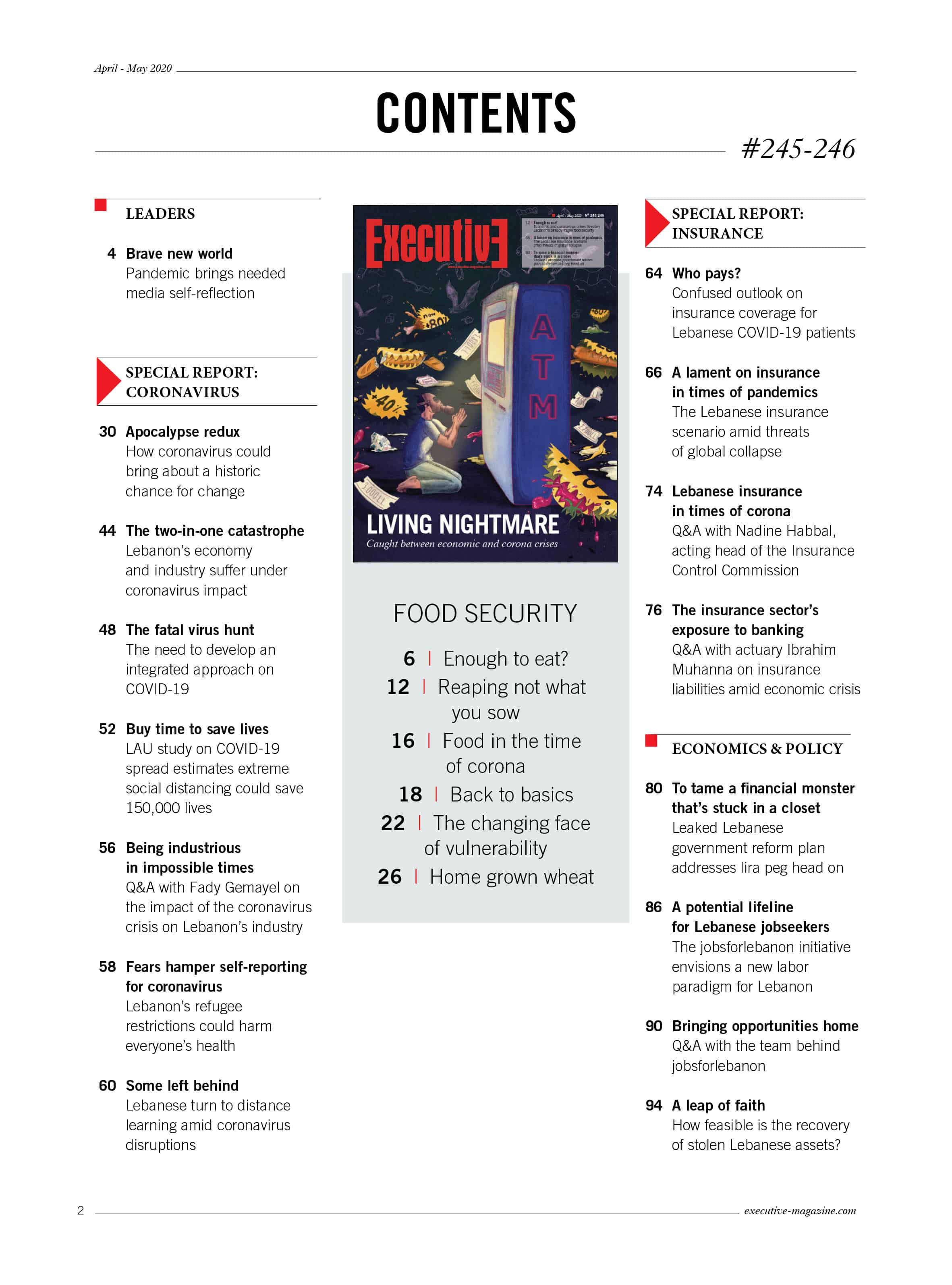
Executive Magazine’s April/May issue

by Executive Editors May 6, 2020
written by Executive Editors

The lockdown in Lebanon has been extended for a fourth time, till May 24. Easing measures are seeing those who can slowly reopen businesses and try to get back to work. But protests have also sprung anew. The reality is for many, there was no work before the lockdown began, and there will be none even when it is fully lifted.

Meanwhile, the lira is in freefall, decimating the purchasing power of many Lebanese as prices in the supermarkets continue to rise at alarming rates. One confrontation between a protester and an army officer, widely shared online, saw the officer respond to the protester’s shout of being hungry with “I’m hungrier than you.” Human Rights Watch warned earlier in April that millions of Lebanese were at risk of going hungry due to lockdown measures.

Now, more than ever, is the time for rigorous, honest, and investigative journalism. 

When it became clear that the country would be going into lockdown to try and prevent the spread of the coronavirus, Executive’s team made a collective decision to reorganize our workflow. Rather than produce content for a monthly magazine format, we shifted to a online-first approach. This did not mean a decrease in our output, on the contrary, our team has been working hard throughout these difficult circumstances to provide detailed analysis on three special report focuses: Lebanon’s food security, the impact of the coronavirus, and lessons to be learned from Lebanon’s insurance industry. 

We recently took the decision to collate all our work over these past two months into a PDF-format magazine that our readers can enjoy as they would our usual magazine. This can now be accessed here, or downloaded directly here.

We hope that you will enjoy seeing our content in its usual format. Of course, all the articles and analyses within remain available to read online, and will be shared on our Facebook, Twitter, LinkedIn, and Instagram pages. 

Moving forward, it is our hope to return to printing our magazine for the June edition, though Executive, as with all media outlets in the country, and indeed the globe, is not immune to the financial pressures and lockdown measures that the coronavirus has brought in its wake. We shall be taking things step by step, to ensure that the safety of our staff continues to be a top priority. 

To our readers, we thank you for continuing to trust us and follow our work, this past month has seen a double digit percentage growth in the number of sessions and page views on our website. You have given us amazing encouragement and we promise to continue our efforts to provide clear, accurate, and independent information on which you can form your opinions in these trying and stressful times. 

As always, stay safe. 

— Executive Editors

May 6, 2020 0 comments
0 FacebookTwitterPinterestEmail
AgricultureCoronavirus CloseupHospitality & TourismQ&A

Q&A with Kamal Mouzwak on the impact of COVID-19 on Tawlet and Souk El Tayeb

by Nabila Rahhal May 4, 2020
written by Nabila Rahhal

After being closed down starting March 11 for almost eight weeks, due to measures taken in response to the COVID-19 pandemic, Lebanon’s restaurants were allowed to re-open on May 4 as part of a phased easing of the lockdown. To learn more about considerations F&B operators were taking into account before reopening, Executive chatted beforehand with Kamal Mouzawak, founder of farmers’ market Souk El Tayeb, Tawlet restaurants, and Beit guesthouses.  

Mouzawak also shed light on how the COVID-19 lockdown has impacted Souk El Tayeb and its food producers, given that the farmers’ market was classed as  a mall and as such will not be able to reopen until May 25.

Have you decided whether you will be opening the Tawlet farmers’ kitchens on May 4 or not?

We are still hesitating. It is risky [in terms of health] for our staff and for ourselves and our guests.

We are thinking that people will most likely feel comfortable being in open air venues in regions close to their homes. So we will open the Tawlet in Ammiq and the Tawlet in Deir el-Qamar. We will also be opening a new Tawlet in Douma. Douma was just a Beit [a bed and breakfast] but will now have a Tawlet too. (NB: The Ammiq, Deir el-Qamar, and Mar Mikhael restaurants did reopen on May 4, and while prices remain the same Mouzawak indicated they would increase slightly in the near future).

How about the Tawlet restaurants in Mar Mikhael and Hamra?

We took the decision to close [Tawlet and Beit] Hamra. It was a catastrophe for us; it was a project that started in June (2019) and cost us a lot of money and now we have to shut it down. We are very sad but it was bad timing since we launched it in the summer, then came October with the protests and now corona.

What is going through your mind as you contemplate reopening your Tawlet restaurants on May 4?

We have to open at 30 percent occupancy (NB: as per the government reopening mandate for the coming two weeks), which is nothing and hardly covers costs. The second thing is that people are still afraid to go out.

The third thing is that we have no recommendations at all on how to open; they just said 30 percent occupancy and that is it. The syndicate [of Owners of Restaurants, Cafes, Nightclubs, and Patisseries] asked consulting company GWR Consulting to give a webinar for 30 minutes but it should be coming from the concerned ministries and not the syndicates.

Hotels have been allowed to operate since April 27. Did you open your Beit projects?

No, because again we don’t know how to deal with this. Our hotels are not big: They are bed and breakfasts with teams that work very close to the guests. So how are we going to deal with it? We don’t know yet how to go about this. 

It’s not enough to say ok now you can open, you have to tell us how to open. We are left alone as we have always been. But sometimes we can deal with the situation when we are left alone, and sometimes we can’t.

Let us try to consider what the situation will be like in the summer or toward the end of 2020. Do you believe it would improve?

I don’t know. We are trying our best to open in outdoor places and hope for the best. We don’t just have the economic situation to deal with, we also have the political one where a person died two days ago (NB: A 26-year-old father and Tripoli resident Fawaz Fouad al-Samman died on April 28, as a result of wounds sustained the night prior in clashes between protesters and the Lebanese Army) and people are back to the streets. In such a situation, no one is in the mood to eat out. There is a lot of uncertainty.

In Greece and Turkey, tourism helped their economies recover from financial challenges. Do you see that happening in Lebanon?

That’s true and you don’t need to convince me about it. But they were only dealing with one negative situation, which is the economic crisis, not the coronavirus-related crisis, or the political crisis we are going through, or the corruption in the country … We have a lot to deal with.

Also, Greece had the backing of Europe while we have no one to back us up.

As you said there is a lot of uncertainty …

Yes, indeed. Yesterday we were working to close [Tawlet] Hamra while at the same time we are opening [Tawlet] Douma. It is totally schizophrenic.

But hasn’t the hospitality sector in Lebanon always been this way?

Not to this extent. We were never this poor. We used to be stronger in the face of crises both emotionally and economically. Even if you have money now, you cannot access it.

On another note, how are the farmers and food producers you work with faring under the circumstances we are facing these days?

The problem is that we barely had time to deal with the economic crisis—and we had just started to adjust and adapt to it—when we were hit with the coronavirus-related lockdown.

The coronavirus crisis is a catastrophe for Lebanon and everyone else in the whole world. But the problem for food producers, especially those that work with fresh produce, is that [their products] are perishable. If you are a fashion designer, you can store a dress safely for when you can sell it but fruits and vegetables have seasons and farmers need to harvest them and sell them in time or they will rot.

Another problem is that farmers have a [more] precarious and fragile situation than others because they work in a medium that is not very lucrative but has a high cost of production.

Has the demand on food products not increased since the lockdown? Given that people are at home and potentially cooking more?

This may be true but how can small scale producers and farmers deliver their products to these consumers? We are selling some of their produce in Dekenet (NB: a grocery store outlet in Mar Mikhael that was launched by Mouzawak and team in February 2020) but it is very limited compared to the market they had prior to the lockdown. Back then, they would sell in Souk El Tayeb and they had their own clients that they would deliver to.

What are the producers you work with doing in the meantime?

Nothing. They are at home; they try to make mouneh products (NB: preserved traditional foods such as pickled vegetables, dried yogurt, tomato pastes) and sell based on demand. But if this is not well organized and there isn’t enough volume, the delivery will cost them more than the profit they stand to make.

In the past few months, we have felt an increase in the recognition of the importance of agriculture and agro-industry to the economy. You at Souk El Tayeb have been aware of that for a long time now but is Lebanon catching up?

Definitely. Following the economic crisis, there was this trend of local production and of course, the first sector that will benefit from this is agriculture.

Where do you see this going? Is there potential to strengthen the sector?

Well, we have no other choice now. With the economic problems, we have no other solution than to produce locally. But we have to look at the costs here considering there are a lot of imported raw material; we have to look at this and also at how much they will be able to sell. We can produce more locally for sure, but at what cost? And at what price? Keeping in mind that consumers’ purchasing power is very low these days.

So you don’t see it as being the salvation to Lebanon’s GDP?

It costs a lot. The land is very expensive and there is no law to protect agricultural land as is the case in the US and many other countries. [Landowners] would prefer to sell their land for commercial use rather than keep it for agriculture since they would make a lot more money from that. 

May 4, 2020 0 comments
2 FacebookTwitterPinterestEmail
AgricultureEconomics & PolicyFood securityOpinionSpecial Report

Food insecurity in Lebanon

by Abdallah al-Wardat May 1, 2020
written by Abdallah al-Wardat

As Lebanon weathers through an economic crisis and COVID-19 outbreak, food insecurity has become a major concern across media headlines and in society. More stories are surfacing on how many families can no longer afford to meet their food needs, raising questions on the future of Lebanon’s fragile food sector.  

What is food security, and what does it mean for a country to be food insecure? For the United Nations World Food Programme (WFP), the world’s largest humanitarian agency concerned with food security and food assistance, these questions are essential in today’s Lebanon. Access to food is a basic need and a basic right, with serious and far-reaching human and economic consequences when under threat, especially since the poorest and most vulnerable groups in society are usually those first and most affected.  

At the 1996 World Food Summit, the United Nations’ Committee on World Food Security defined food security as people having at all times “physical, social and economic access to sufficient, safe and nutritious food that meets their food preference and dietary needs for an active and healthy life.” It is not just food availability that determines the food security status of a certain country, group, or person, but also the stable and constant access to food, and how this food is used. How do these definitions apply to Lebanon in the present circumstances? 

Food availability  

Food availability derives from domestic production or from imports, with Lebanon relying heavily on the latter as a net food importer. The recent scarcity of US dollars and capital control measures have put food availability at risk as food importers have been facing increasing obstacles to make payments on the international market.  

Between 2015 and 2019, Lebanon imported about three million tons of food products each year to meet the demand on the domestic market. Less than 20 percent of the consumption needs of cereals was covered by local production. 

Food access 

Food availability on the domestic market, however, does not guarantee that consumers will be able to afford and to access, in sufficient quantity, the various and adequate food products necessary for a healthy diet. Even prior to the COVID-19 outbreak and the resulting lockdown of economic activity, WFP has been concerned that access to food was threatened by the steady inflation in food prices that commenced in the latter months of 2019 and the economic recession causing large-scale job losses and salary reductions.  

Between September 2019 and March 2020, WFP research recorded an increase of 40.1 percent in the price of the basket of eight basic food commodities (rice, bulgur, pasta, white beans, sugar, sunflower oil, salt, and canned meat) which serves to determine the cash transfer value for food assistance programmes benefitting vulnerable Lebanese and Syrian refugee families. This food basket is known as the Survival Minimum Expenditure Basket (SMEB), as it is required, in sufficient quantities, to cover an individual’s minimum survival food needs for a month. The inflation observed for the SMEB can be compared to the inflation reported by Lebanon’s Consumer Price Index (CPI), derived from a much larger basket of food and non-alcoholic beverage products, which stood 18.4 percent for the period September 2019 – January 2020.  

This high inflation of food prices, unprecedented in Lebanon in the last ten years, is strongly correlated to the unofficial devaluation of the Lebanese lira against the US dollar, which made food imports more expensive and also more difficult to get due to capital control measures. Food price inflation combined with inflation affecting non-food products and services, and with loss of income resulting from rising unemployment and salary cuts, has undoubtedly and drastically reduced Lebanese households’ ability to afford adequate and sufficient food, especially for the poorest and most vulnerable.        

Since 2014, WFP and its partners, including international donors and Lebanon’s Ministry of Social Affairs (MoSA), had already been reaching out to almost 150,000 Lebanese and Syrian refugee families (close to one million individuals) with cash-based food assistance to cover their basic needs (SMEB). Estimates, however, indicate that almost twice as many additional households are currently unable to meet their minimum food needs and would require assistance until economic recovery enables them to afford the cost involved.   

The face of vulnerability  

The economic crisis has changed the face of poverty and vulnerability in Lebanon—it has made it significantly more acute.  

Even prior to the current economic and COVID-19 crises, poverty levels were high in Lebanon, hovering just above 30 percent according to the World Bank. Based on negative GDP per capita growth projections for 2020, the World Bank estimates poverty prevalence will rise to 45 percent in 2020, up from 37 percent in 2019. Likewise, extreme poverty (also known as food poverty) is expected to affect 22 percent of the population, up from 16 percent in 2019. According to these estimates, Lebanon could count as many as 335,000 poor Lebanese households in 2020 (out of 4 million Lebanese residents), including 163,000 households (close to one million individuals) under the food poverty line.  

Significantly, Lebanon’s Ministry of Education and Higher Education reported last January that 40,000 students previously schooled in the private education system had enrolled in public schools, as their families were no longer able to afford tuition fees. This represented a 15 percent increase in students enrolled in the public education system, at a time when the government’s fiscal capacity is severely challenged. This example is emblematic of a sudden and rapid impoverishment affecting even the middle class, while the impact on the poorer strata of society is undoubtedly much more severe.    

Syrian and other refugees as well as migrant workers residing in Lebanon have also been seriously affected by the economic downturn. WFP estimates that between 2019 and 2020, the proportion of Syrian refugee households unable to meet their minimal survival needs, including food, has increased from 55 percent to 83 percent (WFP estimates that Lebanon is host to 1.2 million Syrians). Only half of these extremely vulnerable families are currently receiving basic assistance. 

The need for change 

This sudden and significant rise in poverty and food insecurity comes at a very critical time and in a very challenging context in Lebanon, where targeted social safety nets are the lowest in the Middle East and North Africa region (at less than one percent of GDP), and when public debt and fiscal challenges severely undermine the government’s capacity to mitigate the impact of the crisis, even on the poorest and most vulnerable. 

The government and partners, including WFP and international donors, are acutely aware of the situation and are urgently seeking to protect the most vulnerable in the short term, while looking at sustainable solutions to improve social safety nets as well as economic and fiscal policies impacting poverty and food security in the medium and long term.  

The MoSA’s National Solidarity Programme launched in early April to assist 200,000 vulnerable households through cash-based transfers puts food security at the center of its objectives. Likewise, reform and expansion of the National Poverty Targeting Programme (NPTP), which could benefit as many as 150,000 extreme poor Lebanese households as an emergency social safety net, are being actively discussed. The main feature of the current NPTP, supported by WFP, is to ensure that food needs of the poorest Lebanese families are covered through a food “e-card” that can be used as a means of payment at food retailers. WFP also commends and supports initiatives from civil society and non-governmental organizations to address urgent food needs across Lebanon. 

Availability and access to food at affordable prices have emerged as major issues in Lebanon in recent months. As they are closely associated to basic human and social rights, if not to social justice, and as their contribution to health and economic indicators is highly critical, they deserve priority attention.  

The measures and programmes discussed above are only part of what is needed to address urgent needs and to build efficient social safety nets to protect food security. Food security in Lebanon, sustainable and affordable to all, will require all actors to engage in a wider range of reflections and reforms, touching on domestic food production and transformation, agricultural policy, food value-chains and markets, terms of trade issues, and the environment. In this sense, food security as a central social and economic determinant should also be seen as a critical starting point and catalyst for reform in general.  

Lebanon is facing a period of many unknowns, yet in the current state of emergency at national and global levels the provision of enough food at affordable prices for all Lebanon’s residents, including refugees and migrant workers, must be secured. Failing this, the country’s food security situation will rapidly deteriorate, both in terms of food availability and access to food.

Diminishing food imports will lead to increasing food scarcity, while the agricultural sector is also bound to suffer from the higher prices of imported inputs such as seeds and fertilizers. As for access, if food prices continue to increase and if families continue to lose their income, there is a high risk that residents will no longer be able to afford their daily meals.

This highlights the need to undertake not only appropriate and urgently needed fiscal and structural reforms, but also to address the immediate food and essential needs of the most vulnerable households. Lebanon should also explore cost-effective methods to increase its domestic food production, which would decrease its reliance on food imports and increase job opportunities. It would also relieve the pressure on Lebanon’s scarce foreign currency reserves, and ultimately reinforce them through increasing exports from the food sector.

Lebanon’s food sector must reach stability when it comes to access and availability. This would considerably reduce the risks and consequences of sudden economic or health shocks such as the ones Lebanon and the rest of the world are facing now with the coronavirus pandemic.

May 1, 2020 0 comments
0 FacebookTwitterPinterestEmail
Coronavirus AnalysisOpinionSpecial Report

The need to develop an integrated approach on COVID-19

by Thomas Schellen April 28, 2020
written by Thomas Schellen

The real-life specter of SARS-CoV 2 comes across as existentially frightening. With the virus being as familiar as a seasonal respiratory disease and yet totally untamed by possibilities of existing immunity, it reminds many of a scary scenario in popular fiction (remember that Stephen King one about the bad dude living in Texas and the flu survivors in Colorado?). One must admit, SARS-CoV2 sounds high tech and ominous, much more so than any threat in a tale of hidden monsters under your blanket (I am not a toddler, you know), and much more threatening than a flu (yawn, got that last year), a velociraptor (cute), or an alien (unreal). 

But after more than four months of living with the virus and reading a new story about it every two minutes, it seems inevitable that one develops a certain familiarity with this new monster in our life—but, dangerously, without actually having real knowledge about it. And acting on half-knowledge, in itself, is a serious threat—because, as the Alexander Pope couplet says about a mythological fount of scientific and artistic inspirations, “a little learning is a dangerous thing, drink deep, or taste not the Pierian Spring.” 

Accurately determining all possible trajectories of the coronavirus threat in different national and cultural environments sounds like an impossible challenge. Its dangers lie in the absence of information on what variables actually play how much of a role in influencing the virus’ spread, what its real lethality is, and how the immunity created by a first-wave exposure might or might not nullify the risk of mortality when being exposed to the virus in a future coronavirus wave. 

Correlating a full risk assessment of the virus with a full assessment of the economic risks that could emerge because of measures against the virus, sounds like mission mega-impossible. This modeling of these two unprecedented risk complexes would involve extrapolation of medical factors on yet to be obtained epidemiological knowledge in conjunction with assessments of never before measured social and economic risks pertaining to the death of social lives and slaughter of economic activities in course of implementing lockdowns and isolations of millions. 

How to quantify the risks of increased morbidity and mortality associated with a chain of job loss—impoverishment—long-term unemployment—deterioration of general health—depression and a sense of uselessness that can be triggered as downward spiral through an economic hyper-recession not seen in almost a century? How to compute the thoroughly unexplored risks of social repercussions and lasting life impairments from an experiment putting the human “zoon politicon” (in the Aristotelian sense of humanity as a herd animal) indiscriminately into isolation not seen since the bomb runs and sequestering of masses in air raid shelters in London, Moscow, and Berlin during World War II? Modeling all those intertwined risks on a large numerical scale of affected individuals and over an extended period of time, appears to the non-scientist to be impossibility squared, or total delusion. 

In the small factual base of knowledge about the pandemic and its direct human impact—not accounting for the indirect and induced impacts over time—the confirmed infected percentage of populations such as China, France, Italy, and the United States is at time of writing is assumed to be in the two to three per mille range, meaning that 0.2 or 0.3 percent are infected in countries with, by global comparison, high absolute infection counts. 

The total number of global COVID-19 deaths is horribly high, yes, but this is because the global population is unimaginably large. We humans are numerous—more numerous than ever before in the existence of planet Earth, whose accretion is estimated to have commenced an also unimaginable 4.6 billion years ago. 

Zooming back into the present age of the coronavirus threat, the disease’s mortality rate is moreover so different from country to country that some associated factors jump out—such as the variance in average population ages between a country such as Italy and a population-wise younger country such as Lebanon. As Lebanon’s acting head of the Insurance Control Commission Nadine Habbal pointed out on the sidelines of an interview with Executive, when researching the extent of Lebanese insurers’ likely exposure to the coronavirus she found to her surprise that the average age in Italy is 47 years, while the average age in Lebanon is merely 31. 

Taking this case as example, it is correct that in a Wikipedia list of countries by median age, Lebanon is ranked in position 118 while just north of the Mediterranean, Monaco is noted as the country with the world’s highest median age and Italy as the fifth-oldest. As a matter of fact, Lebanon is in spitting distance of the world average as far as median age of its population. Also with regard to the specific higher vulnerability of older men to the pandemic, Lebanese men would by conventional wisdom have better cards than their Italian peers, given that the median age of men in Italy is almost 15 years higher than that of Lebanese men. 

However, assuming a direct correlation between median ages as single determinant in a national coronavirus propensity profile would be indefensible—Brazil (ranked 103), Turkey (110), and Iran (123), ranked among the world’s 12 worst-infected countries as of April 20, are very similar to Lebanon in terms of median population age. The age factor, when taken alone, thus seems more than questionable for being suited as predictor of anything.

Besides the country’s small size, the young age of the population, and the government’s immediate decision to close schools, further advantageous factors cited by Habbal regarding Lebanon’s response to the COVID-19 pandemic include the country’s heavy reliance on individual modes of transport—“every family has two or three cars; we don’t have a metro or tube we can use,” she noted—and the absence of large social gatherings in the revolutionary and restless months before the coronavirus crisis. 

From the perspective of fighting the coronavirus, it was almost an advantage to have been in subdued spirits due to our Lebanese economic crisis, meaning, for example, to not have had events in February that would have been comparable in their effect to spectator sports events with ten thousands of visitors at football matches in northern Italy in mid-February or a major religious assembly in France’s Alsace region. 

But when taking a complex national specificity into account—even if this diagnosis includes factors that at first seem so thoroughly counterintuitive to national wellbeing as Lebanon’s historical overcrowding with private cars or the new extreme detriment of the economic meltdown—and combining this with currently accumulating data on the spread of coronavirus infections and COVID-19 fatalities as percentages of populations that have been collated in countries with much more thorough testing than Lebanon, it does sound no longer like totally fake news or ignorant deception that official Lebanon reports comparatively benign coronavirus numbers. 

What’s in a number?

It deserves to be repeated, however, that the data uncertainty on the pandemic is immense. With regard to known data, and without even venturing into questions of the distinction and relationship between crude global death rate (total number of deaths during a given time interval) and the cause-specific death rate (number of deaths assigned to a specific cause during a given time interval) related to the coronavirus, it is undeniable that the infection fatality rate (the proportion of deaths among all the infected individuals) of COVID-19—which appears to be more narrow that the cause-specific death rate but wider when taken as the mortality indicator for an epidemic as opposed to the case fatality rate (the proportion of deaths from a certain disease compared to the total number of people diagnosed with the disease for a certain period of time) will support a different sort of bias when the information is processed emotionally, given that infection fatalities are in ranges that will not ever conceivably threaten the survival of the human race. 

The confusing ways of defining and accounting for fatalities makes you wonder if any of the data from any of these definitions would have been helpful to Homeric hero Achilles for answering his fateful question over eternal glory after a short life versus a long life of eternal boredom. Moreover, when compared with, let’s say, statistics on minority rights or gender equality, death rates appear to be a topic that psychologically and philosophically has not been prominent on the agenda of most people in the postmodern age, including media professionals—with the consequence that imbalances in discussions of the pandemic in media sometimes seem to be magnified either out of ignorance or because of editorial or political biases.

Given that huge differences in confirmed infection rates and death rates have so far been recorded in countries around the world—and that among those very divergent accounts are adjacent territories with similar development levels and cultures such as Belgium and Germany where the population-adjusted COVID-19 fatality rates in mid-April were reported in the former as nine times those of the latter (452 versus 52 per million inhabitants) one can safely assume that people with predilection for rational arguments—meaning excluding those who consider metaphysical explanations as well as those who overenthusiastically jump on passing conspiracy wagons—will for much, if not all of this year, hypothesize, guess, and speculate about contributing and exacerbating factors in the pandemic. 

This range of rational assumptions, judging from a scan of statements by governments and reports in media with fact-checking cultures, begins with explanations about statistical methodologies and governmental reporting standards in different countries, as well as testing capacities and health system factors such as available hospital staff and medical equipment. The laundry list of presumed influence factors continues with demographic, environmental, climate, and geographic items, such as age structure and general health of a population, the degree of air pollution, a country’s role in international transit travel, its seasonal climate pattern, and factors of urbanization such as population density, residential clustering, and dominant modes of urban transportation. 

The list balloons further to a line of economic and social factors, the most influential of which is nominal GDP per capita “as proxy for several socioeconomic dimensions” according to Lebanese actuarial consultants i.e. Muhanna & co (see box and Q&A). The firm applied its actuarial exactitude this March and April to developing a tool for calculating and visualizing four factors of import in analyzing COVID-19 mortality—infection rates, GDP per capita, number of hospital beds, and average age of population in a country. 

But the list of economic and social factors appears to stretch much farther still, from the count of accessible water faucets and people’s informedness in underprivileged areas in the developing world to smoking and lifestyle habits everywhere and eventually the atomization of families with segregation of the elderly into group accommodations in economically overdeveloped G7 countries. 

All such assumptions and rational theories about factors that influence the pandemic have yet to be tested and verified or falsified but some already appear likely to become widely accepted as people’s heuristics for estimating the coronavirus risk for years to come. However, the perhaps only thing that during the disease’s first global wave can safely be said about this haystack of rational assumptions is that a multi-faceted look at a country’s circumstances is preferable to a single-focus approach, even when based on factors as fundamental as the case-specific death rate or the number of testing kits that are available in a jurisdiction. 

We are not living a dystopian horror tale where 99 percent of the world population die of a weaponized flu; we all are now actors in a, no less dystopian, play where the 99 percent do not die of a virus but are threatened by convergence of medical and economic risks and need to find their way to a sustainable future. A multi-factor analysis almost certainly will offer a better chance for untangling the complex yarn ball of economic, social, and medical risks that impend on us in the wake of the 2020 COVID-19 pandemic. 

April 28, 2020 0 comments
2 FacebookTwitterPinterestEmail
BusinessCoronavirus AnalysisInsuranceSpecial Report

Q&A with actuary Ibrahim Muhanna on insurance liabilities amid economic crisis

by Thomas Schellen April 28, 2020
written by Thomas Schellen

Practically every private household in Lebanon relies on one or other insurance service, beginning with the mandatory protection of motorists under third-party liability insurance or savings schemes offered by life insurers. Services such as health and pension insurance are becoming focuses of attention as the country’s healthcare and employment systems are increasingly challenged. Commercial lines from property to credit insurance feature in prudent business planning of an increasing number of enterprises. To understand better what risks and threats the Lebanese insurers are facing in the coming months, Executive inquired with Beirut-based international actuary Ibrahim Muhanna about his expert perspectives.

What is your assessment of the financial situation of the Lebanese insurance sector?

Looking at the balance sheets of the insurance industry as of 31/12/2018 and their exposure to the banking sector in Lebanon [reveals] that the total assets of insurance companies in Lebanon are in the neighborhood of LL7,500 billion, which translated into about $5 billion (see table below). From that amount, roughly $2.7 billion is exposed to the financial sector. Simply stated, local insurance companies have a huge exposure to the banking sector.

As an example, if the industry loses 50 percent of its assets that are currently at the banks, because of some form of a haircut, that means that there could be $1.35 billion in losses across the industry. Which would be roughly $29 million per company on average. Obviously, not all companies have the same level of exposure or the same assets. I have calculated that the estimated average exposure of insurance companies to the financial sector is around 55 percent of total assets, with the company with the least exposure having 11 percent and a maximum of 96 percent for the company with the highest exposure.

If we use this representative number to get a first concept, such as $29 million per company, what does this exposure imply in context of the Lebanese banking scenario today?

If the banking industry takes a hit of 50 percent on deposits above $100,000, which is what is being discussed, this means that the insurance industry may take a hit of $1.35 billion on their assets in the banks. Calculating these $1.35 billion, which companies may lose from their assets in banks, against shareholders’ equity in Lebanon’s insurance sector of $1.34 billion means they may be short by about $145 million and their capital may be completely wiped out.

Would that mean the companies with shortfalls in shareholders’ equity will be bankrupted by a potential haircut of 50 percent of large deposits?

In a pessimistic scenario, up to 17 insurance companies would have their equity completely depleted if a 50 percent haircut is implemented in some form. In that scenario, the other 31 companies would maintain a positive shareholders’ equity. However, they may need to inject further capital, in particular insurance companies that write long-term business. What I said so far about the assets, however, is not really the full story. We know that if there is a devaluation of the assets, the associated liabilities of these companies will also have to be revalued. Technically speaking, it cannot be said that the insurance industry is bankrupt because their liabilities in some cases may decrease as well. What is very interesting here is that out of the $2.7 billion in total assets there are about $1.4 billion in assets for the life portfolio, which does not include unit-linked policies (NB: savings-cum-life insurance contracts that are linked to specified assets and are exposed to upside and downside risks. Returns of such plans are linked to market performance and the investment risk in investment portfolio is borne entirely by the policyholder). Insurers total earmarked assets for unit-linked life policies amount to around $700 million, which match the insurers’ associated liabilities. Therefore, the tens of thousands unit-linked policyholders are the ones exposed to any haircut and will be the ones affected. 

Then holders of unit-linked combined life-and-savings insurance contracts will be hit heavily?  

That is right. But it can be mitigated, even when there is a financial crisis. To give an example from the time when the financial crisis hit Cyprus in 2011, our firm was managing pension funds of different syndicates. When capital controls were introduced in Cyprus, we said [to the authorities] that we have seven such accounts with about €500,000 each but these are not really seven accounts. They represent 1,000 individual sub-accounts because each deposit account/fund account is for hundreds of individual members of the total pension fund. Each member’s contributions to the pension fund and rights to the fund are for example in one case €17,000 or in another €56,000. We identified all these contributors, submitted their cases to the central bank, and were able to renegotiate the capital control of certain funds.

Would that be a route that insurers in Lebanon should take in your opinion?

I think that it can be one of the possible options to study to mitigate the risk. You and I know very well that most of the life policies in Lebanon are sold in dollars. If someone has a cash value of his policy of $17,000 or of $26,000, whether in unit-linked or in endowment form, these people should not be hit under the capital controls. They can be safeguarded. We in the insurance industry have an opportunity right now to proactively say that these total amounts are really for our thousands of individual policyholders. They can earmark these amounts and protect and ring-fence these values.

As a consulting firm, we have consulted in different jurisdictions on such situations and ways that insurance companies can protect their assets and their policyholders’ funds. Had the levels of exposure to the banking sector been reduced by other admissible assets, the solvency margins might have been sufficient to safeguard both the policyholders’ and the shareholders’ funds. I am very surprised that few insurance companies were exposed to the banks above 50 percent of their total assets without holding reserves against this risk.

What is the average exposure of insurance companies to banks in other jurisdictions by your experience?

Twenty percent to the banking sector.

How do you think the economic crisis will impact the insurance companies in Lebanon on the demand side? Will market demand for general insurance lines, health insurance, and life insurance hold up or do you expect destruction of demand?  

On the medical side, the demand will be maintained, because people buy insurance out of fear. Whether they can afford to buy it or not is a different ballgame. But the appetite to buy [health] insurance will be there. In other products, whether motor or fire, household or marine, demand will be affected tremendously because of the economic crisis.

Going forward a bit into the future, there will be the IFRS 17 regulation as the new global accounting standard for insurance. A first seminar on the new standard was conducted in Lebanon last fall by the Insurance Control Commission. Even if IFRS 17 will now come into force in January 2023 as per the latest delay announced only weeks ago will the new accounting standards also have an impact on the Lebanese insurance companies?

It is right that regarding IFRS 17 everything is being postponed internationally. I would think, however, that before talking about IFRS in general, this time is an opportunity for the insurance industry to reflect and figure out how they can survive this crisis—the financial crisis in Lebanon, compounded with the corona crisis. Those who will emerge from this crisis will be very few companies in my opinion.

So you expect that if there is the long overdue merger wave of Lebanese insurance companies, it will be bound to happen before IFRS 17 kicks in, rather than after?

Definitely. Now that all the cards are on the table, people will have to view the situation. I think within the next month or so, things will be clarified. In short, I expect a massive impact on the insurance sector in Lebanon and a large role for risk professionals and actuaries to play as they help navigate the upcoming systemic shocks.

You are an actuary and also have long been very active in consulting on pensions. Is it possible in your opinion to create a sustainable pension system for the people of Lebanon?

I was very happy to hear that they are talking about seriously reforming the pensions of the civil service and the military because that is costing the government quite a bit. Certainly if there is more [done about] the electricity authority, they can in my opinion easily balance the budget but they have so much to worry about right now that I don’t know what priority they are addressing.

April 28, 2020 0 comments
0 FacebookTwitterPinterestEmail
BusinessCoronavirus AnalysisInsuranceSpecial Report

The Lebanese insurance scenario amid threats of global collapse

by Thomas Schellen April 28, 2020
written by Thomas Schellen

Judging from the numbers at the tail end of the third phase in the Lebanese lockdown and the start of the transition to a winding-down phase, the picture is flawless from the medical and from the insurance supervisory angle: Lebanon’s case count of severe COVID-19 illnesses up to the second half of April 2020 has been medically and administratively manageable. There was no need for dreaded selections by attending physicians—of who would get respiratory support on a ventilator and who would not—and, in a proxy indicator, there was no undue stress on the hotline of the Insurance Control Commission because of hospitalized persons’ complaints over exclusion clauses in their existing medical insurance policies.    

And although trust in politicians is as rare as a $100 dollar bill in an ATM these days, one had absolutely no need to rely on assurances by government ministers or community leaders to believe the unfathomable: that something in this country was moving the right way. The numbers confirmed that the country has so far been responding with uncommon effectiveness to the medical dangers of the COVID-19 pandemic. 

Firstly, the around 700 confirmed cases up to the last days of the third lockdown period have been reassuringly low, with a slow rate of increase. This impression is compelling, notwithstanding the under-powered testing for coronavirus infections in the population. Even if one hypothesizes a gap between actual infections and confirmed infections to be in the thousands of cases, or upward of 1000 percent, it seems simply implausible that a high cresting of severe COVID-19 infections would have gone unnoticed across the entire (very small) country—particularly when one takes into account the country’s intensity of social communications, the high connectivity of family networks, and the recent protest movement’s shattering of previous social barriers to free expression.

More significantly, no alarming developments have been observed in the crucial count of deaths from the pandemic. There may be—and this must be assumed with high degrees of certainty—individuals who are not included in the official fatality number of 24 as of April 25 because they passed away in their homes in villages or perhaps behind the veils of emergency tents in the southern suburbs. There may thus be deaths related to the pandemic that did not get reported as COVID-19 fatalities. But fatalities show in national statistics even if they are not attributed to the pandemic. And the overall seasonal fatality numbers in Lebanon have not been reported anywhere to be in vast excess over those of previous years, contrary to what the statistics show for countries such as Italy, France, Spain, and the UK, and also are beginning to show for New York City in the United States. 

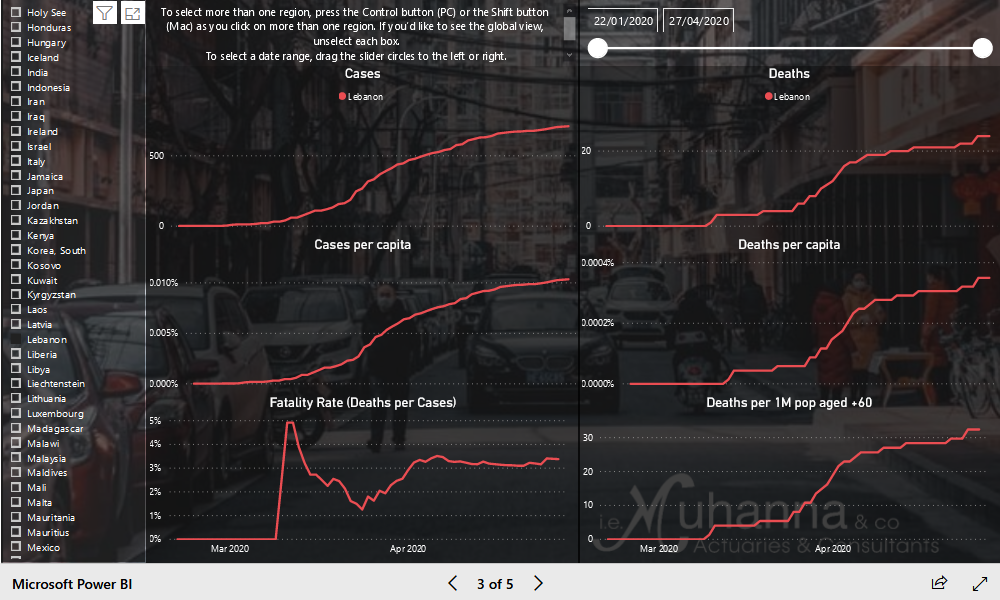
Slide three with Lebanon selected (see box below for more details on the tool)

For the months of March and April, available data from these most-affected countries show that total fatality counts—attributed to COVID-19 or not—have increased undeniably, thereby strengthening the case for vigilant coronavirus containment measures in those countries and countering conspiracy tales that suggested normal death rates to have been present. 

In Lebanon, a conceivable theory of hidden death counts would go in the opposite direction, not alleging that overall fatality numbers were the same as every spring as conspirationalists say in Europe, but alleging that the number of COVID-19 fatalities in this country from the last six weeks is seriously underreported. Of course, the statistics of weekly deaths in Lebanon this April might very well not be available for many weeks and then only as reliable as any other tally in a statistically impaired country. But the question remains if a statistically significant and communally unnoticed aggregation of March/April fatalities in the hundreds or thousands could really occur here.

Deaths per 1 million inhabitants in the pandemic’s worst-hit countries were reported to be multiples of what was this spring observed in Lebanon in terms of deaths per capita. Could a proportional increase of such magnitude have been kept hidden from attention in Lebanon’s small and family-centric society? In a country with this newly hyper-sensitive and protest-eager civil society?  

Upon accepting that the Lebanese response to the COVID-19 pandemic to date has shown good results and saved lives—but without drawing the false conclusion that the country will continue to be spared from worse developments—quite a few questions remain. And these are questions that urgently wait to be answered as the global moods shift from containment of the virus to alleviating the repercussions of lockdowns on economies. 

As the pandemic’s current wave might be slowing in some countries and yet must be expected to surge in others, and as a following wave is expected by many epidemiologists to strike later this year, the question for policy-makers and governments is how to balance the need for a restart or reinvigoration of economic activity on the one hand with the need for containment of the virus on the other. For corporate strategists and investors, the challenge is to limit sunk costs, identify sustainable opportunities that emerge in the wake of the pandemic, reorient teams from old economic nags to new stallions, and also assess risks of the coronavirus recession that might manifest with a delayed fuse. 

Both of these uncertainty complexes—the need of policy-leaders to reduce economic risks while staying on top of the containment and treatment needs, and the need of economic agents to assess risks and potential new rewards in the business landscape—have the common denominator of risk evaluation and risk management. This bears the question, if pertinent evaluation on the balance of medical and economic coronavirus risks or hints for economic opportunities could be procured from the industry that has prided itself over all others as harboring top expertise in the assessment and management of risks in the global economy. This is the insurance industry with its more than $5 trillion in premiums, or more than 6 percent of global GDP in 2018. 

Not all bad news

Curiously, while wave after wave of bad news have been hitting the world economy during the coronavirus crisis, the globe’s insurance giants and reinsurance behemoths have not constantly been in the front row of bad news during the pandemic—as opposed to banks, manufacturing, construction, real estate, hospitality, event, entertainment, tourism, and travel companies as well as all sorts of micro, small, and medium businesses. But insurance interacts with all these economic agents as well as with the, so far, significantly fewer sectors that are named as the best winning bets in the pandemic, such as pharma and biotech companies or online networking, communication, and entertainment companies. 

Where then is insurance itself positioned in context of the global recession, and what can insurance mathematicians, or actuarial consultants, tell us about the changing risk landscape that nations have to navigate with painfully dwindling resources?

As a preamble to looking at those questions, two facts deserve to be noted: Insurance leaders and risk analysts have for years considered the increasing risk of a human pandemic. The threat level assessment of a pandemic, however, had been ridiculously low when viewed against the real unfolding costs of the current pandemic. 

Illustrating the limits of risk surveys and models are, for example, the annual risk maps compiled by the World Economic Forum, which in January of this year named climate risks, economic confrontations, and “domestic political polarizations” as the risks that were top on the minds of economic elites. 

But underestimation of pandemic risk by several dimensions of magnitude was found also in more specialized academic exercises such as the annual global risk assessment published by the Cambridge Center for Risk Studies (CCRS) in the UK. In the 2019 global risk index by CCRS, a human pandemic is the fourth-largest threat in a list of 22 modeled risks that threaten the economies of urban centers around the world. These urban productivity hubs collectively account for over 40 percent of the global economy by CCRS’ reckoning. 

Reiterating a warning from previous editions of the index publication, “Whether it is due to the global nature of supply chains, urbanization or climate change, we see that the potential for epidemics to extend their reach is increasing,” CCRS noted, and stated further, “There is little doubt that a pandemic is due to occur again … but how it will unfold will remain highly variable and dependent upon emergency planners and the insurance community.” 

Given that the study’s projected pandemic threat was quantified at $49.9 billion, accounting for 9 percent of the index’s total global GDP at risk of $577 billion, the conclusion imposes itself that the risk of a pandemic was known but thoroughly misunderstood and insufficiently modeled by leading risk experts.  

Acknowledging the caveat that the unprecedented experience of the coronavirus crisis complex trashes existing conventional wisdoms of economic leaders and nullifies the risk modeling capacities that are based on historic data inputs, the question becomes what economic burdens insurance and reinsurance companies will be faced with during and after the pandemic? The current perspectives of analysts are mixed with some bright spots being projected but the longer term outlook is highly uncertain with swathes of darkness.

For the immediate physical threat perspective of the coronavirus risks, insurance companies and insurance professionals are generally not in the vision line when compared with audience-facing economic activities during the pandemic. In an assessment of physically risk-prone professions during the coronavirus crisis in the United States, data visualization site and online publisher Visual Capitalist listed occupations with high risk exposure. The 40 most risky jobs in that list are top heavy in healthcare (with dentistry-related occupations taking up half of the lead group in riskiness), but also include flight attendants, bus drivers, kindergarten teachers, supermarket cashiers, municipal firefighters, food preparation supervisors, hairdressers, and supervisors of correctional officers.

In this context of coronavirus risk which does not include economic exposure, financial services providers, including bank tellers, would expectedly not be showing near the top of risky occupations, and teleworking insurance professionals are decidedly not considered to be in a high-risk occupation. But even when the attention turns to economic exposure, remoteness from the immediate risk landscape is generally perceived to apply to the insurance industry. Specialized agency Fitch Ratings said in April that it revised its general outlook to negative for all insurance companies/regions globally and specifically mentioned negative outlooks for the life insurance sectors of developed markets and the health insurance sector in the US. However, the agency kept its ratings outlook stable for global non-life, general reinsurance, and title insurance sectors.

Also notably, the world’s two largest reinsurers by premiums, Munich Re and Swiss Re, announced that their dividend payouts this spring would be as projected (and generous looking) as earlier in the year. The companies presented themselves optimistic but nonetheless acted cautiously, by postponing a share buyback program in case of Swiss Re, while Munich Re said in a press release it would not retain a projection of annual profit of €2.8 billion.

In the outlooks of insurance analysts, the issue of burdens on insurance and reinsurance companies actually has become a global concern. Health insurance is the obvious insurance line that comes to mind when thinking about immediate insurance implications of the coronavirus. In this regard, however, the cost of the pandemic to health insurers is from a global perspective not yet assessable. This is because of the large differences in healthcare systems and insurance components between countries and also because of uncertainty about treatment requirements, mortality and morbidity rates of the diseases, and their associated costs, writes Laura Hay, the global head of insurance at KPMG International.

The possibility of billions of dollars in short and medium-term costs for health insurers and reinsurance companies notwithstanding, Hay notes that the outlook for health insurance does not entirely exclude positive scenarios, pointing out that the shock of the pandemic will translate into a significant leap in health insurance awareness and demand, especially in developing countries with underinsured populations. A temporary spike in demand for critical illness policies occurred in Asia after the SARS epidemic, and a parallel phenomenon would be possible post-corona, “with rising sales of health insurance, critical illness, and even life cover around the world,” Hay speculates. 

Similarly, consultants Bain & Co wrote in early April that health insurance payers of COVID-19 covers face risks of long-term respiratory care costs, medical loss ratios, and weakening of returns on financial markets and assets. However, the expectations by Bain also entail upside risks. “In an overstrained clinical environment, most non-Covid patients will have challenges gaining access to care,” write Bain partners Joshua Weisbrod and Vikram Kapur. “From a financial standpoint, payers will face significant pressure on their medical loss ratios. That shift will be offset by a severe decline in high-cost elective surgeries.” 

Moreover, increased health awareness can also, according to Bain, be anticipated under the pandemic’s trigger effect. “In emerging markets such as China, we already see a significant rise in insurance penetration above and beyond the levels that followed previous pandemics such as SARS,” the consultants observed. 

Precedents for the catalytic effect of major disasters and man-made catastrophes on insurance demand reach from historic examples such as the Great Fire of London in the 17th century and the San Francisco earthquake at the threshold of the 20th century to contemporary examples. The latter, while not unilaterally positive from a business point of view, triggered a rethink of correlated catastrophe losses and terrorism insurance as issue of national concern after 9/11 or narrow/transitory demand increases for property and business interruption protection after flood events and changes in demand, risk, and claims of political violence insurance after occurrences of civil disturbance or popular unrest.

In contrast to a mixed outlook of highly probable near-term costs and possible long-term opportunities in health insurance lines, insurance experts from various organizations have rattled off warnings about the pandemic’s impact on insurers and reinsurers, which could reach far beyond the cost of health insurance and life insurance claims. Thomas Wade, the head of financial services policy at the American Action Forum, a conservative advocacy organization in the United States, warned in mid-April against governmental attempts to make insurers pay claims for business interruption insurance that comes with exclusions for incidents related to pandemics. The expert argued that forcing such steps in legislation would be damaging to contract law, run counter to the fundamental business model of insurance as an instrument of risk mitigation by risk sharing, and altogether could kill insurance. “Were insurers to have to pay business interruption claims, it is likely that this would bankrupt the industry,” Wade darkly augurs.  

Citing risk modeling studies from the last few years, Joy Langford, a partner at international law firm Norton Rose Fulbright, warns that the pandemic could unleash a casualty catastrophe for reinsurers, meaning a scenario that extends across different geographies and involves claims from multiple policyholders across different insurance categories. In anticipation of years of needed clarifications and legal disputes over insurance covers on the global mega-event of the pandemic, Langford says that impacts of claims related to the coronavirus recessions could hit reinsurers not only in business lines of health, life, and pension insurance but also have significant general insurance impacts on liability, travel, credit, business interruption, workmen’s compensation, and a number of lesser business lines. She refers to a hypothetical scenario paper produced for the CCRS (not part of the official threat assessment), which projected possible insurance losses of hundreds of billions of dollars in a pandemic. “What can be confirmed by the events of recent months is the accuracy of CCRS’ hypothesis that a global pandemic could present the insurance industry with the type of casualty accumulation capable of rising to the level of casualty catastrophe,” the lawyer points out.  

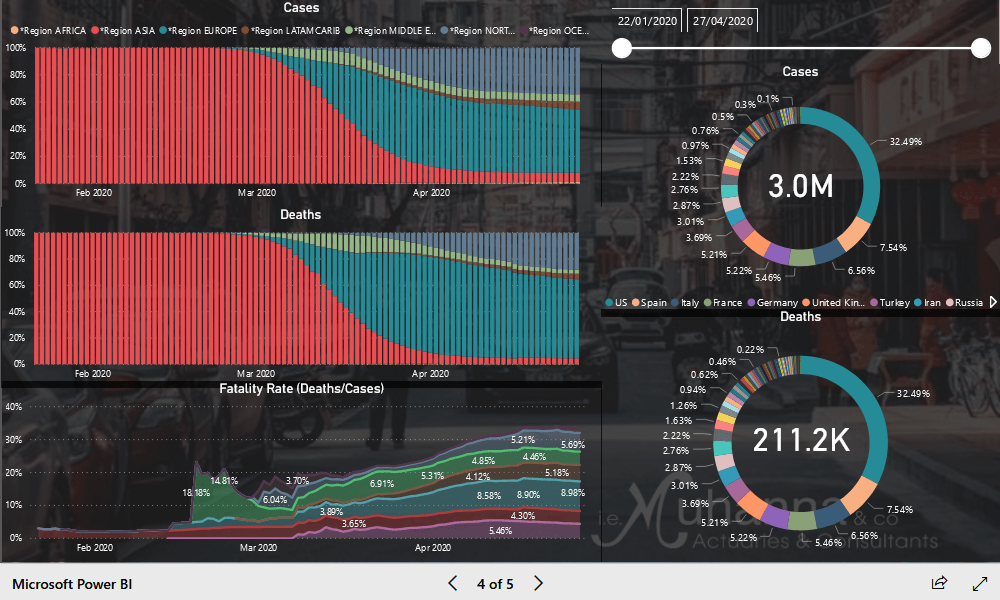
i.e. Muhanna & co COVID-19 data analysis tool

Part of a growing scene of coronavirus visualizations and tracking tools created in intellectual hubs around the world, a research tool developed by Lebanon-based actuarial firm i.e. Muhanna & co looks at the coronavirus impact through the lens of social policy-making.

Analyzing 66 days of data in the January to March 2020 period, the actuarial firm first released a policy note in early April to show that four research variables—confirmed infections, nominal GDP per capita, total number of hospital beds per 1,000 inhabitants, and age structure of the population—all had significant impacts on the development of country-specific trajectories of mortality rates connected to the COVID-19 disease.   

Upon encountering follow-up inquiries from clients, the firm subsequently made the tool accessible on its website to interested researchers and the general public, to enable analysis by region, age group, health sector capacity, and the economic condition of individual countries or country groupings.  

According to Ibrahim Muhanna, the founder and CEO of i.e. Muhanna & co, the firm’s actuaries and data experts invested more than 100 hours of pro-bono work in development of the tool and initially published the policy note on their findings to open the eyes of policy-makers to the correlations of different factors that can help in decision-making during the coronavirus crisis. 

Reliance on numbers is very dangerous when driven by only one pertinent angle among several, Muhanna pointed out, such as lockdown or social distancing policy decisions made irrespective of national specificities in countries with very young populations and large informal sectors where up to 80 percent of working people survive on daily incomes. “Are policy-makers trying to save lives at the expense of killing the economy?” he asks. “What is the right balance? We found interesting correlations looking at the health sector, the economy, and the age [structures] of countries and observed moving trends.”

As the early April policy note observed: “Simple cross-country regressions show that, all other things being equal, death rates decline with the level of GDP per capita and the number of [hospital] beds per capita and increase as a function of the average age of the population.” It confirmed the strong correlation between new infections and mortality rates, which makes the number of infections per capita the main predictor for the observed number of deaths and controlling the number of cases the main instrument by which countries can reduce the future number of deaths, but followed this observation by warning that, “Because policies that control the number of cases – social distancing – also have impact on jobs and labor productivity, the optimal [strategy] might not be to suppress the virus but to mitigate the contagion.”

According to the policy note, 4.6 billion people, or 62 percent of the world population live in countries where the median/average age is in two age brackets between 30 and 39 years but lockdown decisions are heavily influenced by countries with a high share of people above 60. Countries where the average age is higher by five years see additional 3.5 deaths per one million inhabitants, Muhanna tells Executive. This group of 37 countries with average age above 40, which has an aggregate population of 821 million (11 percent of world population), is driving policy decisions on coronavirus together with China (a country in the 35-39 bracket for average age), whereas global coronavirus policy trends appear to not at all be driven by countries with average populations aged 20 to 29 years or even less, which are 50 plus countries in Africa and South America. 

The tool that facilitates analysis of coronavirus trends with actuarial techniques is updated continually and has been made freely accessible here (but is best accessed in desktop environments). 

Under pressure

In a picture that is getting increasingly complicated, insurers in recent weeks have been facing mounting pressures—up to the level of American presidential pressures—that they should honor claims irrespective of their validity under existing policy stipulations. At the same time insurers were operating in environments that led several providers to support emergency workers by giving them privileged protections and also issue rebates on motor insurance premiums in lockdown periods. On the other hand, windfalls were pocketed by health insurers due to reduced numbers of elective surgeries, not to mention that the expectations regarding reinsurance are of protracted legal disputes over the coverage of non-life claims that are part of recession events.    

In business concepts of insurance, the downside question is how badly the industry will be impacted and driven down by weakened financial markets and elevated losses in multiple lines from life, health, and pension insurance to general lines including business interruption, workmen’s compensation, credit, liability, and specialized lines. As far as the upside, the question is if and how profitably insurance companies will be performing as high-power players in the rescue and resuscitation of the global economy. 

In considering these polar questions, one can disagree if the insurance industry is systemically important for the function of the long-term financial system of a capitalist society. Or, when taking account of insurance stereotypes and thinking in terms of urban dictionary-type utility, one can wonder if insurance is just boring and thus superfluous for society, or if it is boring on the surface and sexy beneath—like the proverbial accountant or librarian whose hunky or voluptuous qualities are very well concealed. 

For more serious aficionados of the purpose of insurance, a reasonable assumption globally might be that the coronavirus crisis and deep worldwide recession will add to already existing pressures. These business-revolutionary pressures have been building throughout the last ten to 15 years toward reinventing the way in which this industry addresses digitally enabled economies, how it responds to changing behaviors of millennial generations in terms of things such as personal mobility and the sharing economy, and to new cyber risks. Insurance companies’ recent behaviors during the crisis in this sense have been hinting at changes in the sector’s culture and need for further changes. 

The prospects of changes in international insurance culture notwithstanding, it is an unanswered and unanswerable question if such a hoped-for global insurance revolution and adoption of socially more harmonious modes of operations would infuse new life into the Lebanese insurance sector. In the past 20 years, the local culture in insurance was more neighborly than if it was solely determined by paradigms from international markets but the sector was also marked by less innovativeness than one would expect, given the quality of insurance talents in the country. However, ignition of digitally innovative thinking and alignment with a reborn global insurance culture is, in any case, not an immediate concern that Lebanese insurers can afford to ponder. The challenges of demand destruction and the immediate to mid-term financial future are much more pertinent concerns on the tables in the approximately 50 corner offices and boardrooms of Lebanon-based insurers.  

To give an example, the country’s sole specialized insurance provider for trade credit insurance, LCI, is by default on the daily pulse beats of trade and also an operator of an insurance line that is highly sensitive to local and international fluctuations in the real economy. As CEO Karim Nasrallah confides, LCI took drastic measures already in October and November of 2019 because of the erupting economic crisis. These measures proved efficient for the situation but will not provide indefinite relief. “We took very drastic measures in terms of lowering exposures, cutting down on risks, and not taking on new business,” Nasrallah tells Executive. “Our business is also sharply down because it is based on sales by our customers. Thus in our Lebanese operations, we are working on a very, very slow pace. As you can imagine, this will trigger many payment defaults and issues, which are still manageable but we will have a big problem in the market here if the situation gets stuck for a long time.” 

Like every business leader that Executive communicated with in the past six weeks, Nasrallah sees the dual economic and coronavirus crisis as a very heavy burden on Lebanon. The crisis massively includes the insurance sector and is in urgent need of a sustainable solution. “As a country, we are very much exposed; we have to hope for the best,” he says. 

In the description of acting insurance commissioner Nadine Habbal, some immediate problems of the Lebanese insurance sector are being addressed, specifically the challenges which sector companies face with regard to executing international transactions for payments of their quarterly reinsurance dues. However, longer term issues such as the implementation of the upcoming IFRS 17 regulation, will require large investments in the sector and mandate massive consolidation of the overpopulated provider field, she tells Executive.   

Due to the implications of the much debated haircut in the Lebanese banking sector, the highly banking-exposed insurance companies already face near-term prospects of asset write downs, says Lebanese actuary Ibrahim Muhanna (see Q&A). He explains that in a pessimistic scenario, the shareholders’ equity of up to 17 insurance companies would be completely depleted if insurers’ assets in the banking sector would be subjected to a 50 percent haircut on large deposits. Another 31 companies would maintain positive shareholders’ equity but would need to inject further capital, especially if they write long-term business. 

Moreover, associated liabilities of insurance companies will have to be revalued in light of the new economic circumstances in Lebanon, which could leave some companies with increased liabilities and others with decreases, in addition to spelling bad news for small life insurance policyholders. “Insurers’ total earmarked assets for unit-linked life policies amount to around $700 million which match the companies’ associated liabilities,” Muhanna says. “Therefore the tens of thousands holders of these policies will be taking all the hit that comes as a consequence of any implemented haircut … In short, I expect a massive impact on the insurance sector in Lebanon and a large role for risk professionals and actuaries to play as they help navigate the upcoming systemic shocks.”

There is, in sum total of the accounting of the coronavirus crisis impact on insurance from a Lebanese vantage point, absolutely no certainty about the future incarnations of global insurance culture and still less certainty on the local market question how many insurance companies will still be active one year onward from what one might call the great Lebanese crisis of coronavirus, everything economic, and politics. Also the question how the local provider landscape will be composed and oriented in terms of companies that are independent local, bank-affiliate, or units of international firms, will only be answered with time. 

However, a very pertinent question remains with view to the culmination of the coronavirus and economic crisis in Lebanon and elsewhere: Can insurance wisdom and actuarial risk assessment provide value to countries that are deciding on their path out of their respective medical and economic crisis scenarios? (See box above). As the ICC’s Habbal noted in a conversation with Executive, each country has a specificity that must be properly understood and addressed if the aim is to reach an optimum path of sustainability. 

It emerged, as a generally agreed upon perspective during the coronavirus crisis, that lives count more than money. While, as IMF head economist Gita Gopinath noted in April, “there is no trade-off between saving lives and saving livelihoods” in the sense that countries need to enable health systems to cope with the disease as condition upon which resumption of economic activity can occur, however, countries also can ill afford to have their economies die and kill scores of people in the process while enterprises are waiting for the virus to be controlled. 

This means that careful, balanced, and constructive navigation of the coronavirus crisis’ medical and economic cliffs is essential. As economic cliffs may loom very large in countries with overwhelmingly young populations and large informality in the economy, there may be urgent needs for immediate income as well as productivity gains. Such economically needy societies are not found in old Europe or among the two largest economies on planet earth, but they exist in places like Africa and South America—and, with a unique other specificity, in Lebanon. Adequately addressing these nations’ specificities and needs for recovery and new growth will need a lot of investment money, probably debt forgiveness too, but much more than that: smart policies, accountable politicians, and custom-tailored coronavirus solutions.       

April 28, 2020 0 comments
0 FacebookTwitterPinterestEmail
AgricultureCoronavirus AnalysisFood securitySpecial Report

Growing trend of individual or community planting in Lebanon

by Nabila Rahhal April 27, 2020
written by Nabila Rahhal

As prices of both imported and locally produced food items continue to increase and Lebanon’s food security is potentially threatened (see articles on agro-industry and food security), the old Lebanese proverb “fellah mekfi, sultan mikhfi”—which roughly translates to “a satisfied farmer is really a sultan”—rings true. Knowing how and being able to grow one’s own consumption needs of fruits and vegetables, is a wealth in these economically challenging times we are passing through.

This awareness of the significance of a productive sector like agriculture was close to zero prior to 2019. Ramy Boujawdeh, deputy general manager at Berytech—an ecosystem that fosters innovation technology and entrepreneurship, initiated in 2002 by Université Saint-Joseph, recalls (in an earlier interview with Executive) that when they launched the first edition of accelerator program Agrytech in 2017, they struggled to attract participants. After a lot of efforts to drum up interest in agriculture, targeted mainly toward universities, this was slowly beginning to change and their third accelerator round—launched on October 16, 2019—attracted 110 participants (up from 65 in the first batch). 

As indicators of bleak days to come over Lebanon showed their first buds toward the end of 2019, this emerging interest in agriculture was heightened as more Lebanese felt the need to be food independent (being able to provide food for one’s self and community). This interest was manifested at individual and community levels, with more people showing interest in growing their own food. Kon, a neighborhood growing initiative in Furn el-Chebbak that was developed in early 2020, is one example of community efforts revolving around agriculture.

Also born out of this awareness of the value of producing one’s food were volunteer-based movements or initiatives aimed at supporting those interested in becoming more food independent. The popularity of these movements can be viewed as an indicator of the growing interest in agriculture. A Facebook group called Izraa, developed by agricultural engineers to answer all agriculture-related questions (whether urban or rural, high or low tech) and to share expertise through tutorials, exceeded its admin’s expectations by reaching 1,000 members barely two days after it was launched in mid-January 2020, according to Salim Zwein, one of Izraa’s founders. The group has 14,500 members at time of writing, an increase of 2,200 from the same time last week, and receives an average of 15 questions per day, per this writer’s observation.

Similarly, a talk on food sovereignty that was held in Tripoli’s Nour Square early in December 2019 took three hours instead of the planned hour and a half due to the high level of engagement, with a larger than expected 150 attendees. The talk was organized by Haraket Habaq, a movement which was also founded in December by a group of youth who live in Tripoli and which promotes sustainable development through agriculture and local production. Mourad Ayyash, one of its founders, tells Executive, “We saw the need for us to organize this momentum that had developed around the importance of agriculture and food sovereignty so, we went across Lebanon (Hemmanah, Majdal Anjar, Saida, Sour, Akkar, Tripoli, Beirut, and the Bekaa) engaging with whoever was interested in this subject. From these talks, other initiatives were born.”  

There is also increased interest in agriculture from private sector individuals, according to Shady Hamadeh, director of the Environment and Sustainable Development Unit (ESDU) at the American University of Beirut’s Faculty of Agricultural and Food Sciences. “Many are expressing interest in investments in agriculture,” Hamadeh says. “So we would like to take this opportunity, through Ardi Ardak [NB: a national food security initiative launched in December 2019 as a collaboration between ESDU, the Lebanese League for Women in Business (LLWB), the Food Heritage Foundation and Zico House] to link these investors and big land owners with small farmers and rural women. Rural women are at the center of Ardi Ardak.”

The face of the modern day farmer

Those interested in individual and community planting nowadays span a wide range of people in Lebanon. “We have professional farmers who ask us a question related to crop disease and also individuals asking us how to best care for their gardenia or what vegetables to plant next to their olive trees, so we cater to everyone,” says Izraa’s Zwein.

Although the interest in agriculture and being food independent was born out of Lebanon’s economic crisis—proof being that a big percentage of the initiatives promoting agriculture were developed by the end of 2019—the COVID-19 crisis gave people enough time on their hands to do something about it. Izraa receives daily comments from members who had no prior background in agriculture but say they have developed a passion for planting after having first tried their hand at it during the lockdown, according to Zwein. Although he cannot yet quantify it, he also says that based on interaction within the group since the start of the lockdown there has been an increase in both high-quality rooftop garden installations, complete with raised beds, and in youth returning to rural areas and planting in the neglected land of their grandparents.  

Asmahan Zein, president of LLWB, also believes that the coronavirus crisis has made people with no background in agriculture realize its value as a productive sector. “People are looking toward alternative productive industries that would help them survive and they no longer assume that everything will arrive to them while they are at their office in Beirut,” Zein says, explaining that this thinking has allowed her to gather several organizations they work with around Ardi Ardak.

Because the quarantine measures limit gatherings, growing efforts are more at the individual level rather than the community level nowadays. Souad Abdallah, founder of Kon, says that some neighbors have expressed their interest in the initiative but have shied away from actively participating because of the restrictions; she expects this to change once the lockdown is lifted. For now, there are four active participants in the rooftop garden of her building and they communicate online with representatives of another rooftop garden two minutes away from her and three balcony planting projects, also in the area.   

The ABCs of planting  

The beauty of planting is that anyone interested can find a surface to grow something in. When it comes to food, herbs are ideal for those planting on small balconies, says Zwein, while potatoes and tomatoes are more suitable for rooftop gardens and those with access to land can plant wheat alongside a variety of fruits and vegetables, depending on the land’s specifications.

Abdallah says they have assigned different produce for the participating neighbors depending on the specifications of their planting area: One neighbor grows lettuce for the community because his garden gets a lot of shade and that is favorable for lettuce, for example.

The initiatives Executive spoke to all promote sustainable agriculture, which Hamadeh explains as environmentally friendly agriculture that is resources efficient, or permaculture, defined as “an agricultural system or method that seeks to integrate human activity with natural surroundings so as to create highly efficient self-sustaining ecosystems.”

This type of agriculture does not use chemical fertilizers or pesticides, which has the benefit of driving down gardening costs. The latter two, according to Zwein, are the highest costs for farmers, especially nowadays when the price of chemical fertilizer has gone up because of the foreign exchange rate. Instead, permaculture uses organic fertilizer or compost instead. This can either be homegrown—Abdallah says Kon makes its own compost out of egg shells, coffee grinds, and organic material such as fruit peels—or bought from local producers. In this case, the cost of compost for a 200-square meter rooftop garden would be an average of LL50,000, Zwein says, speaking out of personal experience.

Abdallah says permaculture uses less soil than conventional planting, explaining that in Kon they use layers of dead matter (dead leaves), green matter (grass), horse manure, and soil to plant the seeds in. “This decreases the weight on the roof and the usage of soil and creates a healthy environment for plants,” she explains. Other ways Kon is decreasing costs is by using donated recyclable items for planters and pots, and relying on exchange of services to get some gardening tasks done (neighbors help her plant in exchange for seeds or seedlings, for example).  

Zwein estimates that a 6 meter by 3 meter raised bed (for rooftop gardening), with a depth of 60 centimeters, would need a maximum investment of LL1 million when using the best soil (a mix of 80 percent peat moss and 20 percent compost). Those who already have arable land would have an understandably smaller investment, since the soil is already there.

Why plant?

There are many reasons why Lebanese are more inclined to spend more time with a shovel and soil these days. A main driver for promoting agriculture among the movements and initiatives Executive interviewed is to promote food independence. “Food sovereignty among urban dwellers is a main goal for Kon because we are passing through an economic crisis when it is very easy to produce our own food and also very healthy since we know we are putting into the soils,” Abdallah says. 

Ayyash also speaks of the importance of food sovereignty and people’s right to nutritious food. He adds that providing refugees with employment opportunities is another goal for Harkat Habaq, since Lebanese labor law restricts the fields which they can work in. He gives an example of a project in Tripoli that Haraket Habaq is collaborating on with another organization called Hajjar w Bashar (Stones and People) where the municipality donated a 13,000 meter square garden to be planted by the two organizations—produce from the land will be distributed by them to vulnerable communities.

Aside from being able to feed one’s self and community, planting in rooftop gardens and small plots of land, if done at a very large scale, could conceivably free up Lebanon’s already limited agricultural land. “When people can feed themselves from these ways, it will decrease the pressure on the land used for vegetables nowadays and so it can be used for more interesting projects such as growing wheat or animal feed, for example,” Zwein says.

One of the main goals of Ardi Ardak, according to its concept document, is to “promote food security at the rural producers’ level by promoting small scale producers’ access to markets; and urban consumers level by providing them access to healthy local produce.”

For Abdallah, community growing in urban areas has the added benefit of improving air quality, an element which she feels is very important in Beirut, where air pollution exceeds World Health Organization recommendations over threefold. Abdallah also says that neighborhood planting initiatives such as Kon nurture a sense of community among neighbors and she hopes to see this initiative eventually replicated across many of Beirut’s communities. “It shows that people can work together on a common interest without having a political umbrella or identity,” she says.

Whether this individual and community growing trend is a temporary fix to lockdown and economic hardships or whether it will remain in the long term remains to be seen.  What is clear, for now, is that people have realized that they can no longer take for granted their access to food, and that the effects of the economic and coronavirus crises has had and will continue to have impacts.   

CORRECTION: This article was updated on 08/05/2020 to reflect that the talk held in Tripoli’s Nour Square was organized by Haraket Habaq, not the Socio Economic Action Collective (SEAC). During our initial interview, Executive was informed that the talk was organized by SEAC, and that Haraket Habaq was a media offshoot of the organization. We have since been contacted by Haraket and asked to remove this reference, as their organization is independent.

April 27, 2020 0 comments
0 FacebookTwitterPinterestEmail
Coronavirus AnalysisEconomics & PolicyOpinionRefugeesSpecial Report

Lebanon’s refugee restrictions could harm everyone’s health

by Nadia Hardman & Aya Majzoub April 22, 2020
written by Nadia Hardman & Aya Majzoub

Government responses to the spread of the COVID-19 virus have exposed the extra barriers to healthcare for refugees and migrants worldwide. But discriminating against already marginalized noncitizens not only erodes their capacity to avoid or survive infection, but inevitably has a negative impact on the wider society’s health.

This is undeniably the case in Lebanon, home to nearly 1.5 million refugees—almost a quarter of its population. Both Palestinian and Syrian refugees have suffered from long-standing discrimination and marginalization as a result of Lebanese policies that deny them access to basic rights, including housing, work, education, and healthcare. The COVID-19 outbreak in Lebanon has only heightened the marginalization of both groups. Many municipalities have introduced unjustifiable, discriminatory movement restrictions and curfews on Syrian refugees that do not apply to Lebanese residents as part of their effort to combat COVID-19. And leading Lebanese politicians have fueled anti-refugee sentiment by implying that Syrian and Palestinian refugees will be responsible for spreading the virus. 

Yet, the Lebanese government’s national response plan for COVID-19 depends on self-reporting. People are advised to call a national health ministry hotline for advice about testing and treatment. The United Nations Refugee Agency (UNHCR), which is responsible for Syrian refugees, and the United Nations Relief and Works Agency (UNRWA), which is responsible for Palestinian refugees, have both said that they will only cover the cost of testing and treatment of refugees if the refugee has first contacted the hotline and followed its instructions. 

While it is widely acknowledged that testing and contact tracing are key to tackling this virus, Lebanon’s response plan rests on an assumption that an individual experiencing coronavirus-like symptoms will feel comfortable enough to call a government-run service, travel to get tested and treated, and potentially share information about where they live, whom they live with, where they have traveled, and where they work. However, Syrian refugees have told Human Rights Watch (HRW) and aid agencies of their fear of further discrimination and stigmatization if they contract COVID-19. Some Syrian refugees have even expressed fears of deportation if they exhibit COVID-19 symptoms. They cite these fears as a deterrent from seeking medical care, even if they experience symptoms.

Our interviews with Syrian refugees lay bare the government’s failure to provide them with up-to-date and accurate information about the virus and the healthcare services available to them—a human rights obligation of the Lebanese government. More than a month into the COVID-19 outbreak in Lebanon, the majority of Syrian refugees that HRW interviewed said that they did not know what they should do in case they experienced symptoms, nor did they know of the existence of the health ministry hotline. Humanitarian organizations have cited similar findings. 

At a time when that trust is most needed, the Lebanese authorities are conducting business as usual and adopting policies that fail to alleviate the refugee populations’ mistrust of the authorities. This lack of trust could easily undermine efforts to prevent control and spread of the disease. Lebanese policies should guarantee access to healthcare for refugees, including testing and treatment for COVID-19. The government should simultaneously push an information campaign to provide refugees with all the facts that they need to protect themselves against infection and to seek healthcare in a timely manner. The authorities should also proactively reassure refugees that they will not face retribution or stigmatization if they seek testing or treatment for COVID-19. 

The international community must also step up. Lebanon has the highest number of refugees per capita in the world. While not an acceptable excuse for the discriminatory and abusive measures that marginalize refugees or endanger their health, the burden is something the international community should help carry. 

UNRWA has suffered several funding cuts, including when its erstwhile biggest donor, the United States, cut its funding entirely, and is now running a deficit of over $120 million. In 2019, only 55 percent of the Lebanon Crisis Response Plan for refugees was funded. Other states may have been able to stem the flow of refugees across some borders, sometimes in unconscionable ways, but it cannot do the same with this virus. 

Lebanon and the international donor community should do better in assisting refugees to build their resilience by ending discriminatory practices and by ensuring that they are able to get healthcare and adequate housing. It should not take a global pandemic to force this position, but as the first case of COVID-19 was recorded in a refugee camp in the Bekaa on April 21, the authorities may soon realize that they have no other choice.

April 22, 2020 0 comments
0 FacebookTwitterPinterestEmail
BusinessCoronavirus AnalysisInsuranceSpecial Report

Confused outlook on insurance coverage for Lebanese COVID-19 patients

by Thomas Schellen April 22, 2020
written by Thomas Schellen

In the immediacy of the coronavirus crisis, the most pertinent insurance question for the holder of a medical policy is simple: Who will pay if I need to be hospitalized?  The answer, as with many things in Lebanon, depends. According to Nadine Habbal, acting head of Lebanon’s Insurance Control Commission, slightly more than half of Lebanon’s health insurance policyholders have coverage for coronavirus-related hospitalization costs. Their providers either have written no exclusions of pandemics into their contracts or have waved such exclusions as a service to their clients, she tells Executive. Another category consists, she says, of “companies health insurance portfolio is divided into two parts: some policies that don’t exclude pandemics and the remaining policies that exclude pandemics. (For additional information, see Q&A).   

Notwithstanding that commercial insurers listed on the ICC website, by Habbal’s assurance, honor their health insurance obligations in COVID-19 cases, the picture is not automatically clear as to how large a percentage of health insurance policyholders will be admitted without any questions and how many would be faced with incongruences in admittance procedures when in need of hospitalization for the disease. According to Elie Torbey, the president of the Association des Compagnies d’Assurances au Liban (ACAL), coverage of COVID-19 cases is to date clear and secured for one client category only: all those who are medically insured as foreign workers in Lebanon under coverage (up to a ceiling of $20,000) that is mandated under labor regulations. “In our opinion, most of the Lebanese are not covered by insurance in corona cases,” Torbey tells Executive. “Just two or three companies in Lebanon cover the corona cases for Lebanese [policyholders], but only because they are linked to head offices abroad. They are [units of] international companies and since their head offices says they will cover COVID-19 cases, they will have to follow coverage.”  

According to him, the total population with private sector insurance is composed of 845,000 policyholders, of whom almost 200,000 are holders of expatriate medical insurance policies designed for foreigners who are employed in Lebanon. After accounting for the expats, 670,000 Lebanese policyholders with existing health insurance contracts remain, and many of their policies explicitly exclude coverage of pandemics. “A limited number of the insured are covered for COVID-19,” Torbey reiterates. 

The problem about actuarial calculation of premiums for coverage of the pandemic is the lack of data. Given that a global pandemic on the magnitude of the coronavirus infection might happen once every 200 or more years, no data exists upon which a rational calculation could be based, Torbey explains. “That is what we are afraid of,” he says. “We are afraid of the frequency and the severity of cases. If we have data, we can calculate how much we should require from the clients if we want to impose an extra premium for the future, and then we will cover it. We don’t want to shift from problems of covering coronavirus cases to a situation where we have a problem that might go as far as bankruptcy of a few insurance companies if they are highly affected by the cost of treating coronavirus cases inside Lebanese hospitals.” Ten to 12 Lebanese insurance providers have large medical portfolios and could be highly exposed to COVID-19 risk, he says, but to his view, exposure of insurance companies to the pandemic would in any case require placing caps, meaning a maximum limit, on risk exposure per company.

In addition to the fundamental difficulty of assessing the pandemic’s coverage risk, the situation of insurance payments for in-hospital treatments of COVID-19 appears to have not yet been sorted in two further respects. According to Torbey and other sources in the insurance industry, private sector companies are, at time of this writing, still engaged in pricing disputes with hospitals and discussions with ministries. In their negotiations, which Torbey says are progressing now on the level of the office of Prime Minister Hassan Diab and his staff, insurers are asking to be invoiced for treatment dues for coronavirus infection at or near the discounted rates that hospitals receive from the National Social Security Fund (NSSF) for patients with NSSF coverage. 

On their parts, hospitals demand insurance companies to pay rates that appear to exceed the NSSF rates by as much as 150 percent, based on information that ACAL gleaned from a number of invoices that had already been sent to insurance companies after they assumed responsibility for coverage of COVID-19 treatments. 

However, it seems that the NSSF rates are not suitable as benchmarks for determining full treatment cost in the coronavirus scenario, given that hospitals, according to Torbey, argue that they are incurring extreme costs for protective gear needed in care for pandemic patients and that such gear, which is purchased on basis of dollar prices and reportedly accounts for 30 percent of total patient care cost, is not included in the NSSF’s coverage.    

What is furthermore missing and yet to be developed is a rule for tariffication of treatments under a medical code for the novel coronavirus infections. Medical codes are standardized and detailed scientific catalogues that come into force when approved by health authorities. They entail information on diagnosis, procedures, drugs, and prices of treatment for a classified disease and note correlations with other ailments if such are applicable. Guidance on such codes for coronavirus infections is internationally evolving with the pandemic; interim or emergency codes have been issued by the World Health Organization and some developed countries over the past two months while research into clinical and epidemiological features of COVID-19 is still far from complete. 

In Lebanon, medical codes are developed and regularly reviewed by a committee of high-powered medical professionals and officials for the Ministry of Public Health (MoPH). While Habbal confirms that the medical code for the novel coronavirus is needed and that discussions on this issue are progressing with support from the minister of health and MoPH teams, there is no indication of the code having been completed. 

However, seeking to give a signal of hope for the people with private sector insurance, Habbal points out that a recent ministerial decision by the economy minister through Ministry of Economy and Trade (MoET), the administrative superior of the ICC, has been issued to remove any ambiguity on the inclusion of pandemic coverage from future health insurance policies in Lebanon. “As part of our efforts to improve the medical insurance offering in Lebanon, a ministerial decision was issued on April 15 requiring insurance companies to introduce a compulsory pandemic cover in every new or renewed policy,” she tells Executive in a Q&A. “This will enhance the insurance protection for existing and new insured members, and would present a better value proposition that is uniform for all.” 

Insurers confirm the receipt of the MoET’s ministerial decision but did not enthuse about it. On one hand, their first worry is about dealing with existing policyholders (an issue not addressed in the new ministerial decision) and finding a solution for the tangled situation of insured clients whose needs are neither provided for by their contracts with Lebanese insurers nor included in treaty coverage of local insurers with international reinsurance companies. “Our priority is to cover existing policies,” Torbey says. “We are working now with the prime minister’s office to find a solution for the existing, non-covered clients. We should find a solution for those clients, because it is clearly mentioned in our policies that pandemic is excluded; so if we have to pay, we will be paying from our own pocket.” 

He also is not exactly cheery about the long-term risk implications of the new decision. “We are not overly in favor of this because if they cover pandemic it is not mentioning corona [specifically],” Torbey says. He emphasizes that another pandemic might just be too much for Lebanese insurers to cover and alludes to principles of risk mitigation under which large aggregate risks such as pandemics and earthquakes are tasks for governments rather than commercial insurance markets. 

This general principle of governments’ responsibility for handling national-scale disasters, however, does not answer the question if either the Lebanese insurance sector or the country as a whole would emerge intact if another, equally severe pandemic to COVID-19 were to hit Lebanon next year. Even the thought of such a possibility reminds that in insurance and governmental preparations for eventualities of catastrophes alike, fortuitous timing and utmost actuarial diligence in planning may both be needed—and certainly appear to be so in this Lebanese spring of 2020. 

April 22, 2020 0 comments
1 FacebookTwitterPinterestEmail
  • 1
  • …
  • 47
  • 48
  • 49
  • 50
  • 51
  • …
  • 689

Latest Cover

About us

Since its first edition emerged on the newsstands in 1999, Executive Magazine has been dedicated to providing its readers with the most up-to-date local and regional business news. Executive is a monthly business magazine that offers readers in-depth analyses on the Lebanese world of commerce, covering all the major sectors – from banking, finance, and insurance to technology, tourism, hospitality, media, and retail.

  • Donate
  • Our Purpose
  • Contact Us

Sign up for our newsletter

    • Facebook
    • Twitter
    • Instagram
    • Linkedin
    • Youtube
    Executive Magazine
    • ISSUES
      • Current Issue
      • Past issues
    • BUSINESS
    • ECONOMICS & POLICY
    • OPINION
    • SPECIAL REPORTS
    • EXECUTIVE TALKS
    • MOVEMENTS
      • Change the image
      • Cannes lions
      • Transparency & accountability
      • ECONOMIC ROADMAP
      • Say No to Corruption
      • The Lebanon media development initiative
      • LPSN Policy Asks
      • Advocating the preservation of deposits
    • JOIN US
      • Join our movement
      • Attend our events
      • Receive updates
      • Connect with us
    • DONATE