• Donate
  • Our Purpose
  • Contact Us
Executive Magazine
  • ISSUES
    • Current Issue
    • Past issues
  • BUSINESS
  • ECONOMICS & POLICY
  • OPINION
  • SPECIAL REPORTS
  • EXECUTIVE TALKS
  • MOVEMENTS
    • Change the image
    • Cannes lions
    • Transparency & accountability
    • ECONOMIC ROADMAP
    • Say No to Corruption
    • The Lebanon media development initiative
    • LPSN Policy Asks
    • Advocating the preservation of deposits
  • JOIN US
    • Join our movement
    • Attend our events
    • Receive updates
    • Connect with us
  • DONATE
Last WordOpinion

Those responsible for attacks on the press must be held accountable

by Roula Mikhael February 7, 2020
written by Roula Mikhael

Journalists were among the most active in documenting the Lebanese protests, according to our Lebanon Protests open-data platform. This role has put members of the press at risk, with attacks on media spiking in mid-January—the SKeyes Center for Media and Cultural Freedom identified over 20 violations against media between January 14 – 20, raising the total number of violations to 75 since the protests began on October 17, 2019.

This popular uprising is revolutionary because it exceeded the prevalent ceiling of freedom of expression and broke through the barrier of fear over prosecution—almost as if the streets wanted to destroy the image of politicians because they could not remove them from power.

Criticism has become a daily discourse for protesters. One achievement has been how traditional media has opened up to activists and protestors—criticism of political elites that would have been censored by default prior to the protests now regularly appears on air. This has changed the public discourse, with blame for the ongoing financial crisis and the impoverishment of the country and its people laid firmly at the door of a political elite, accused of selfishness, corruption, and inefficiency.

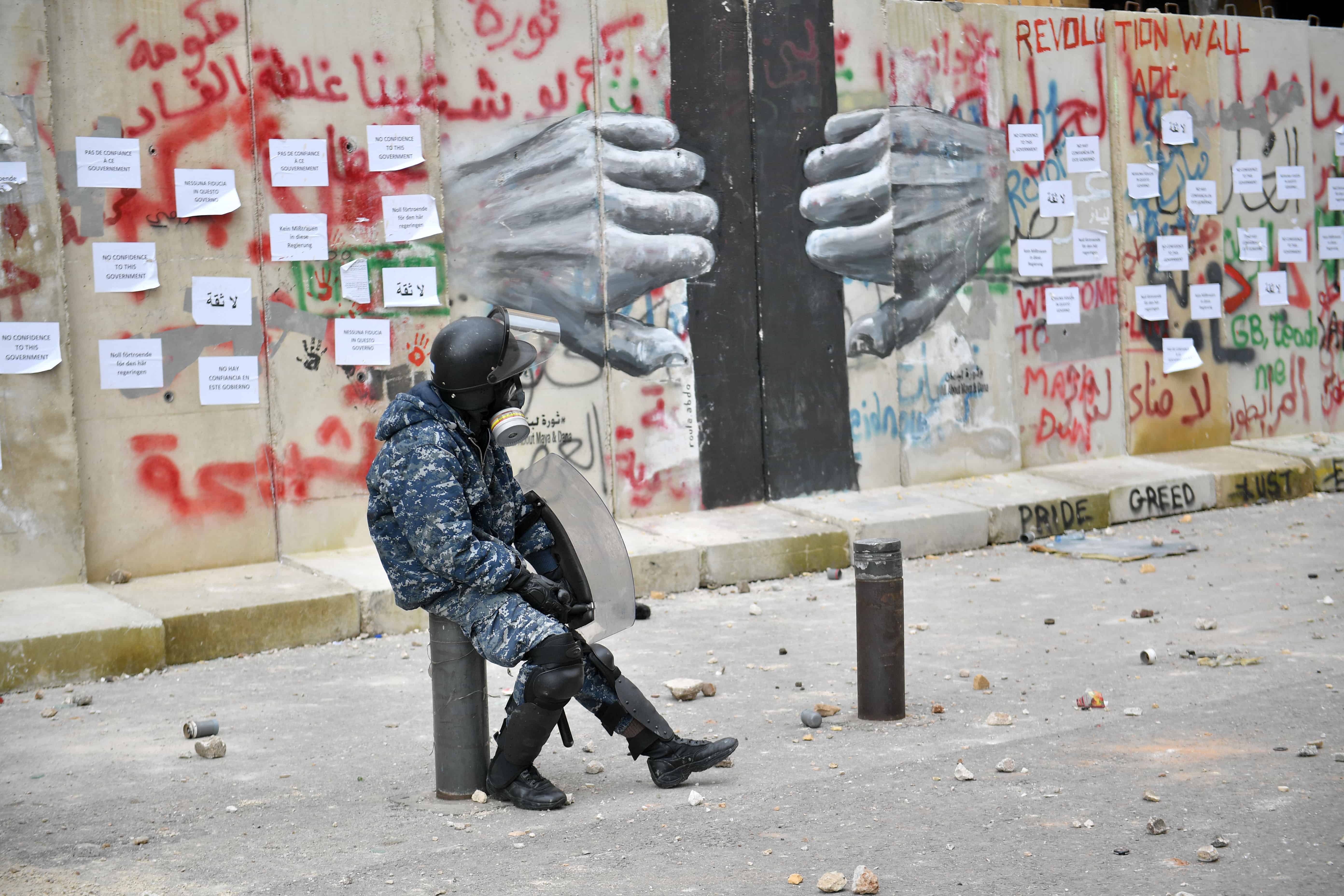
However, this high ceiling of criticism has come at a price. As the protests continued, the frequency of street violence increased, and the reaction of the security forces has been documented as disproportionate and oppressive. Instead of being protected while covering the protests, journalists have become a target of repression and assault.

January 15 marked a dangerous shift, with previously unseen levels of violence against both protesters and the media. Riot police were filmed as they attacked dozens of journalists and photographers in front of Helou barracks in Beirut that were there to cover protests taking place in solidarity with 59 detainees who were arrested the night before during clashes in Hamra. Journalists, clearly identified as such, were trying to protect their cameras while fighting off illegal attacks on their person. Journalists were not only beaten, some were also arrested, including journalists from Reuters, MTV, Al Jadeed TV, and Executive’s photographer, French national Greg Demarque. All were released the next day.

On January 18, several journalists and photographers were also injured while covering the confrontations between demonstrators and the security forces in Downtown Beirut. The next day, also in Downtown, journalists covering the protests were hit by rubber bullets. Al-Jazeera reporter Ihab Al-Aqdi was shot in the leg, while an Al-Jadeed cameraman, Mohammed al-Samra was shot in the hand and taken to hospital for treatment.

Violations and attacks on media by security forces have not only been extensively documented, but have taken place despite these journalists being clearly identifiable as press. Press have also been attacked by civilians while covering protests in areas or crowds that are hostile either to the presence of media in general or to certain media outlets, such as the attacks against press during clashes on the ring. Some members of the press have been subject to cyber bullying campaigns and doxxing in attempts to intimidate them; notably two female journalists were the targets of bullying campaigns via the use of abusive hashtags and verbal harassment online.

The media are doing their professional duty on the front lines of these protests, it is paramount that they receive the protection necessary to do their job. Following the attacks on journalists outside Helou barracks, then-interior minister Raya el-Hassan apologized and assured that an investigation would take place and those responsible held accountable. This needs to happen—and not behind closed doors. It is not acceptable to condemn attacks against the press while abdicating responsibility. All investigations into violations by security forces must be held transparently and perpetrators held publicly accountable.

Beyond guaranteeing freedom of the press and accountability for those who violate it, there needs to be a broader understanding of how Lebanon has changed. The barrier against freedom of expression that has been torn down by these protests must not be rebuilt. Instead, the state must address the issues surrounding Lebanon’s defamation laws, which criminalize citizens for speaking their minds and have no defense in truth. Freedoms won through these revolts must not be lost, and pressure must be maintained to ensure that Lebanon adopts and protects the highest international standards when it comes to rights to protest and freedom of expression.

February 7, 2020 0 comments
0 FacebookTwitterPinterestEmail
EntrepreneurshipOpinion

Going virtual to survive Lebanon’s financial crisis

by Maria Frangieh February 7, 2020
written by Maria Frangieh

IN BRIEF

  • The virtual working model benefits employers and employees.
  • It has the potential to foster decentralized economic growth.
  • It can be a shield for businesses in times of crisis.

The political crisis in Lebanon has compounded an economic crisis that has been looming in the shadows for decades. News of business closures, salary reductions, and layoffs are added worry to Lebanese already struggling under the burden of the ongoing liquidity and financial crisis. Without urgent reforms, the economy is at risk of experiencing a deep recession.

Adapt to survive

The current—and potential—consequences of these twin crises are catastrophic, especially to Lebanese businesses. In order to survive, companies must reduce their expenditures. Unfortunately, the first instinct in these circumstances is to lay off employees—this will only further damage the economy in the long run.

Instead, companies must adapt to survive. This is where the virtual model can play a huge role. A virtual business conducts all or most of its business via the internet, eliminating the challenges faced with office costs, with geographically unattainable talent, and with scarce cash flow. There is a growing body of evidence to suggest that, if adopted correctly, the virtual model can be both productive and lucrative. Advanced digital and IT transformation strategies have led internationally to success for a diversity of companies such as Dell, Articulate, and Buffer. In Lebanon, however, companies are not yet embracing this change. With the current crisis, they may be forced to.

Adopting a remote working model has mutual benefits for employees and business owners. The latter can save on their costs—electricity, internet, rent, office supplies, and talent retention—as well as gain more flexibility in their business management, while the former can save on fuel, time spent in traffic, food, and professional wardrobe costs, and can have an economic advantage over colleagues who are reporting to the office. In Lebanon’s case, current instabilities will have a reduced impact on businesses adopting a virtual model as employees will be able to continue to work unaffected by road closures from the ongoing protests.

The virtual model also has the potential to influence on the country-wide economic level, as towns outside of Beirut could benefit from flows of income and investment. Virtual working allows employees to stay in their hometowns rather than migrate to the capital, and their spending and investments in these towns, if at a large enough scale, could help foster a decentralized boost that would contribute to Lebanon’s economic growth.

Can it work?

Going virtual is a big change that requires time and effort. If implemented correctly, this model can help businesses survive during difficult times.

Not all businesses can operate remotely, however, and for those that can, there are varying levels of difficulty making the shift to a virtual operation. If a business has a clear organizational structure and tasks lists, the shift can be smoother. On the other hand, businesses with complex organizational structures that are not able to remotely access their files will have a hard time.

The virtual model also requires the use of web tools to manage virtual teams. These tools are already available on the majority of laptops. Companies can also purchase more sophisticated tools as part of their fixed costs.

Successfully virtualizing a company’s infrastructure and operations is also heavily reliant on the team. As businesses strive for a complete reform, one of the biggest impediments is finding employees with the right skillsets.

A final, and key, factor is trust. Managers should earn their team’s trust by providing them with the right tools, training, and space to thrive.

Employees should also demonstrate their commitment through an organized and timely workflow. It is only by combining all these elements that a business can become a virtual success.

As Lebanon races against time to avoid an economic crash, companies should take measures to protect themselves and their employees. The virtual model could be the armor that shields a business from financial catastrophe. It can also play a part in revitalizing the economy outside of Beirut.

February 7, 2020 0 comments
0 FacebookTwitterPinterestEmail
EntrepreneurshipOpinion

How Lebanese entrepreneurs can survive the liquidity crisis

by Roxana Mohammadian-Molina February 7, 2020
written by Roxana Mohammadian-Molina

IN BRIEF

  • The liquidity crisis requires immediate attention and will likely result in an IMF program, with consequences for poorer Lebanese.
  • In the short term, an IMF-backed loan program would need to create a specialized fund to promote the local private sector and entrepreneurship.
  • In the long term, the government needs to foster relationships between itself, the education sector, and businesses to help promote entrepreneurial growth.

Right now, the challenge every Lebanese entrepreneur is facing is the liquidity crisis. A two-speed approach is required: 1) a set of short-term policy measures to tackle the urgency of the funding gap left by the liquidity crisis, and 2) more medium- to long-term policy measures that are focused on building and strengthening the Lebanese entrepreneurship ecosystem.

Emergency crisis management

As the outlook continues to deteriorate for Lebanon, the newly appointed finance minister Ghazi Wazni said late January that Lebanon needed foreign aid to save it from an “unprecedented” situation that had forced people to “beg for dollars” at the banks and fear for their deposits. The scene looks set for an International Monetary Fund (IMF)-backed program for Lebanon, bringing to mind the example of Egypt. Analysts, observers, and international financial institutions alike have hailed Egypt for tough economic reforms tied to a three-year, $12 billion loan program with the IMF, agreed to in late 2016. The reforms included devaluing the Egyptian pound by about half, relaxing the exchange rate regime to let the currency float freely, cutting energy subsidies, and introducing a value-added tax (VAT). Those changes have reduced the country’s current account deficit, inflation, and unemployment—thus strengthening the national currency. In its fifth and final review of Egypt’s economic reform program completed in July 2019, the Executive Board of the IMF said that “the macroeconomic situation has improved markedly since 2016, supported by the authorities’ strong ownership of their reform program and decisive upfront policy actions. Critical macroeconomic reforms have been successful in correcting large external and domestic imbalances, achieving macroeconomic stabilization and a recovery in growth and employment, and putting public debt on a clearly declining trajectory.” The IMF further noted that the outlook for Egypt’s economy remains favorable.

In Lebanon’s case, given the urgency of the liquidity crisis, any reform that comes along with an IMF-backed loan program would need to address the liquidity requirements of entrepreneurs and SMEs

Yet, Egypt’s robust IMF-backed structural reform program that has helped steady the economy has also been accompanied by an increase in inequality and poverty. Indeed, while macroeconomic indicators have drastically improved, measures such as price increase of basic foods like bread, milk, and lentils, as well as slashing fuel subsidies, which meant an increase in the price to consumers of gasoline, diesel, kerosene, and fuel oil, have left many of Egypt’s nearly 100 million citizens under increased economic strain and struggling to make ends meet. According to Egypt’s Central Agency for Public Mobilization and Statistics, 32.5 percent of Egyptians lived below the poverty line in 2018—up from 27.8 percent in 2015. This darker side of the IMF’s help programs was also visible in a 2019 loan agreement with Ecuador that called for an enormous tightening of the country’s national budget—about 6 percent of GDP over the next three years. It does not bode well for the more than 25 percent of the Lebanese citizens who live in poverty that an IMF-backed program will most likely include raising taxes that fall disproportionately on Lebanon’s poorest citizens while making cuts to the already thin public investment.

In Lebanon’s case, given the urgency of the liquidity crisis, any reform that comes along with an IMF-backed loan program would need to address the liquidity requirements of entrepreneurs and SMEs—95 percent of companies in the country are SMEs, which account for 50 percent of employment. One such short-term emergency crisis management solution is the creation of an entrepreneurship fund or loan to promote the local private sector and entrepreneurship. The IMF has been very vocal about the importance of private sector investment in creating jobs and achieving strong growth, particularly in the MENA region. Once again, Egypt’s example comes to mind. In 2015, Egypt received a $1 billion loan from the World Bank in order to support the country’s small businesses and entrepreneurial sector and pave the way for new job opportunities. That was followed by annual loans worth $3.15 billion from the bank between 2015 and 2017 to help Egypt’s economic reform program and local business development.

This IMF-backed entrepreneurship fund should also go hand in hand with reform policies to make it easier to start and manage a business, policies that tackle the complex and burdensome regulations in Lebanon that have historically held back investment and, hence, job creation and growth. Both the IMF and the World Bank have traditionally been very vocal about the fact that enhancing accessibility to finances, and promoting entrepreneurship and transparency in tax filings and government procurement would allow independent small businesses to thrive and establish new opportunities.

Build and strengthen the ecosystem

Once the short-term crisis is over, and the country is hopefully on the right track to recovery and growth, there are long-term challenges to building a strong entrepreneurship ecosystem that need to be targeted. Within that, government interventions need to be carefully crafted to be limited to improving the environment that surrounds startups. In short, the government’s role is to optimize conditions for entrepreneurs. It is difficult to point to any entrepreneurial ecosystem that has risen through direct government intervention, yet many successful entrepreneurial ecosystems and innovation districts, such as the UK’s Silicon Corridor or Spain’s 22@Barcelona project, have been assisted by governments that are entrepreneurial at the level of policy, legislation, permit authorization, purchasing, infrastructure investments, education, and coaching.

In some regions, such as the GCC, public policy to enhance access to finance has included the creation of regional VC funds, usually taking a hybrid form in which both public and private sector money is combined under private sector management. Yet, this approach has come under criticism for mixed results, with some observers noting the impact on the ability of purely private sector VC funds to raise money in those countries. Furthermore, the focus on risk capital neglects the fact that only a small minority of startups use this financing channel, at least in the early stages. Instead, encouraging the creation of a well-regulated peer-to-peer lending system is more effective as it provides seed and start-up capital and its trust-based nature means that investors typically invest in businesses that are close to home (see article in Executive’s September edition). It is also important to point out that ultimately, it was the liquidity crisis of 2008 that led the way to the creation of the alternative lending sector, peer-to-peer lending, and crowdfunding in the US and Europe.

Ultimately, however, a well-organized interaction between education, business, and government is an important key to success.

As part of the medium- to long-term strategies to build on and strengthen the Lebanese entrepreneurship ecosystem, special attention needs to be paid to policies by stakeholders such as the government, the central bank, and the Banking Control Commission of Lebanon that can foster connections between the different players within entrepreneurial ecosystems. For example, professional networking organizations, such as the Lebanese International Finance Executives (LIFE), entrepreneurship clubs, VC-backed groups, professional associations, and diaspora associations. Lebanon has already seen the emergence of organizations that have sought to build bridges between different entrepreneurial actors through the creation of communities of practice or entrepreneurial networks, such as Berytech, SPEED@BDD, the UK Lebanon Tech Hub, and AltCity—all of which have provided mechanisms for entrepreneurs in the knowledge economy to experiment, improve, and scale up.

Ultimately, however, a well-organized interaction between education, business, and government is an important key to success. This can be done through the effective provision of support to entrepreneurs during the pre-startup, startup, and early post-startup stages. In particular, public sector and university-led business accelerators and incubators have the opportunity to provide startups with advice, networking opportunities, and finance in order to help foster these fledgling ventures.

February 7, 2020 0 comments
0 FacebookTwitterPinterestEmail
InvestmentReal estate

Recent investments in property benefits Lebanese real estate developers and buyers

by Nabila Rahhal February 7, 2020
written by Nabila Rahhal

IN BRIEF

  • Prior to October 17, 2019, the real estate market was suffering from high developer debt and low interest rates on deposits.
  • Lack of trust in banks has since then lead to an uptick in real estate investments, which in turn has allowed developers to pay back their bank loans.
  • Long-term implications on the sector are dependent on the performance of the new government.

The 1st century Arab poet Al-Mutanabbi could be describing a current scenario in Lebanon when he wrote “masa’eb kawm ‘and kawm fawa’id,” that what is seen as a catastrophe by some is an opportunity for others.

The real estate sector in Lebanon has been suffering from a slowdown since 2014, although hard data is largely unreliable and anecdotal (see Executive’s December 2018 article). Reasons behind the sector’s woes include increased interest rates on the bank loans of real estate developers—which reached up to 13.5 percent—and the market slowdown, largely brought on by the high interest rates on deposits that made people reluctant to invest in real estate (see article in Executive’s September 2019 issue).

“The hike in our interest rates when the market was slowing down at first, and then became stagnant for several years, made it impossible for developers to pay their loans,” says Mireille Korab, head of business development and communication at FFA Real Estate. Korab estimates the debt owed to banks at around $20 billion. Massaad Fares, chairman of investment management firm Legacy Central, told Executive the same figure, breaking it down into $11 billion owed by developers and $9 billion by homeowners.

Adding to difficulties faced by indebted real estate developers looking to lessen the burden of their loans, according to Fares, was the high interest rates on deposits over the past two and a half years. He tells Executive that the majority of Lebanese were tempted by these interest rates—reaching up to 12 percent—and so kept their money in the banks rather than diversifying their investments.

When, in early September 2019, Lebanese began to fear for those deposits—with the first warning signs of the current financial crisis manifesting through gas strikes and difficulties obtaining dollars at ATMs—Fares says this sparked renewed interest in real estate investments. “Our phone started ringing after a couple of years of not ringing once,” he says. “I had people from all walks of life calling me to ask for my opinion about investing in real estate as a means of saving their life’s earnings from the banks.” He adds that following the 15 days of bank closures that started on October 18—the second day of the still ongoing thawra (revolution)—this initial interest turned into panic as consumers’ distrust of banks grew.

This created what those in the real estate sector Executive spoke with characterize as a mutually beneficial cycle. Lebanese wanting to withdraw their money from a banking system they no longer trusted opted to invest in real estate, which benefited real estate developers seeking to lessen their debt burden, which, in turn, benefited banks as these developers began repaying their loans. “It’s a healthy situation where the investor is taking his money out of the bank and is happy; the developer is taking the investor’s money and transferring it—maybe in the same day—to the bank while making sales from his unsold stock of property, and so is very happy; and the bank is also happy because money is coming into [borrower] accounts,” says Walid Moussa, president of the Real Estate Syndicate of Lebanon. Executive reached out to several banks for this article but received no response to interview requests.

The need to buy

Lebanon’s current financial crisis has arguably been exacerbated by the lack of unified banking policies and clarity over capital control measures, leading many Lebanese to continue a slow drip run on the banks. Increasingly restrictive withdraw limits, however, have made those wishing to remove their deposits from the banking system more creative.

Some Lebanese are using bankers’ checks to invest in high-value items as a means of converting deposits into tangible assets that they hope they can eventually resell. In this scenario, the real estate sector is one of their only options, Moussa says. “Even investing in gold, jewelry, or art is no longer feasible since those sellers are asking to be paid in cash and not check,” he explains. “The real estate sector is one of the few value investment channels that is still accepting checks.”

According to Korab, there are precedents to investing in real estate during times of crisis, which could explain why Lebanese are turning to the sector now. She says that investor profiles range from high-net-worth-individuals looking to buy buildings in Downtown valued at millions of dollars to those who have worked all their life and want to protect their retirement finance through a medium-sized investment in real estate (in the range of $100,000 to $150,000).

Paying the price of real estate

Speaking from his perspective as a real estate investment manager, Fares tells Executive that some buyers are playing hardball, holding out for very large—and to his mind not feasible—discounts, as they assume that indebted developers will make concessions to close the sale. He says that potential investors are also benefiting from this situation and should take advantage quickly, lest the tide change. “Eventually your purchasing power may decrease even further,” he warns. “You can afford the apartment that is $250,000 now, but maybe in a while, you cannot buy it at this price anymore because there might be a haircut or your money may be exchanged to Lebanese lira at LL1,500 [to the dollar], and lose its value. If you want to invest in real estate, waiting is losing.”

However, developers are also guilty of milking the situation, according to Fares, lowering discounts on properties from pre-thawra rates because demand has increased­­—and they know potential investors have an added incentive to move quickly. Prior to the October 17 protests, he says that properties were being sold at a 30 to 40 percent discount—now they are being sold at an average discount of 25 percent in prime areas like Solidere. The more that developers repay their debts, the less the urgency they have to sell, and so they become greedy, he explains. It is worth mentioning that investment shares in Solidere have gone up from $6.6 at closing in January 2019 to $7.9 at closing in January 2020. It is notable that the only real estate related stock on the Beirut Stock Exchange (BSE) improved in December 2019/January 2020, even as overall BSE market cap dropped.

Moussa advises developers not to play with prices nor be overconfident of demand. “Developers have to be careful not to lose this opportunity to sell—if they increase their prices, this will halt the trend,” he says. “People will not evade a potential 20 percent haircut in the banks to go invest in the retail sector at a high price because at the end the result will be the same for them.”

All those interviewed told Executive that only developers indebted to the banks are selling property in today’s market; non-indebted developers do not want money from sales to be trapped behind the ongoing capital controls at the banks and so are holding off for more favorable conditions.

What lies beneath

This uptick in demand for real estate investment, however, has not directly translated into actual sales. “Demand is crazy,” Moussa says. “People want to buy, but they don’t know what to buy—they know they want to get their money out of the bank and are acting more out of panic than conviction.

“So what happens is that we are receiving hundreds of demands per week, but the transactions are not in the hundreds [but in medium double digits].” He explains that the uncertainty about a financial solution is causing cold feet—from both buyers and sellers—before many deals are closed.

Both Fares and Moussa agree that the number of transactions in the last quarter of 2019 have increased in comparison with the fourth quarters of both 2018 and 2017. “From all that we are hearing, 30 percent of that has materialized in transactions,” Fares says. “Out of every 10 people who walk through our door, three are buying, but it is better than before the thawra when only one was buying.”

And then what?

As long as mistrust in the banking system continues, Fares believes that this increased interest in real estate investment will remain. Although it is still too soon to assess the impact Lebanon’s newly formed government will have on the banking system, speaking before its formation, Fares tells Executive that its credibility will have a strong impact on the recent real estate trend. “If a worthy government is formed, then the mistrust will decrease, and this enthusiasm [for investment] will decrease,” he says. “But if we get an unworthy government, this enthusiasm will continue. And this is when I ask both developers and buyers to not be greedy to save their money and their property.”

Moussa believes this phase of investment in real estate is transient as uncertainty over haircuts on deposits and the long-term solvency of banks remains. He advises that developers keep prices reasonable or risk negative long-term implications on the sector. “We have to see what will happen to the real estate sector in terms of prices,” he says. “If prices go up now and the bank situation deteriorates further, prices might go down again and we will have to wait for a decade to be able to resell at good prices and recover investments.”

Korab says this trend of investment in real estate will continue until developers pay off their debts. Once free of debt, developers will be able to wait until the situation stabilizes before selling. This is when, according to Fares, prices will start to increase. “When the debt is entirely repaid and developers enter the capital making phase, they will no longer make discounts and prices will eventually go up by percentage increments—although this will take many months to happen,” he says.

In the long term, given the volatile financial situation Lebanon is in, those Executive interviewed say that it is impossible to make predictions with any degree of accuracy. They foresee that a lot of property will be up for sale or rent, but, whether there will be a market for them is unclear. Investment in real estate is one option to withdraw money from the banks—and may be the answer to an indebted developer’s prayers—but it remains a risky proposition for the investor, as no one can predict if they will be stuck with a non-liquid asset down the line.

February 7, 2020 0 comments
0 FacebookTwitterPinterestEmail
Lebanon UprisingNeuroscienceOpinion

The resilient brain

by Natali Farran & Maya Bassil February 7, 2020
written by Natali Farran & Maya Bassil

IN BRIEF

  • Resilience can be learned and developed.
  • The brain adopts different strategies to cope with stress.
  • There are ways to improve individual resilience during political violence.

Resilience, or the capacity to recover quickly from difficult situations is not a trait that is unique only to some. In fact, resilience—defined by Professor of Developmental Psychopathology Michael Rutter as “lower vulnerability to experiences of environmental risk, and the ability to overcome adversity and stress or to achieve a relatively good outcome despite risk experiences”—includes thoughts and behaviors that can be learned and developed. Put simply, at the physical level of the brain, resilience is a process associated with neuroplasticity—the brain’s ability to reorganize itself by forming new neural connections—and a response to stress. This means that resilience is a trait that can be fostered through certain behaviors.

Resilience is a process associated with neuroplasticity—the brain’s ability to reorganize itself by forming new neural connections

The resilient brain

The building blocks of a resilient brain can be found with tools of neuroscience. In particular, the development of the resilient brain is closely tied to positive individual traits, such as positive coping mechanisms, high self-esteem, and optimism, as well as the emergence of intact social networks. The brain relies on different strategies to operate more efficiently in the face of adversity. What might additionally underpin resilience is a range of sensitive reactivity and adaptability within certain brain regions. Specifically, evidence suggests that the prefrontal cortex and the ventral striatal are larger in resilient individuals. The former is related to various complex behaviors such as planning; the latter to personality development, playing a role in mood, addiction, and learning. Other factors that underpin resilience include the brain’s sensitive reactivity in reward-related regions, and the capacity to modulate the amygdala—a key area for emotion regulation. Lastly, overlapping brain circuits are also affected by “happy” hormones—serotonin and dopamine—and stress-regulatory genetic variations that interact with the environment to predict social behavior and psychopathology.

In studying resilience, however, social and environmental factors also play a key role. In a November 2019 briefing paper, the British Psychological Society noted: “Policies need to consider not just resilient people but also resilient places and resilient communities.” The resilient brain can be examined through a social lens, with impacts on individual and
community resilience.

In an expert review published in 2019, neuroscientist Nathalie E. Holz and colleagues synthesized the results of 121 studies on resilience. Their findings noted that social risk and resilience factors include genetic makeup, social environment, and personal characteristics. These factors, taken together, shape specific neural components that may underlie acute stress reactivity, adaptation, and active coping. As such, resilience is implicated on a system-level in the brain, rather than through one area or
one mechanism.

Taken together, vulnerability and resilience to stress-related negative sequelae converge in part on shared neural mechanisms in the brain. These phenomena also relate to the brain’s ability to change within particular areas. Such information highlights the capacity of the human brain to adapt to or buffer adverse environmental influences. It also encourages efforts that foster resilience.

Resilience in politically uncertain times

A 2014 study found that 71 percent of those surveyed (in a nationally representative sample of 2,857 individuals) reported at least one lifetime traumatic event related to war.

Since October 17, 2019, Lebanon has been in the grasp of anti-government protests, which have, in the latter half of January, witnessed increasing violence. Political violence, unfortunately, is not a new phenomenon in Lebanon. A 2014 study found that 71 percent of those surveyed (in a nationally representative sample of 2,857 individuals) reported at least one lifetime traumatic event related to war. Despite this adversity, many individuals are able to overcome challenges through resilience. Below is advice based on principles of psychology and nutrition that can be applied in these politically uncertain times.

Know your limits

Political uncertainty and violent times can place a significant burden on individuals, communities, and governments. The American Psychological Association offers the following tips:

Stay informed, but know your limits: Consider how much news you take in, how that information is affecting you, and what limits should be placed.

Find commonalities with others: Try to identify commonalities within different views, or disengage if none are present.

Find meaningful ways to get involved in your community: Identify issues that are important to you, and be active in them.

Seek solace: Engage in relaxing activities such as meditation, and get support from community organizations.

Take care of yourself: Prioritize healthy habits such as getting enough sleep and doing activities that you enjoy—avoid ineffective coping mechanisms, such as alcohol or drug abuse.

The ongoing protests in Lebanon have taken over the media and social media platforms. Escaping this 24-hour coverage is important for psychological well-being. Schedule short blocks of time during the day to catch up on the news, instead of being constantly in sync. Take “digital breaks” to de-stress through hobbies. In discussions, stay open and approach issues in a calm and constructive manner. There are many community initiatives to become involved with, such as soup kitchen Matbakh el-Balad, Lebanon Needs (an expat led initiative that’s gathering essential medical survival equipment), and the Lebanese Food Bank. Similar community organizations can provide vital emotional support during these stressful times. For instance, mental health NGO Embrace offers emotional support; they also run a suicide prevention hotline on 1564. Lastly, find and maintain activities that help reduce stress, such as exercising.

Fighting stress through food

Nurturing a resilient brain also requires adopting and maintaining a healthy lifestyle through diet, physical activity, and other daily habits. This can be challenging during political and economic crises due to the emotional and material costs. Stress-induced hormones include cortisol, ghrelin, and leptin, all of which increase our cravings for unhealthy fats and refined carbohydrates and sugars. While the latter foods offer a short-term relief by increasing serotonin, their increased consumption leads to harmful health outcomes in the long run. Chronic intake of high fat and high refined carbohydrates has been linked to inflammation, obesity, and the associated diabetes and cardiovascular diseases. A link has also been found between poor socioeconomic status and the intake of cheaper energy-dense carbohydrates and fats like white bread, rice, potato, ghee, and fried foods, rather than the healthy, often more expensive alternatives available.

Nevertheless, affordable healthy alternatives do exist. Foods that have been shown to fight stress, inflammation, and obesity comorbidities include nuts, olive oil, and fatty fish rich in unsaturated fats —as opposed to trans and saturated fats—as well as whole grains, fruits, and vegetables rich in vitamins, minerals, and fibers. A resilience-nurturing diet in economically stressful times could incorporate whole/brown bread and grain products, burghul as replacement of white rice, pulses like beans, chickpeas, and lentils, baked potatoes with skin, and seasonal fruits and vegetables. Cheaper canned options, such as sardines and tuna, are also rich in depression-fighting omega-3 fats.

Other healthy habits that can complement a healthy diet for a more effective stress-fighting and resilient lifestyle include drinking a minimum of 1.5 liters of water per day, increasing physical activity to at least 30 minutes daily, sleeping for seven to eight hours daily, and reducing or preferably quitting smoking.

February 7, 2020 0 comments
0 FacebookTwitterPinterestEmail
Economics & PolicyOil and gasOpinion

An investigation into the revenues from Lebanon’s seismic data

by Diana Kaissy February 7, 2020
written by Diana Kaissy

One of the major obstacles that post-war Lebanon has faced is the absence of adequate transparency tools that, if there, would have lead to greater public accountability. Access to information has been limited, and mandatory disclosure mechanisms are verging on nonexistent. Such limitations have encouraged many forms of corruption.

Despite the fact that the past five years have seen efforts to provide the public with greater transparency tools—Law 28 (2017) on access to information, Law 83 (2018) on whistle-blower protection, and Law 84 (2018) on enhancing transparency in the petroleum sector—post law scrutiny has shown that the state had little intention of using such tools to promote public accountability and incubate trust amongst the different stakeholders. The October 17th revolution was in part fueled by years of bottled up outrage and frustration over the corrupt and self-serving practices of politicians—Lebanese citizens are demanding more accountability.

Our aim at the Lebanese Oil and Gas Initiative (LOGI) is to ensure that Lebanese citizens benefit economically from their natural resources. In that vein, in December 2019, and in partnership with the Heinrich Böll Stiftung Middle East, we collaborated with investigative journalist Jad Ghosn to study the sales revenues of seismic data. Since 2003, Lebanon has been receiving a percentage of the revenues from the sales of its offshore seismic data packages. Clarity around how these revenues are managed is needed if we are to ensure that proper governance over the petroleum sector is maintained and public accountability is enhanced. In particular, we were interested in understanding how these revenues were accumulated—the legal framework—and how they are managed. The ultimate goal was to recommend concrete action steps that would ensure proper public oversight leading to accountability around this public money.

A series of interviews and literature reviews were undertaken. Different stakeholders—three MPs and three experts in the field—were consulted on the issue. After all the data was compiled and analyzed, LOGI released a study this past December which detailed the following:

  1. Two companies, Petroleum GeoServices (PGS) and Spectrum, signed separate contracts with the Lebanese government that granted the latter a percentage from the revenues earned by each of the companies upon the sales of the seismic data packages to interested parties. The seismic surveys were completed in 2014 but began in 2000 (Spectrum) and 2006 (PGS).
  2. Our research indicated that the government received 80 percent of the revenues from the sale of seismic data; the companies 20 percent. However, LOGI was unable to confirm this as the contracts are currently not publicly available. (Public release would require a determination on commercial sensitivity by the National Anti-Corruption Agency, which has yet to be established.)
  3. The accumulated revenues are deposited in a bank account run by the Minister of Energy and Water and the Director of the Oil Installations
    of Lebanon.
  4. As per the Lebanese Petroleum Administration, the accumulated revenues until October 2019 stood at $43.03 million.

In light of the above, LOGI recommends the following to enhance public ability for oversight:

  1. Audit the account in which these returns are deposited through an independent auditing company—selected through a transparent procurement process—to vet the incomes deposited, their sources, and the expenditures. The objective of this audit is to follow transparency measures still absent in the management of public funds, notwithstanding the size of the account.
  2. Publish the agreements by virtue of which the Lebanese state collects a share of the sale of seismic data, while withholding information that could jeopardize the interests of the state vis-à-vis the companies—this falls within the maintenance of competitiveness. (According to the stakeholders, publishing the agreements could be detrimental to the public interest, as disclosing such information could negatively affect the competitiveness required for the companies interested in the licensing rounds, and so weaken the state’s capacity to negotiate with other companies that could be contracted in the future to perform additional surveys.)

These recommendations, along with the full investigation, can be found on LOGI’s website. Despite the fact that the oil and gas sector is not a magic remedy that will help Lebanon overcome current economic, fiscal, and political difficulties, it does represent hope for the Lebanese. This is why it is vital to safeguard this hope by ensuring that moving forward, the petroleum sector will be held to the highest standards of public oversight and accountability.

A previous version of this article referenced a member of the Lebanese Petroleum Administration (LPA) as one of the consulted stakeholders. This was removed on the request of the LPA as their involvement was a brief telephone conversation and not a full consultation.

February 7, 2020 0 comments
0 FacebookTwitterPinterestEmail
Economics & PolicyForeign PerspectiveOpinion

The US approach to Hezbollah and the new Lebanese government

by Mohanad Hage Ali February 7, 2020
written by Mohanad Hage Ali

The United States’ approach to Lebanon seeks to reconcile two often conflicting policies: supporting the Lebanese state, army, and government, while pursuing a maximum pressure campaign on Hezbollah. During the past months, the “Iran lens” defining US policy has overshadowed the commitment to supporting stability and building state institutions in Lebanon. This was clear in the sanctions against Jammal Trust Bank in August, leading to its closure, and in the deliberate delays in releasing military aid until December 2019.

This binary approach, and Hezbollah’s response to it, climaxed during the government formation process this January. Hezbollah and its allies, who face looming sanctions, managed to produce a government that is acceptable to the US and the international community, and so could receive a green light for external assistance—if and when it succeeds in passing necessary reforms.

Many observers had anticipated an escalatory response following the early January assassination of Iranian major general Qassem Soleimani, a personal friend of Hezbollah secretary general, Hassan Nasrallah. Instead, there was a conscious effort on the part of Hezbollah to avoid confrontation through this government lineup. For the first time since the party entered government in 2005, Hezbollah lacks direct representation in cabinet. And, for the first time since the Syrian era in the 1990s, a foreign minister has been appointed who has no known bias in favor of the Syrian regime or Hezbollah. That the majority of ministers are also US citizens could also be seen as a sign of appeasement.

Given the inflexible and authoritarian nature of Lebanon’s political class, Hezbollah included, this is a rather exceptional effort and compromise in government formation. The timing of the new government, announced just over two weeks after Soleimani’s assassination, says volumes about the level of Hezbollah’s fear of the repercussions of a Lebanese financial meltdown and the desire for a bailout.

This policy also reflects the changes in the organization’s nature; Hezbollah has been playing an active role in managing other battlefields. The group has become a hybrid between a political party and a “consultancy” with an elite fighting force. In a nutshell, Hezbollah no longer wants Lebanon to be a proxy battleground, as it has been since the 2000 Israeli withdrawal, and would like the US and Israel to meet it half-way. The response to the Soleimani killing will be restricted to expelling US forces from Iraq. Hezbollah has and most certainly will play a role, at least politically, in uniting Iraqi Shia factions against the US presence. Whether the US will confine this confrontation to Iraq, rather than escalating in Lebanon, remains to be seen.

Erratic policy-making

Although the US administration seems keen on de-escalating, unilateral, erratic policy decision-making could suddenly shift gear. With two secretaries of state, two defense secretaries, and four national security advisors in three years of this presidency to date, one should not expect coherent or consistent foreign policy in the region. The exception is only when this foreign policy is a factor in local elections, such as the “Deal of the Century,” and the maximum pressure campaign on Iran, given its significance to the Trump pro-Israel evangelical electorate. The Soleimani assassination, months before the US elections, is case in point. Such unpredictability might impact what seems to be a consistent US policy in Lebanon.

Trump’s administration is reportedly considering expanding its sanctions, likely through the Global Magnitsky Act, to include corrupt politicians and their known business cronies. Such an escalation might devastate what little trust the Hassan Diab government has. If, however, the sanctions are designed to target high-ranking members of the corrupt elite—though not at the level of senior political figures—they could go further than any cabinet in meeting the protestors’ demands. Given the current composition of Parliament, it is highly unlikely that the new cabinet will effectively take on corruption. This is why some DC pundits believe that sanctions against the corrupt elite could empower the current cabinet, and create space for more daring reforms. Regardless, this new batch of sanctions is overdue and could impact US policy in Lebanon. For now, external assistance awaits reforms, and the US could act as a facilitator if and when these changes take place. The first sign of this conditional engagement will be when the US Ambassador Elizabeth Richards visits the prime minister, once his government wins the vote of confidence.

February 7, 2020 0 comments
0 FacebookTwitterPinterestEmail
Budget 2020Economics & PolicyOpinion

Lebanon’s 2020 budget fails to address the financial crisis

by Mohammad al-Akkaoui February 7, 2020
written by Mohammad al-Akkaoui

The 2020 budget was expected to be a main pillar of the multifaceted crisis management plan that citizens have taken to the streets to demand. In reality, it fails to meet the urgency of the financial crisis—in fact, the current situation is not referenced at any point in the budget law.

The budget approved on January 27 targets a LL6,336 billion fiscal deficit or 8.73 percent of GDP (assuming the economy stagnates in 2019 and contracts by 15 percent in 2020). This is the result of a 15.55 percent drop in budget expenditures and a 11.08 percent drop in revenues when compared to a projection of 2019’s figures. This is a clear attempt to maintain the appearance of relatively stable public finances by conducting an artificial curb-down of public spending.

Over-reliance on BDL

A key pillar of this reduction is a gentleman’s agreement involving the Ministry of Finance (MoF), the Association of Lebanese Banks, and Banque du Liban (BDL), Lebanon’s central bank, to drop the government’s debt servicing cost without setting it within a clearly-stated, medium-term debt strategy as part of a crisis management plan. No indication was given of the type of operation underlying this agreement, but sources have indicated that it involves an 80 percent haircut on lira bond coupons, and so reduces public expenditure by LL4,500 billion. This measure represents a selective default on Lebanon’s local currency sovereign debt, more than 50 percent of which is held by BDL.

The government has been fully reliant on BDL to cover its deficit since the third quarter of 2018. This use of monetary policy to cover for fiscal spending, and transfer of the government’s deficit to BDL, has led the country to its current financial position and has depleted BDL’s foreign exchange reserves. This year will see a continuation of that trend and its public deficit will be financed through freshly printed lira notes, with near zero interest rates, from BDL. This would lead to a steep rise in inflation—with money demand collapsing, and bank liquidity unavailable, BDL might not be able to sterilize this new injection of liquidity as it has been doing before.

Another contributor to the drop in expenditures is a 40 percent drop in transfers to ElectricitĂ© du Liban (EDL) compared to the 2019 budget. Given that there is no official change in EDL’s pricing model, this measure will result in more power cuts. The last major contributors are cuts in current spending that do not take into account the effect on the operations of their corresponding state-owned entities, in addition to a sharp drop in capital spending that will put even more pressure on Lebanon’s ailing infrastructure. Reducing expenditures adopted in a multi-year program, and delaying them to 2021, cannot be considered a serious policy. This approach reveals the inability of the authorities to set priorities and public spending policies.

On the revenue side, the government’s figures rightfully factor in a double-digit economic contraction. However, the rise in civil disobedience—mostly tax payment boycotts—would further limit the MoF’s ability to collect these taxes.

What Lebanon urgently needs is an “emergency crisis management team” to coordinate with local and multinational players in designing a macro-fiscal-financial plan to avoid the hardest of landings. The plan would start with restructuring the stock of public debt (both the MoF’s and BDL’s) to a sustainable level, given the amount of expected financial flows in and out of the treasury and the country as a whole. These flows are a function of the broader macroeconomic plan the cabinet must put in place to bring Lebanon back to its potential economic output.

Missed opportunities

Furthermore, the government should consider a better distribution of its expenditures. More specifically, funds should be allocated for a social safety net to protect those affected by the sharp economic contraction resulting from the ongoing crisis.

On the revenue side, the government should redesign Lebanon’s tax system to ensure it discourages rent-seeking behavior and encourages productive sectors. Examples of needed tax reforms include enacting a unified income tax law, introducing better planned tax incentives, and adapting tariffs to better fit Lebanon’s development targets.

The 2020 budget was a missed opportunity to signal to citizens, donors, and the market that the government had decided to face the elephant in the room. As adopted, it will likely aggravate the crisis and lead to an inevitably larger correction further down the line.

The full brief by Kulluna Irada on the 2020 budget can be accessed here.

February 7, 2020 0 comments
0 FacebookTwitterPinterestEmail
Cover storyEconomic rescueEconomics & Policy

Analytical approaches to economic rescue plans for Lebanon

by Thomas Schellen February 7, 2020
written by Thomas Schellen

Lebanon’s political economy today is in a situation where risks are existential and inaction opens the gates to disaster, but potential payoffs are highly skewed to the upside—if successful. This suggests that the newly eager-for-action behaviors in the political class—which appear in many ways counter intuitive to previous decision-making patterns here—convey at least a modicum of hope.

Besides rapid action determination by the current political cohort, what is accentuating the potential for optimism further into the realm of rational hope (as opposed to groundless speculations), is the growing count of emergency rescue proposals (which according to Executive’s information is set to increase further) drafted by local and expatriate stakeholders (see story). This emergence provides both hope—based on the surge of desire and mental commitments for resolving the Lebanese mess—and an incentive for rational analysis by anyone from the concerned government ministers to members of civil society and media.

Although there are cognitive and experiential caveats against attempting predictive analyses based on economic theorems and laboratory research, and although the scope of this story only permits looking at a few relatively uncomplicated propositions, the exercise of putting three specific rescue recipes to an analysis, hopefully, will add to the rationality of rescue hopes.

Financial transparency needed now

One interesting and specific proposal is the abolition of banking secrecy, proposed in a paper by small Lebanese consulting firm Triangle. The idea of an incremental fade-out of banking secrecy, which does not feature as prominently in many other plans, is touted by the consultants as “most pragmatic solution” for the problem of insufficient tax collection in Lebanon.

“Lebanon should pursue a staged dismantling of the banking secrecy framework,” Triangle suggests. “First, confidentiality protections should be lifted for all public officials and civil servants, along with all parties who are awarded state contracts. Next, the reforms should allow financial investigators to access the accounts of all Lebanese citizens, facilitating stronger compliance with progressive taxes. Then, non-resident account holders should also lose their rights to banking secrecy.”

In Triangle’s reasoning, the idea of abolishing banking secrecy is garnished with several unproven statements and questionable assumptions. These include the stipulation that until recently banking secrecy helped Lebanese banks achieve “easy wins” through provision of tax haven services and “offering progressively higher interest rates,” or that phasing out of banking secrecy protection means that “Lebanese banks must start working harder for their money.”

Furthermore, the consultancy’s admonition that Lebanon’s “banking secrecy hinders the imposition of a fairer, more progressive tax system”—which is reasonable when recalling European governments’ recent successes in collection of previously evaded tax dues from professionals with high incomes taxable at (historically) more or less progressive rates—does not automatically mean that Triangle’s implied assertions of greater tax justice and collection rates after removal of banking secrecy have self-fulfillment qualities.

The prudent path could reside in a focus on adaptability and nimbleness in iterating decisions.

Contemplating Lebanon’s quality of state services, provision of social safety and welfare, and paucity in redistributive transfer payments, it seems somewhat unlikely that it will mainly be a question of banking secrecy if the willingness of the Lebanese tax population to contribute their share to the fiscal authorities should remain below par. More transparent, fairer, and, especially for society, more rewarding taxation—in the sense of the state providing provable and appreciable benefits to the resident population—might be deserving much greater investments of reformist energy by fairness advocates and policy-makers alike.

This notwithstanding, it is undeniable that the archaic shielding from transparency for those who can pay enough for this self-interested and unethical form of privacy protection has no moral justification. More practically, it has, in recent years, been disappearing as a comparative advantage for banks, as even bankers in Switzerland (at least in their publicly voiced views on the issue) have been eager to assure. In this context of a world that is moving ahead, the eventual benefits of reassessing banking secrecy as a relic and obstacle to a fairer society (and improved tax collection) in Lebanon appear to outweigh arguments for the dated practice.

Use the gold

Another proposal that combines very tangible dimensions with direct financial implications for Lebanon appears in comments by Chairman of Bank BEMO Riad Obegi and is picked up in Lebanon Opportunities’ LeadersClub economic revival plan: the usage of gold hoarded in Banque du Liban (BDL), Lebanon’s central bank. In Lebanon Opportunities’ reasoning, the gold reserves’ legal status of being by law untouchable and protected from squandering since the beginning of the Lebanese conflict in the last century “has rendered such an asset devoid of dividends or other financial benefits.” Moreover, according to the same source, the gold reserves’ “cushion of trust” effect has been diminishing “when compared with the enormous national debt (18 percent of net public debt).”

At first sight, the issue of gold, like the issue of banking secrecy, seems to be one of historical dimension in conjunction with a limited function in the Lebanese financial system and real economy. As such, it seems reasonable and deserving further detailed assessment if economic rescue proposals suggest, as does the Lebanon Opportunities paper, that, “In a revival plan, the gold should be put to work in favor of the State.” Technical aspects of employing the gold hoard, such as renting the gold to an AAA rated country or using it as collateral, as suggested by Obegi, raise no immediate red flags about economic cross effects and appears to be worth examining further as non-squander-some means toward amelioration of Lebanon’s domestic lending rates and sovereign credit rating.

Seek the collective

A third example for a vital proposal in an economic plan, a proposal that has few or no obvious collateral implications for further analysis, is the first item on the 10-point to-do list in the paper promoted by Carnegie Middle East.

Suggesting to “establish an empowered economic emergency steering committee,” the idea covers two core points. The first one refers to the need on the part of the government “to design, negotiate and implement the [economic rescue] program.” Having witnessed the politically induced deficiencies of past cabinet planning—highlighted most recently in the drafts of the 2019 and 2020 budgets with their incongruent numbers, knee-jerk fiscal measures, and strategically mystifying reforms, it makes a great deal of sense to suggest a clearly defined and empowered body with economic competence.

The second aspect of the proposal addresses the need to organize (and perhaps even institutionalize) interaction with society with regard to economic rescue. Here the suggestion is to “create participatory mechanisms to discuss with civil society the policy package, and to empower citizens to monitor its implementation.”

When compared with other pillars and top-line agenda items in rescue plans, the idea of an empowered committee—presumably with a good number of experts—and a participatory mechanism has some potential downsides such as the cost and time factors involved, but the potential upsides of a well-structured emergency committee and communication interface with society can easily outweigh such drawbacks. Moreover, the idea looks to be implementable without creation of major unwanted side effects or detrimental cross influences on other action needed for Lebanon’s economic salvation.

The two issues—unintended negative side effects on society, and detrimental or contradictory cross influences between seemingly unrelated policy measures aiming to facilitate the country’s economic rescue—can often not be excluded when analyzing other proposed points in economic plans. This extends to both main pillars such as package proposals on fiscal, monetary, banking, financial, and privatization measures, and to less prominent line items in detailed proposed economic concepts, for example ideas relating to rural reform and agriculture.

Stay aware of caveats

A large analytical caveat on complex packages—and complexity is the middle name in many fiscal and monetary concepts that have been put forth—is to be noted in the fact that measures such as raising or redesigning taxation, or cutting subsidies on electricity combine economic and social impacts, and therefore have a wide range of potential upside/downside effects that cannot be modeled perfectly, and thus involve
blind spots.

A further barrier against attempting to analyze the points in the economic plans cogently—in addition to their sheer number—originates from the limited or non-existent usefulness of comparisons with other economic emergencies and the rescue measures used therein on the crisis response side and with suggested “case studies” of other, very different economies on the growth recipe side. The large number of variables in the economic fabric of countries that previously saw themselves forced into debt restricting and requests of programs by the IMF or other institutions stands against drawing conclusions for Lebanon by means of induction.

Doubts appear to be furthermore in order when it comes to proposals on the immediate emergency implementation of CEDRE and the—by now even more dated—Capital Investment Plan for infrastructure projects or the Lebanon Economic Vision prepared by international consultancy McKinsey. Obstacles to analyzing these growth plans under current realities arguably start with the different frameworks and economic mindsets of Lebanon under distress.

Blunders resulting from economic narratives—that are by default tainted by human biases and discolored by injections of ideologies—are numerous, and first-world economic experience, especially the past 100 years implies that ruling lords of the financial system often inadvertently cause these systems to become dysfunctional by their very own systemic interventions that only tried to improve performance—like tuning an engine until a casket blows.

Reviewing the economic rescue plans for Lebanon from an analytical angle, indications are dichotomous in the sense that a number of factors—such as the need to avoid overconfidence in comparisons with trajectories of restructuring scenarios in other countries, the mainstream assumptions of the non-scientific economic sciences, and the fundamental cognitive impossibility of exhaustively analyzing any system involving innumerable and cross-active variables before it is implemented in reality on substantial scale—imply limitations of any such analyses and cautiousness against relying on them blindly.

Measures such as redesigning taxation combine economic and social impacts, and so have upside/downside effects that cannot be predicated.

Other factors—the need to chart the most promising course for an economic rescue process, the amazing investments on local and foreign experts into the design of numerous plans for this purpose, and the importance of thoughtfully structured and sequenced action for having a chance at success in solving the huge mess that the economy is in right now—speak to the contrary for enacting of analyses in the current time of intense preparation for undertaking the project of Lebanon’s economic rescue.

In the balance of considerations, the prudent path could reside in a focus on adaptability and nimbleness in iterating decisions—flexibility that coincidentally is associated with entrepreneurial thinking and noted by observers of local business virtues as a strength of private economic initiatives in Lebanon.

One might note, on the side, that the openness to embrace the genius of the “and,” the readiness to adjust anything except for core values, and the willingness to try, and keep—with the implication to be ready to err and iterate—happen to be three of the virtues attributed to highly visionary companies in 1994-vintage business bestseller “Build to Last” by Jim Collins and Jerry Porras.

On this note, the best approach to the urgently needed further analysis and development of economic rescue plans for Lebanon may not lie in sorting the proposals into orthodox neoliberal or more deficit-spending oriented ideas, of which there are just a few on the table, but (with a distant nod to development economist Paul Collier) in eschewing all economic ideology and attempting detailed practical reasoning.

February 7, 2020 0 comments
0 FacebookTwitterPinterestEmail
Cover storyEconomic rescueEconomics & Policy

Experts tackle Lebanon’s dilemmas with a plethora of rescue plans

by Thomas Schellen February 7, 2020
written by Thomas Schellen

IN BRIEF

  • The implications of Lebanon’s current fiscal crisis are grave, but not fated to be devastating. 
  • Economic rescue plans circulating remain in the pro-private and neo-liberal economic modes of thought.
  • As a result, there is a reassuring amount of overlap but little efforts to explore solutions outside these paradigms. 

At the beginning of 2020, Lebanon’s socio-political landscape lay in mental chaos. Void as before the first day of a creation process. The most elusive sight was solid economic ground and a stable future. From the lira exchange rate in the parallel market and inflation of consumer prices to the vapid statements of political intent for government formation plus the correlated vain media speculations, everything looked unhappily fluid. Even the weather fell in line, with an overload of cold, drenching rain that extended over the New Year into the second week of January.

To add to it, the thawra (revolution)—by early January appearing increasingly amorphous to the observer—seemed to vacillate in wild contradictions between justified political outrage on one day, a destructionist approach to, admittedly easily criticized, political efforts the second, and violent rioting in apparently instigated attempts to smash civil peace on the third.

The most solid prospects at hand in the middle of all the shakiness curiously appear to have the substance of paper. More precisely, a hope of solidity for the country emerged in form of economic rescue plans. Such plans have been presented in the past weeks in the public debating square—and arguably the discussion of these papers has become the biggest opportunity for progress in rescuing the country.

This is because both the political camp and the protest camp—at least until the middle of the third week of the month—seemed to have only a universal failure to deliver working solutions for the economy in common, as long as the former kept playing the usual power distribution game and parts of the latter stayed enraptured in drumming out-of-the-world demands for the immediate change of everything.

Careless or sincere?

Although many of the new proposals have been penned by impressive collectives of economists in collaboration with private sector stakeholders or by individuals with excellent credentials, questions necessarily arise about their content, approach, and compatibility. Being presented with a variety of action plans, emergency solutions, and salvation concepts for the political economy does, in this sense, constitute its own element of risky fluidity—there is a great need for assessment and comparison.

Assessing a wide variety of plans would be easy and enjoyable if it did not come with the backdrop of a serious and life-threatening affliction for Lebanon. These plans do not just speculate about an impending large recession in the way that economists everywhere do at least once each quarter by virtue of their trade. Before they offer their medicine for Lebanon’s economic resuscitation, the plans raise specters of an economic meltdown and even greater social disaster. The issue is not about personal taste, but about determining—to the best of stakeholders’ ability—which formula for economic salvation is the one with the best chances of working.

This need is made no less challenging by the realization that there is no room for trying out which rescue plan might be the perfect one. All would-be rescuers of the country’s economic and social state have only one desperate shot to find the remedy that delivers the best results.

A matter of variables and approaches

The first large variation between the economic plans exists in the proportions to which analysis of “what went wrong” is juxtaposed with descriptions of impending threats and the proposed remedy. Some plans give very short shrift to the discussion of reasons for the crisis of 2019. A paper published on January 6 by 10 individual signatories under the umbrella of the Carnegie Middle East Foundation, for example, dedicates approximately 30 percent of its content to descriptions of the current problems and possible disastrous outcomes, over 60 percent to its remedy proposal, and less than 10 percent to its assessment of what led to the crisis.

As to the latter issue, the authors declare the crisis categorically to be “as its core, a governance crisis emanating from a dysfunctional sectarian system that hindered rational policymaking and permitted a culture of corruption and waste.” They proceed to say—in many ways accurately, but also in somewhat simplified manner—that Lebanon, “led by the public sector, lived beyond its means,” and they blame the economy’s high debt and “bloated banking sector” on this model having been pursued
over decades.

Photo by Greg Demarque

Barely more elaborate on the deep background of current misery, the Lebanese International Financial Executives (LIFE) organization says in its economic rescue paper, published in October 2019, that “Lebanon appears to be heading towards an economic meltdown with severe consequences for Lebanese citizens of all walks of life.”

While emphasizing that it promoted approaches to solve the crisis for the past two years, LIFE highlights that current challenges to Lebanon “include a large and increasing debt load, spiraling fiscal and current account deficits, waning investment confidence, increasing political gridlock and external liquidity shortages,” but does not venture further into the history that led to their rise.

By contrast, presentations by some economists delve into financial detail of analysis concerning the debt buildup and the mechanics of the unconventional measures that were used at Banque du Liban (BDL), Lebanon’s central bank, in the past decade and specifically since 2016. Economist Freddie Baz, until earlier in 2019 the chief strategist of Bank Audi, outlined three scenarios in a presentation delivered on December 12 at the UniversitĂ© Saint Joseph. Firstly, an inflection point; reached in 2016 through divergence of monetary and financial policies resulting in erosion of foreign currency (FX) reserves. Secondly, a stalling point; incidents of market disruption and loss of investor confidence. Finally, a tipping point; when the foreign currency crisis scenario in September 2019 became meshed with a financial crisis and a liquidity crisis. Backing his views up with plenty of data references, Baz traces the problems of the Lebanese trajectory ultimately back to the 1990s. He notes the accumulation of financial distortions between 1992 and 2019, such as a cumulative trade deficit of $281 billion versus gross inflows of $290 billion and a cumulative public finance deficit of $82 billion over the period.

Marwan Mikhael, until end of last year heading economic research at Blominvest Bank, has provided two analyses (both first published in Executive in October and December of last year). In the second, he outlines his vision for a prudent economic course to overcome the current situation that he describes as “an economic recession combined with a liquidity drought that is unsustainable beyond the short term.” 

Mikhael voiced his view on the genesis of the current crisis in his October contribution to Executive, where he observed that the partial dollarization of the bank deposits in Lebanon has a history that goes back to the 1960s. While governments in the past 30 years were unable to restore investor confidence to levels seen before the Lebanese Civil War, the increase of stress in financial markets in recent years and current crisis, according to Mikhael, can be understood as resulting from the extraordinary length of the problematic situation as an uninterrupted accumulation of multiple shocks, which began in 2011. This is juxtaposed to earlier shocks—in a country over-rich with shocks—as occurred in the 1990s, 2005, 2006, and 2008.

His narrative of successive overlapping shocks in the 2010s in the closer and wider region—from the Syrian conflict’s impact on Lebanese trade to the ISIS insurgence, the drying up of regional investments as result of weakened oil economy in the Gulf, and war pressure in Yemen, added to domestic confidence shocks through a long presidential vacancy and the prime ministerial resignation of 2017—portrays a rather convincing buildup to the 2019 situation without pointing to any alleged single cause.

Some opinion-makers, before prescribing any recipes for rescue, focus their search for reasons on the side of blame, seeking to name and shame financial actors for the debt handling patterns, dollar movements, and financial engineering numbers that have played a role in the crisis’ exacerbation. Nasser Saidi, a former vice-governor of BDL and economy minister in the late 1990s—and a signatory to Carnegie’s rescue plan—addressed the crisis in a number of op-ed newspaper columns. For him, a “Ponzi-like scheme” in the Lebanese financial sector was key to the problem.

Lebanese consultancy Triangle expounded on the topic to greater length in a study titled “Extend and Pretend: Lebanon’s Financial House of Cards,” which ominously states that dollar inflows to Lebanon have been “recycled for decades” by Lebanon’s fiscal, monetary, and banking players “to create a regulated Ponzi scheme, which has benefited the banking sector and left the Lebanese people to foot the bill.”

In Triangle’s analysis, this scheme involved the state (cabinet leadership and treasury), BDL, and commercial banks as core actors, and the resident population as the primary victims of the arrangement. Under this perspective, the study did entertain the question, however, of how much the resident population’s advantages of the past three decades—artificially heightened purchase power of the Lebanese lira and the state’s low collection rate of taxes from average incomes—were measuring in the bottom line against the distortional effects of regressive taxation, unmitigated inequality, lack of social safety networks, and the tax payers’ bill for debt financing interest paid by the state to BDL and, indirectly, commercial banks.

Contrasting through emphasis on wider political and regional contexts with the above mentioned purely financial or very brief general treatments of the roots and causes of Lebanon’s economic problems, a paper for its “LeadersClub” by Lebanon Opportunities asserts that the backstory of the economy’s highly troubled situation is rather complex. Whereas most analyses of the lead up to the crisis have emphasized on “past fiscal policies, a lack of economic vision, corruption, and ineffective public administration,” the paper admonishes that these views have either fully neglected or mostly ignored the “local and regional political dimensions” of the deterioration process.

Citing specifically the “Hezbollah component” for making the Lebanese crisis unique, the paper speculates that economists’ and other opinion leaders’ neglect might have been due to fear of repercussions, lack of political insights, or myopic preoccupation with blaming corruption for all problems in the Lebanese economy. The Lebanon Opportunities paper does not, however, venture into further analysis of the backstories behind the situation and merely asserts: “Whatever the reasons, the economy
has crashed.”

Photo by Greg Demarque

Warnings of doom

Whereas some of the publicized economic rescue plans do not add new perspectives to the discussion of the crisis’ roots and genesis, a joint element across plans is the pronouncement of dire warnings to act quickly, and the alternative of economic and social catastrophe if the downward spiral is not brought under control.

The Carnegie paper lists several such consequences if the approach to the crisis is not improved. A deep recession in the economy, with continuing business closures, salary reductions in the private sector, and retrenching in the public sector, will translate into a double-digit drop in GDP in 2020, the authors predict. Other consequences will be serious depreciation in the lira value and subsequent price inflation, increasing controls of capital movements by banks, destruction of wealth and expansion of poverty, and possibilities of political unrest. All this will become a “lost decade,” meaning the paper prophesizes a 10-year long economic crisis for the Lebanese economy. The authors further argue that without deep reforms in Lebanon, international financial support will not be large enough to revive the economy.

Similar to Carnegie’s collaboratively produced doom alerts, the papers by LIFE members and by Lebanon Opportunities radiate with a certain intensity on the disastrous outlooks if there is no radical change to national policy. According to LIFE’s gloomy estimate, in addition to the country heading toward an “economic meltdown” with “severe consequences,” they are “concerned that failure to tackle current problems immediately and comprehensively could result in spiraling unemployment, uncontrollable inflation, more social unrest, civil strife and a severe deterioration in public health services and other basic resources.” Lebanon Opportunities’s “Economic Revolt” papers—which notably admits sole authorship of proposals, information, and opinions expressed in the study—predicts that “a worst-case scenario has become reality. Each pillar of the economic temple is toppling. It is too late for a rescue plan. What is needed is a ‘Revival Plan.’” Thankfully, the plan presented to the LeadersClub provides precisely the draft of a “Plan for Revival.”

Individually written plans appear to dedicate proportionally less effort on outlining details of economic and social pain if no new plan for treatment of the country’s malady is initiated promptly. Baz mentions three major macroeconomic challenges lying ahead, namely unsustainable public debt dynamics, unsustainable external debt dynamics, and erosion of FX reserves at BDL. While not explicitly advocating an economic rescue plan, he sees three possible courses of action in a self-made rescue attempt, a collaboration with a “club of friends” or a program under International Monetary Fund (IMF) tutelage. Whichever course is chosen, in his view, avoidance of hard landing of the economy will depend on the speed and magnitude of addressing public financial imbalances, the availability of $30 billion in urgent international financial assistance, regulatory capacity to quickly address banking sector issues, and the banks’ ability to again start attracting financial inflows. He cautions that any decisions on the rescue course will be difficult due to inter-linkage of the balance sheets of the government, BDL, and commercial banks and also due to the possibility of further social and political disruptions by popular protests.

Mikhael, who (writing prior to Diab’s government) notes that the crisis perception is prone to spark self-fulfilling prophecies of economic disruption in a vicious cycle with lost confidence as its starting point, says that unless a government is formed and reforms put on the way, restrictive policies—presumably by banks—will increase, and the parallel exchange market will see a larger depreciation of the Lebanese lira. The cash economy will flourish as depositors will avoid putting money at banks.
Whether highly elaborate or neutrally descriptive, all the narratives of threatening doom have their purpose that emerges when reading on into the core concern of each plan. The warnings, alarmist or not, serve to set the stage to make their readers receptive to the subsequent assurance that other, better approaches are within reach for a determined and united polity.

Assurances of rescue potential

To start with the individually produced rescue concepts, the most important initial step toward rescue in Mikhael’s view, and also according to a brief comment by Saidi, is government formation. Writing in the first week of January, Saidi calls for immediate empowerment of a “credible and effective government” with abilities to implement unpopular reforms and approach the international community with requests for financial help as the first step in a six-point plan to “rebuild Lebanon’s economy.” Mikhael, in his “roadmap to recovery” published in December stipulates that “the first step before getting into any future economic plan is to form a government”—which was finally delivered on January 21 as a government of 20 ministers, but at the time of writing with an unfathomable outlook.

For Mikhael, the second urgent step prescribes restoration of investor confidence by measures that include debt restructuring by lengthening of maturities but under utmost avoidance of either a currency devaluation or a so-called haircut on deposits. The third key step would be acceleration of Lebanon’s recovery through an agreement with the IMF. For Saidi, the five other steps for the economy entail fiscal reform and cutting of subsidies (especially those to ElectricitĂ© du Liban [EDL]), restructuring of public debt, reforming of commercial banks, scrapping of the dollar peg, and entry into an IMF program.

In Obegi’s view, like that of other bankers, a haircut or a compulsory conversion of foreign currency deposits to local currency should be excluded from any possible financial rescue package lest these measures be detrimental to future investor sentiments.

According to Baz, the rescue steps need to incorporate the implementation of structural reforms within one year or less, recalibration of banking and monetary policies to address solvency issues, setting of disciplined deficit and debt targets, formalization of capital controls, reduction of imports by about 40 percent, collaboration with the IMF to determine the real exchange rate, soft debt restructuring in line with short-term liquidity needs, and the provision of social buffers for the poor.

Referring to an August 2019 evaluation by the IMF, Baz further stipulates upside as well as downside risks and patterns that could influence the country’s situation. Upside risks include reconstruction of Syria and gradual return of refugees as well as a commercial discovery of oil/gas but are juxtaposed with downside risks of government failure to implement reforms, exacerbation of political and social tensions, and regional geopolitical deterioration besides accentuation of deficits and bubbles.

Also to be noted as part of the private initiatives to sketch out a better course for Lebanon are rescue ideas that their authors have spread out by putting their proposals into a series of newspaper and magazine comments. Riad Obegi, the chairman of Bank BEMO, made this effort with several partners, publishing together with Fouad Zmokhol, president of the Association of Lebanese Business People in the World, and on another occasion with consultants Myrna Sabbagh and Claude Khayat.

In Obegi’s view, like that of other bankers, a haircut or a compulsory conversion of foreign currency deposits to local currency should be excluded from any possible financial rescue package lest these measures be detrimental to future investor sentiments. He adds a perspective that Lebanon’s gold reserves, which are protected by law, should be authorized for renting out or use as collateral in obtaining a credit line of $10 billion.

For other measures, the articles propose a revision of Lebanon’s industrial policies and suggest to support 10 industrial activities through tax benefits, standard setting, and other pro-industry measures. The 10 sectors on the list of industries to be supported extend from information technology and finance, to design, education, healthcare, and various service specializations. Recommended in an article jointly produced by Obegi, Sabbagh, and Khayat are measures to monetize Lebanon’s publicly owned assets, from privatization of ports and airports to telecommunications, water, electricity, Middle East Airlines, and resource extraction of oil and gas.

As for the collaborative concepts, the rescue model of LIFE calls firstly for creation of fiscal space, meaning revenue and cost reduction measures (most prominently elimination of EDL subsidies with all their consequences), initiation of pension reform, and launch of privatization. Second on the LIFE list are measures to strengthen transparency and judicial independence; then a review of debt servicing and management that includes voluntary obligations by banks; enhancements of governmental communication and coordination; and, finally, no less than adoption of a new economic model that is not based on exported brains and import-fueled consumption, but places emphasis on growth potentials such as identified in the Lebanon Economic Vision (LEV), otherwise known as the McKinsey report.

The LeadersClub itemization of the road to revival similarly sets the first step at reduction of the fiscal deficit and production of a primary surplus. Numerous tools are suggested for achieving this aim, from a “large-scale transfer of public employees to the private sector” to “immediately stopping production of electricity” until the rehabilitation or privatization of power generation to debt renegotiations or cancellations (of state debt to BDL), and a “temporary” tax system adjustment that replaces direct taxes with value-added tax (VAT). Further proposed revival pillars address foreign exchange, monetary and banking policies, measures for stimulation of economic growth, implementation of CEDRE and McKinsey’s LEV, as well as confidence restoration with the help of a, presumably media, campaign.

The paper circulated under the Carnegie Middle East umbrella describes the first item on its 10-point priority list as designation of an “empowered economic emergency steering committee,” and other priorities consisting of formalized and centralized capital and banking controls, decisive action on public debt, credible fiscal reform, and plans to deal with private debt. The list of priorities includes repairing BDL’s balance sheet and restoring banking sector health as points six and seven; this leaves as concluding list items a focus on preservation of social peace, rethinking of FX/monetary policy mix, and finally seeking an international fund of about $25 billion—LIFE’s estimated need of Lebanon—which the plan discreetly calls “a multi-year Stabilization and Structural Reform Facility.”

The proposals in Mikhael’s December contribution similarly portray three reform pillars as crucial for rescuing the Lebanese economy. As his first pillar, he ascertains that macroeconomic stabilization in the state’s economic performance needs to entail the two fiscal sub-pillars: 1) revenue improvement through better tax collection and 2) a solution for the fiscal drainage by the electricity utility EDL. An additional sub-pillar in the macro context Mikhael names is a social one: the increase of state spending on the poorest Lebanese. Offering further overlap to the views of others—both individual economic thinkers and collectives—Mikhael’s second main reform pillar is induction of structural measures and the third lies in gaining access to new financing from the international community—implying most possibly an IMF program—that will give Lebanese reforms time to work.

The downside implications of Lebanon’s current political economy situation are grave but not fated by any historic power to be as devastating as they are painted in the exceedingly dystopian narratives that are in circulation in the public squares.

A read through the various reform plans thus reinforces a threefold impression: 1) the downside implications of Lebanon’s current political economy situation are grave but not fated by any historic power to be as devastating as they are painted in the exceedingly dystopian narratives that are in circulation in the public squares; 2) it should not be assumed that the economic rescue plans are independent from the generally pro-private and known economic approaches that have been dominant in Lebanon during the past three decades; and consequently, 3) the rationales of economic rescue concepts currently in circulation have a large amount of reassuring overlap with each other, but at the same time, somewhat concerningly, are not—even if sometimes asserting the opposite—exploring all heterodox economic approaches.

As the big unknowns of thumping through pages and pages of paper in physical or electronic form, the final and biggest note of concern, however, occurs to be if the respective powers of state—the new Council of Ministers—and newly recalcitrant society—Lebanon’s protesters of many diverse identities—will take it upon themselves to diligently research and commit to pursuit of an actionable economic rescue plan on the part of the government, and to abstain from empty rejectionist populism.

February 7, 2020 0 comments
0 FacebookTwitterPinterestEmail
  • 1
  • …
  • 52
  • 53
  • 54
  • 55
  • 56
  • …
  • 696

Latest Cover

About us

Since its first edition emerged on the newsstands in 1999, Executive Magazine has been dedicated to providing its readers with the most up-to-date local and regional business news. Executive is a monthly business magazine that offers readers in-depth analyses on the Lebanese world of commerce, covering all the major sectors – from banking, finance, and insurance to technology, tourism, hospitality, media, and retail.

  • Donate
  • Our Purpose
  • Contact Us

Sign up for our newsletter

    • Facebook
    • Twitter
    • Instagram
    • Linkedin
    • Youtube
    Executive Magazine
    • ISSUES
      • Current Issue
      • Past issues
    • BUSINESS
    • ECONOMICS & POLICY
    • OPINION
    • SPECIAL REPORTS
    • EXECUTIVE TALKS
    • MOVEMENTS
      • Change the image
      • Cannes lions
      • Transparency & accountability
      • ECONOMIC ROADMAP
      • Say No to Corruption
      • The Lebanon media development initiative
      • LPSN Policy Asks
      • Advocating the preservation of deposits
    • JOIN US
      • Join our movement
      • Attend our events
      • Receive updates
      • Connect with us
    • DONATE